Breakthrough in Bionic Vision Technology Mimics Birds' Extraordinary Sight
Scientists at City University of Hong Kong (CityUHK) have developed a groundbreaking wearable bionic device that replicates birds' exceptional visual capabilities and operates with a near-zero power consumption. This innovation represents a significant leap toward creating more efficient and advanced machine vision systems, with the potential to revolutionize how autonomous systems interact with their surroundings.
Machine vision is crucial in time-sensitive situations, such as quickly identifying and classifying objects, essential for autonomous driving and robotics. However, traditional silicon-based vision chips face significant challenges, including high energy consumption and difficulties in mimicking complex biological behaviours.
The research team led by Professor Johnny C. Ho, Associate Vice-President (Enterprise) and Professor of the Department of Materials Science and Engineering at CityUHK, has addressed these limitations by combining advanced materials with neural network architectures, creating a vision system that not only “see” better even in low-light condition but also operates with minimal energy consumption and offers broadband non-volatile storage capabilities.
“Integrating large-area wearable visual bionic devices onto any surface can advance AI hardware for everyday use and seamlessly combine it with algorithms,” said Professor Ho. “By adapting arrays of neuromorphic devices to work with deep neural networks, this approach can significantly enhance recognition efficiency while reducing energy consumption.”
The team’s innovative approach uses specially oriented GaAs nanowire arrays combined with liquid-surface-assembled P3HT organic films to form van der Waals heterojunctions. Using a reservoir computing system, they successfully recognized multiple features of moving objects, including shape, motion, colour, and UV grayscale information.
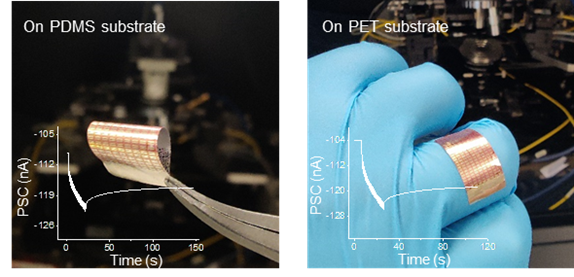
One of the key achievements of the project was overcoming the challenge of achieving precise molecular orientation in the semiconductor films. The team developed reliable methods to ensure consistent device performance across various surfaces, making the technology highly adaptable for diverse applications.
The research opens new possibilities for intelligent visual processing. The device has the potential to be integrated into a wide range of visual perception systems, with promising applications in smart driving, robotics, and advanced vision devices. Moving forward, the research team will focus on integrating the system with external circuits to enable seamless hardware and software interaction.
Their study, “Birdlike Broadband Neuromorphic Visual Sensor Arrays for Fusion Imaging,” was recently published in Nature Communications.


The first authors of the paper are Dr. Pengshan Xie from CityUHK, Dr. Yunchao Xu and Ms. Jingwen Wang from Central South University. The corresponding authors are Professor Johnny C. Ho, from CityUHK, and Professor Jia Sun from Central South University.
For inquiries, please contact Professor Johnny Ho, the Department of Materials Science and Engineering at CityUHK, by email at johnnyho@cityu.edu.hk.