Hydrogel device enables painless transdermal delivery of nucleic acids
Nucleic acid (NA)-based medicine has been a focal point of research over the past two decades and has shown immense promise for both therapeutics and vaccines. The rapid development and deployment of NA-based vaccines during the COVID-19 pandemic underscored their potential. However, the efficient in vivo delivery of these nucleic acids, particularly when cytosolic delivery is required without leaving residual materials in the body, has remained unsolved.
A recent study led by Professor Shi Peng from the Department of Biomedical Engineering at City University of Hong Kong (CityUHK), addressed this challenge with the development of a hydrogel-based, multifunctional organic electronic device. This innovative device is capable of transdermal delivery of nucleic acids and in vivo microarrayed cell electroporation, presenting a promising solution for one-step, self-administrable and painless transdermal gene delivery in clinical immunotherapy.

"This technology could transform the use of nucleic acid-based therapeutics in the human body to deploy the immune system as a tool to treat different diseases, including cancer,” said Professor Shi, highlighting the transformative potential of this technology.
The uniqueness of this technology lies in its footprint-free approach, providing a simple and efficient method to introduce DNA/RNA into the human body without leaving behind any additional reagents. This method genetically engineers subcutaneous immune cells for therapeutic purposes without the need for the systemic administration of large numbers of nucleic acids.
"The most challenging part of this research was developing a hydrogel-based electronic device that integrates multiple functions into a unified construction,” said Professor Shi. "This device performs skin penetration, DNA encapsulation and release, and cellular electroporation in programmed consecutive on-skin operations.”
The research promises to revolutionise the delivery of nucleic acid-based vaccines by offering a painless solution via a wearable skin electronic patch. The innovation involves using conductive hydrogel to fabricate microscale electrodes pre-loaded with DNA encoding cancer-specific antigen proteins. When pressed against the skin, the electrodes penetrate the superficial layer, rehydrate and are electrically triggered to release the DNA into the subcutaneous space.
The device then applies programmed electrical pulsing to achieve highly efficient DNA transfection in dendritic cells, activating cancer-specific adaptive immunity. This method has been shown to effectively inhibit tumour growth in both therapeutic and prophylactic modes in rodent models.
Beyond cancer immunotherapy, the technology could be adapted for various DNA- and RNA-based treatments, including vaccines for infectious diseases and gene therapies for genetic disorders. Future plans of the research team include refining the device for human use and exploring its efficacy in treating different types of cancers and other diseases. This pioneering research opens new avenues for the application of nucleic acid-based medicine, potentially transforming the landscape of therapeutic and preventive healthcare.
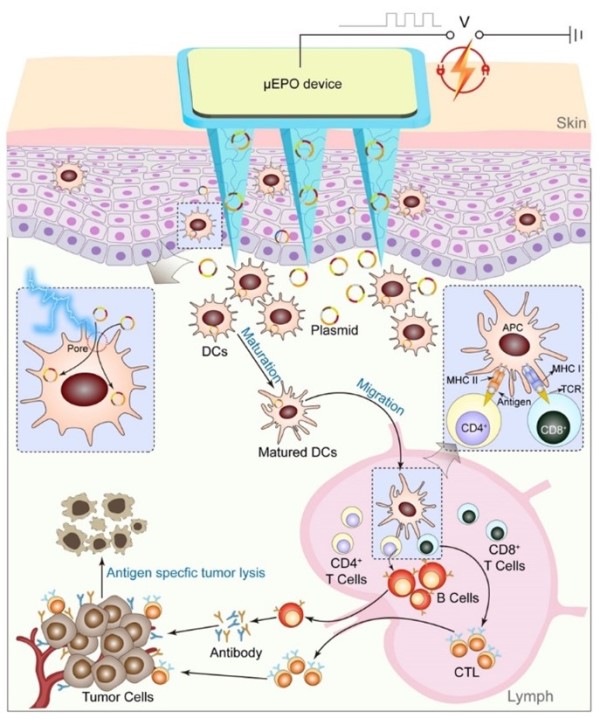

The findings were published in the journal《Proceedings of the National Academy of Sciences》 (PNAS), titled “Transdermal microarrayed electroporation for enhanced cancer immunotherapy based on DNA vaccination”.
The co-first authors are Dr Wang Yuan and Dr Qu Jin from CityUHK, and the corresponding author is Professor Shi. The research received funding support from CityUHK and Hong Kong Centre for Cerebro-cardiovascular Health Engineering under the InnoHK and Research Grants Council.
For enquiry, please contact Professor Shi Peng from Department of Biomedical Engineering at CityUHK, by email at pengshi@cityu.edu.hk.