CityU neuroscientists identify a small molecule that restores visual function after optic nerve injury
Traumatic injury to the brain, spinal cord and optic nerve in the central nervous system (CNS) are the leading cause of disability and the second leading cause of death worldwide. CNS injuries often result in a catastrophic loss of sensory, motor and visual functions, which is the most challenging problem faced by clinicians and research scientists. Neuroscientists from City University of Hong Kong (CityU) recently identified and demonstrated a small molecule that can effectively stimulate nerve regeneration and restore visual functions after optic nerve injury, offering great hope for patients with optic nerve injury, such as glaucoma-related vision loss.
“There is currently no effective treatment available for traumatic injuries to the CNS, so there is an immediate need for potential drug to promote CNS repair and ultimately achieve full function recovery, such as visual function, in patients,” said Dr Eddie Ma Chi-him, Associate Head and Associate Professor in the Department of Neuroscience and Director of the Laboratory Animal Research Unit at CityU, who led the research.
Enhancing mitochondrial dynamics and motility is key for successful axon regeneration
Axons, which are a cable-like structure that extends from neurons (nerve cells), are responsible for transmitting signals between neurons and from the brain to muscles and glands. The first step for successful axon regeneration is to form active growth cones and the activation of a regrowth programme, involving the synthesis and transport of materials to regrow axons. These are all energy-demanding processes, which require the active transport of mitochondria (the powerhouse of the cell) to injured axons at the distal end.

Injured neurons therefore face special challenges that require long-distance transport of mitochondria from the soma (cell body) to distal regenerating axons, where axonal mitochondria in adults are mostly stationary and local energy consumption is critical for axon regeneration.
A research team led by Dr Ma identified a therapeutic small molecule, M1, which can increase the fusion and motility of mitochondria, resulting in sustained, long-distance axon regeneration. Regenerated axons elicited neural activities in target brain regions and restored visual functions within four to six weeks after optic nerve injury in M1-treated mice.
Small molecule M1 promotes mitochondrial dynamics and sustains long-distance axon regeneration
“Photoreceptors in the eyes [retina] forward visual information to neurons in the retina. To facilitate the recovery of visual function after injury, the axons of the neurons must regenerate through the optic nerve and relay nerve impulses to visual targets in the brain via the optic nerve for image processing and formation,” explained Dr Ma.
To investigate whether M1 could promote long-distance axon regeneration after CNS injuries, the research team assessed the extent of axon regeneration in M1-treated mice four weeks after injury. Strikingly, most of the regenerating axons of M1-treated mice reached 4mm distal to the crush site (i.e. near optic chiasm), while no regenerating axons were found in vehicle-treated control mice. In M1-treated mice, the survival of retinal ganglion cells (RGCs, neurons that transmit visual stimuli from the eye to the brain) was significantly increased from 19% to 33% four weeks after optic nerve injury.
“This indicates that the M1 treatment sustains long-distance axon regeneration from the optic chiasm, i.e. midway between the eyes and target brain region, to multiple subcortical visual targets in the brain. Regenerated axons elicit neural activities in target brain regions and restore visual functions after M1 treatment,” Dr Ma added.

M1 treatment restores visual function
To further explore whether M1 treatment can restore visual function, the research team gave the M1-treated mice a pupillary light reflex test six weeks after the optic nerve injury. They found that the lesioned eyes of M1-treated mice restored the pupil constriction response upon blue light illumination to a level similar to that of non-lesioned eyes, suggesting that M1 treatment can restore the pupil constriction response after optic nerve injuries.
In addition, the research team assessed the response of the mice to a looming stimulus – a visually induced innate defensive response to avoid predators. The mice were placed into an open chamber with a triangular prism-shaped shelter and a rapidly expanding overhead-black circle as a looming stimulus, and their freeze and escape behaviours were observed. Half of the M1-treated mice responded to the stimulus by hiding in a shelter, showing that M1 induced robust axon regeneration to reinnervate subcortical visual target brain regions for complete recovery of their visual function.
A looming visual stimulus behavioural test was performed six weeks after optic nerve crush. Uninjured mice with normal vision immediately froze and ran under the shelter (top left). Strikingly, half of the M1-treated mice (bottom left) responded to the looming stimuli by rapidly freezing and hiding in the shelter, and up to 67% had the same response (bottom right) with Pten suppression (Pten is known as a regeneration-associated gene for regulating the growth rate of cells). However, these visually evoked defensive responses were not evident in vehicle-treated mice (top right). (? Au, N. et al. https://www.pnas.org/doi/10.1073/pnas.2121273119)
Potential clinical application of M1 for repairing nervous system injury
The seven-year-long study highlights the potential of a readily available, non-viral therapy for CNS repair, which builds on the team’s previous research on peripheral nerve regeneration using gene therapy.
“This time we used the small molecule, M1, to repair the CNS simply by intravitreal injection into the eyes, which is an established medical procedure for patients, e.g. for macular degeneration treatment. Successful restoration of visual functions, such as pupillary light reflex and response to looming visual stimuli was observed in M1-treated mice four to six weeks after the optic nerve had been damaged,” said Dr Au Ngan-pan, Research Associate in the Department of Neuroscience.
The team is also developing an animal model for treating glaucoma-related vision loss using M1 and possibly other common eye diseases and vision impairments such as diabetes-related retinopathy, macular degeneration and traumatic optic neuropathy. Thus, further investigation is warranted to evaluate the potential clinical application of M1. “This research breakthrough heralds a new approach that could address unmet medical needs in accelerating functional recovery within a limited therapeutic time window after CNS injuries,” said Dr Ma.
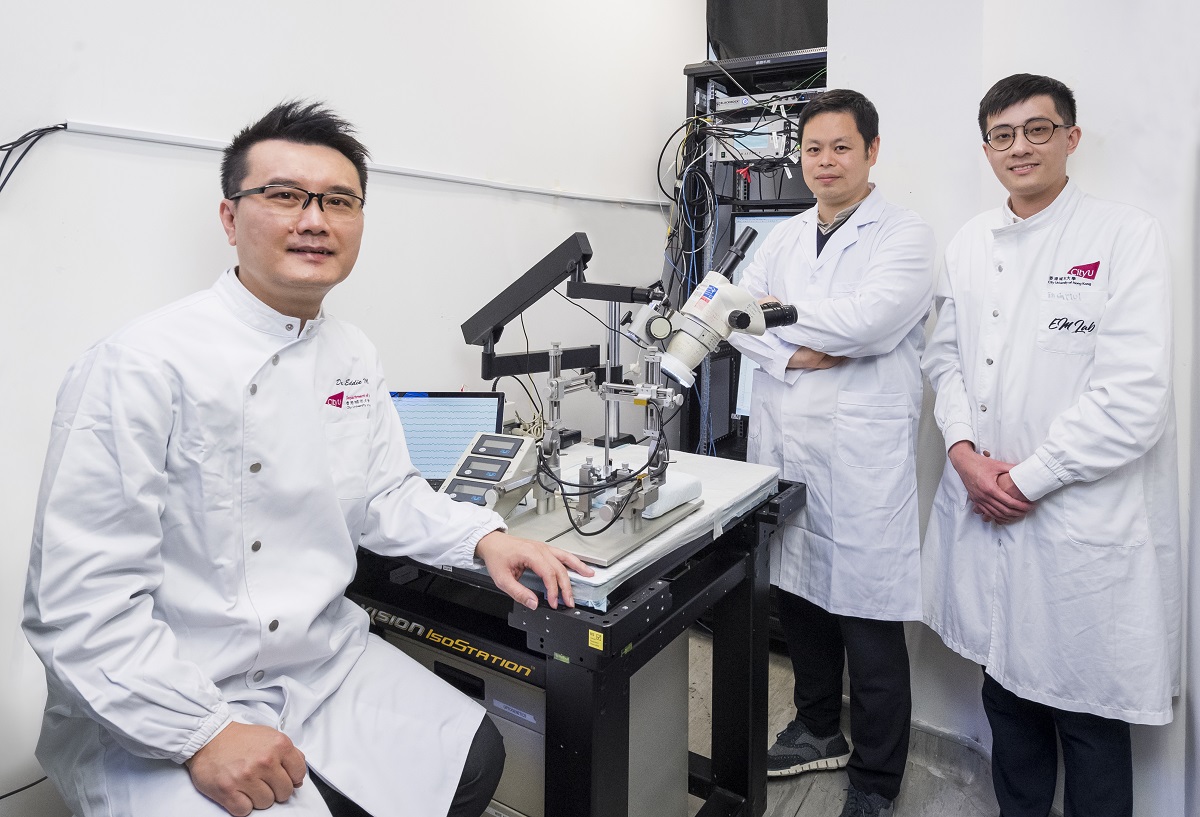
The findings were published in the international scientific journal Proceedings of the National Academy of Sciences (PNAS), under the title “A small molecule M1 promotes optic nerve regeneration to restore target-specific neural activity and visual function”.
Dr Au and Dr Ma are the first author and corresponding author, respectively, of the paper. Another collaborator is Dr Vincent Ko Chi-chiu, Associate Professor in the Department of Chemistry at CityU. The research was funded by CityU and the Research Grants Council of Hong Kong.