CityUHK establishes the “JC STEM Lab of Innovative Thermo-Fluid Science”
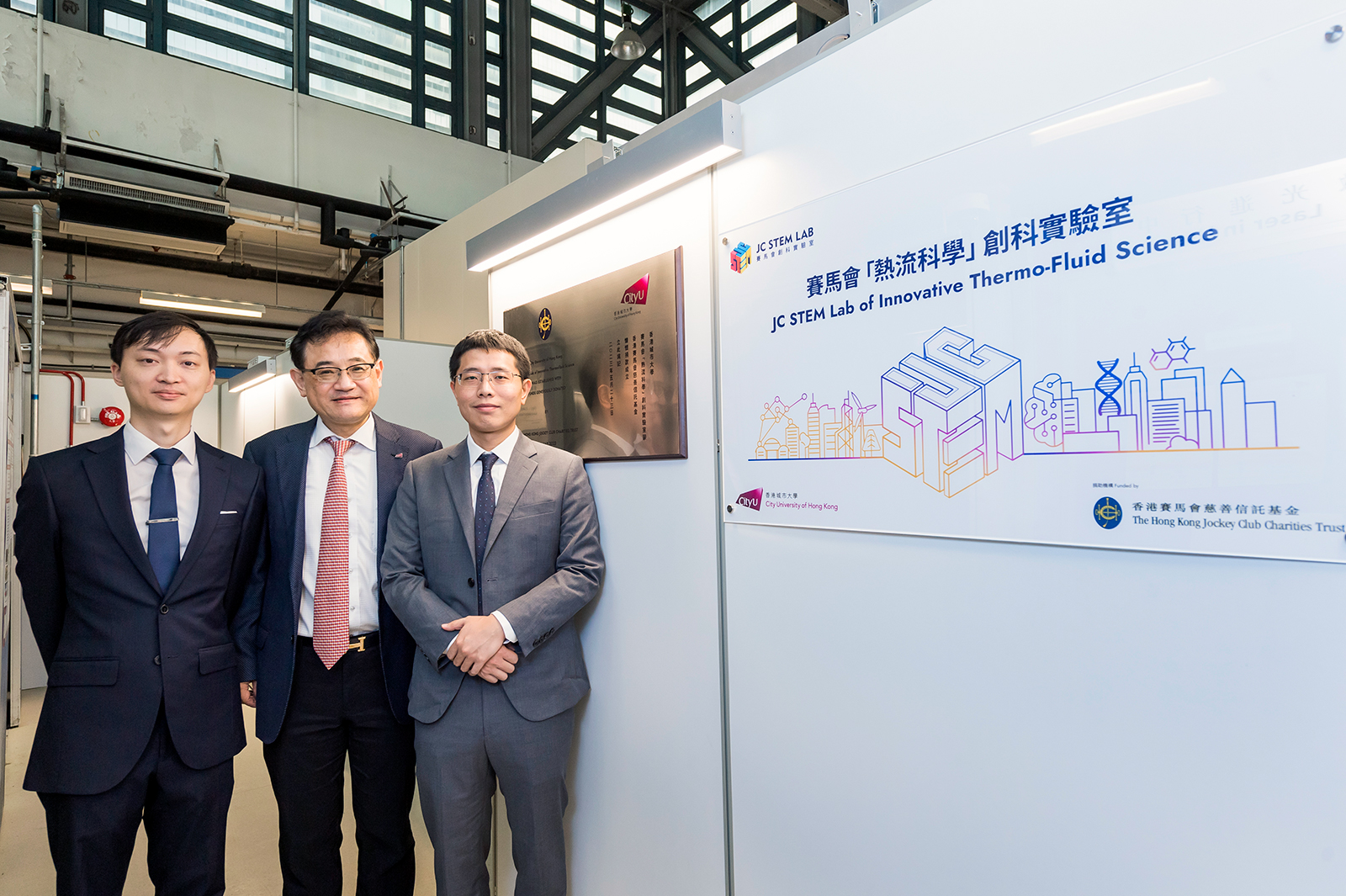
City University of Hong Kong (CityUHK) is pleased to announce the establishment of the JC STEM Lab of Innovative Thermo-Fluid Science (the Lab), supported by a generous donation of HK$10 million from The Hong Kong Jockey Club Charities Trust. The Lab, the first of its kind in Hong Kong, has great potential to enhance zero-carbon direct emissions nuclear energy research and fill the gap in local energy research.
To contribute to the strategy of ‘Net-zero electricity generation’ under Hong Kong’s Climate Action Plan 2050, the Lab was established under the leadership of its Director, Professor Takashi Hibiki, Chair Professor of Thermal-Fluid Engineering in the Department of Mechanical Engineering at CityUHK and Global STEM Professor, granted by the HKSAR Government.
Professor Hibiki expressed his immense gratitude to The Hong Kong Jockey Club Charities Trust for its generous donation to support the Lab’s establishment. “The Lab will collaborate with local research users, including the power industry, construction companies, national laboratories, and related government departments,” he said. “The Lab’s research outcomes will benefit academia, education and industry, enhancing predictability, cost-effectiveness and safety in two-phase flow equipment design.”
The Lab focuses on formulating key constitutive equations for advanced two‐phase flow analyses, producing unique experimental data to validate the advanced computational fluid dynamics (CFD) code, and developing the innovative high‐fidelity two‐phase flow CFD code for zero‐carbon energy science.
Two-phase flow technology is indispensable for power generation and energy-saving equipment in various industries, including nuclear engineering, mechanical engineering, civil engineering, aerospace engineering, petroleum engineering, marine engineering, chemical engineering, and building environment and energy engineering.
The Lab will contribute primarily to zero-carbon energy through nuclear thermal-hydraulic research. Nuclear power plays a central role in zero-carbon emissions energy, as it produces electricity without CO2 emissions. Currently, the nuclear power produced by the Daya Bay Nuclear Power Plant provides about 25% of Hong Kong’s electricity needs. Nuclear safety, new reactor design, power uprate and life extension assessments require two-phase flow simulation in nuclear reactors. Accurate nuclear safety analyses for transient conditions and severe nuclear accidents are crucial for determining the licensing of nuclear reactors. A much safer and more economical new reactor design process requires extensive two-phase flow simulations, which are essential for evaluating the possibilities of power uprate and life extension.
The Lab’s work will enhance nuclear safety, public confidence and cost-effectiveness through improved numerical simulation codes. These codes assess reactor safety, evaluate power uprate and life extension, and help create new nuclear reactor designs that are more economically competitive and safer. The Lab’s outcomes will lead to enhanced safety, power uprate, life extension, and help create new reactor designs in the long term.