CityUHK researchers simulate nanoscale superlubricity behaviour of 2D water/ice on graphene sheet
Researchers from City University of Hong Kong (CityUHK) and Peking University have successfully achieved the direct measurement and simulation of the nanoscale superlubricity behaviour of a 2D water/ice on graphene sheet.
The joint research revealed for the first time the nearly vanishing static friction behaviour between a 2D bilayer water/ice and a graphene sheet. This finding represents a major advancement in nanofluidic engineering and nanotribology, prompting calls for potential applications in nano-filtration and reduced tribological consumption.
The research, titled "Probing structural superlubricity of two-dimensional water transport with atomic resolution", was recently published in the scientific journal Science.

Nanofluidic engineering and nanotribology are crucial disciplines in nanoscience and nanotechnology, and superlubricity conventionally refers to a nearly-ideal frictionless state between two sliding solid surfaces with a kinetic friction coefficient being less than 0.01.
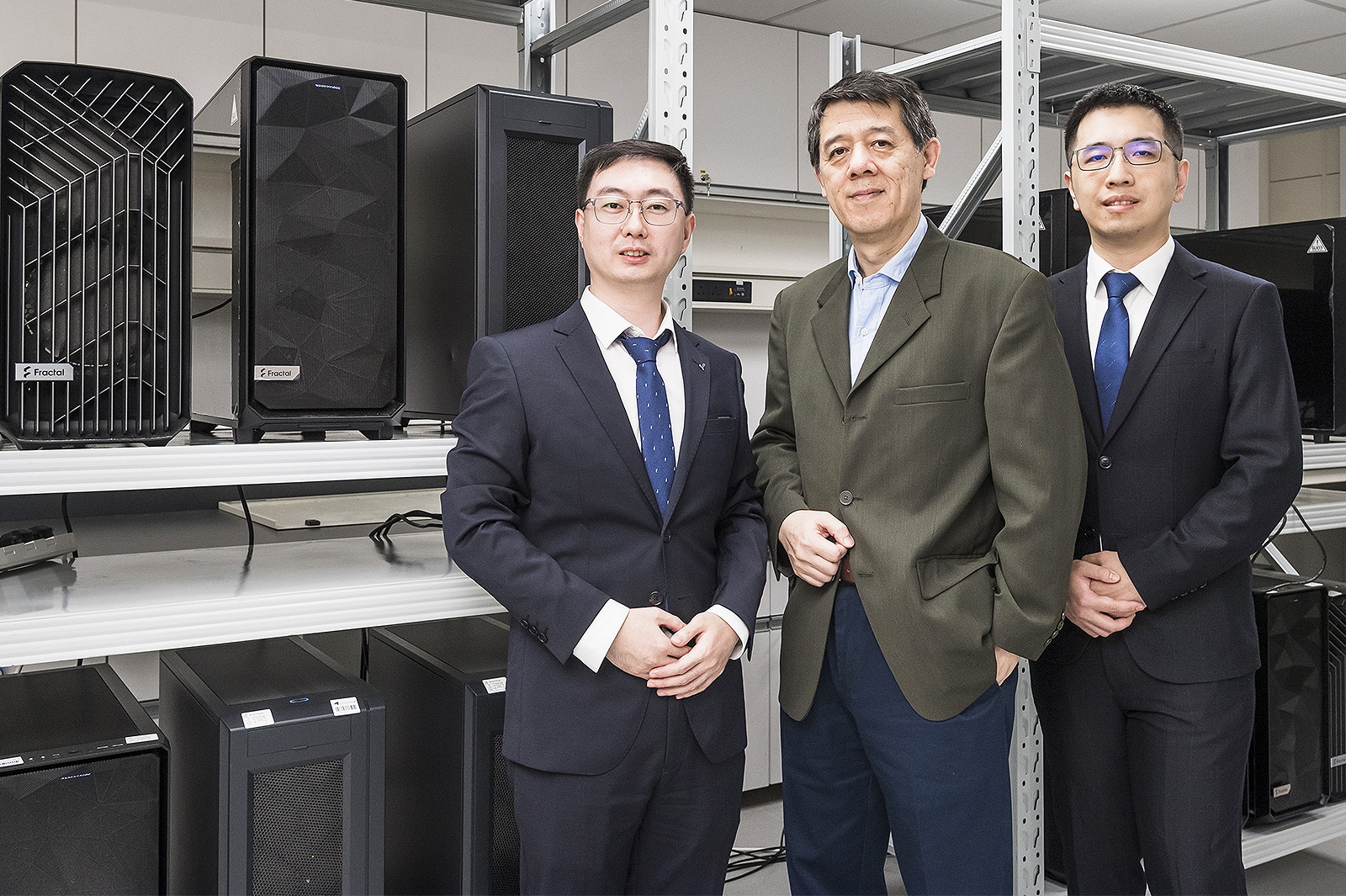
A computational research group led by Professor Zeng Xiaocheng, Head and Chair Professor in the Department of Materials Science and Engineering at CityUHK, carried out comprehensive molecular dynamics (MD) simulations on the laterally sliding behaviour of the 2D water/ice on a graphene monolayer.

The CityUHK researchers focused on the static friction behaviour and computed the maximum static friction force and static friction coefficient of the 2D ice/graphene systems. To mimic realistic experimental systems, the MD simulations were designed with the size of 2D ice ranging from a few nms to hundreds of nms, comparable to those grown in the experiment conducted by Peking University.
They found that the area-normalised static friction is inversely related to the contact area of the bilayer ice. Such a relationship can be described by a power of ~-0.5, confirming the experimental measurement. More interestingly, the static friction coefficient can even approach 0.01 for relatively large size 2D ice island. These findings indicate that superlubricity behaviour on static friction between the 2D bilayer ice and graphene is consistent with the experimentally discovered trend of static friction force by the Peking University team.
Professor Zeng said that this joint experimental/computational work is of fundamental significance, not only because it offers atomic-level understanding the origin of the water transport under nanoscale confinements but also because it moves the frontier of nanofluidic engineering and nanotribology research by revealing superlubricity behaviour in static friction between a soft-solid and a hard-solid.
“Additionally, this work will inspire future exploration of new superlubric, nanofluidic systems and energy-saving tribological systems for practical applications,” said Professor Zeng.