Groundbreaking multimodal haptic feedback interface developed by CityUHK’s biomedical engineers

A team of researchers from City University of Hong Kong (CityUHK) has made a major advance in the field of haptic technology by developing a skin-integrated multimodal haptic feedback interface capable of stimulating different sensory receptors in the skin, thereby drastically enhancing haptic feedback performance.
Tactile sensations involve the complex acquisition of data through mechanoreceptors in the skin. While wearable devices offer high mobility and potential for application, accurately reproducing these sensations using haptic feedback interfaces has been a significant challenge. The development of skin-integrated haptic interfaces is still in its nascent stages.
To overcome these challenges, Professor Yu Xinge and his team from CityUHK’s Department of Biomedical Engineering (BME) have developed a pioneering interface that uses three actuation modes: temperature, mechanical deformation, and electrotactile stimulation.
The team’s innovative approach involves using thermoelectric stimulation to control temperature changes on the skin, thereby reproducing thermal sensations between the skin and objects. The devices’ sandwich structure facilitates efficient heat dissipation, ensuring effective thermal feedback. Mechanical sensations are generated by inducing skin deformations using mechanical actuators.
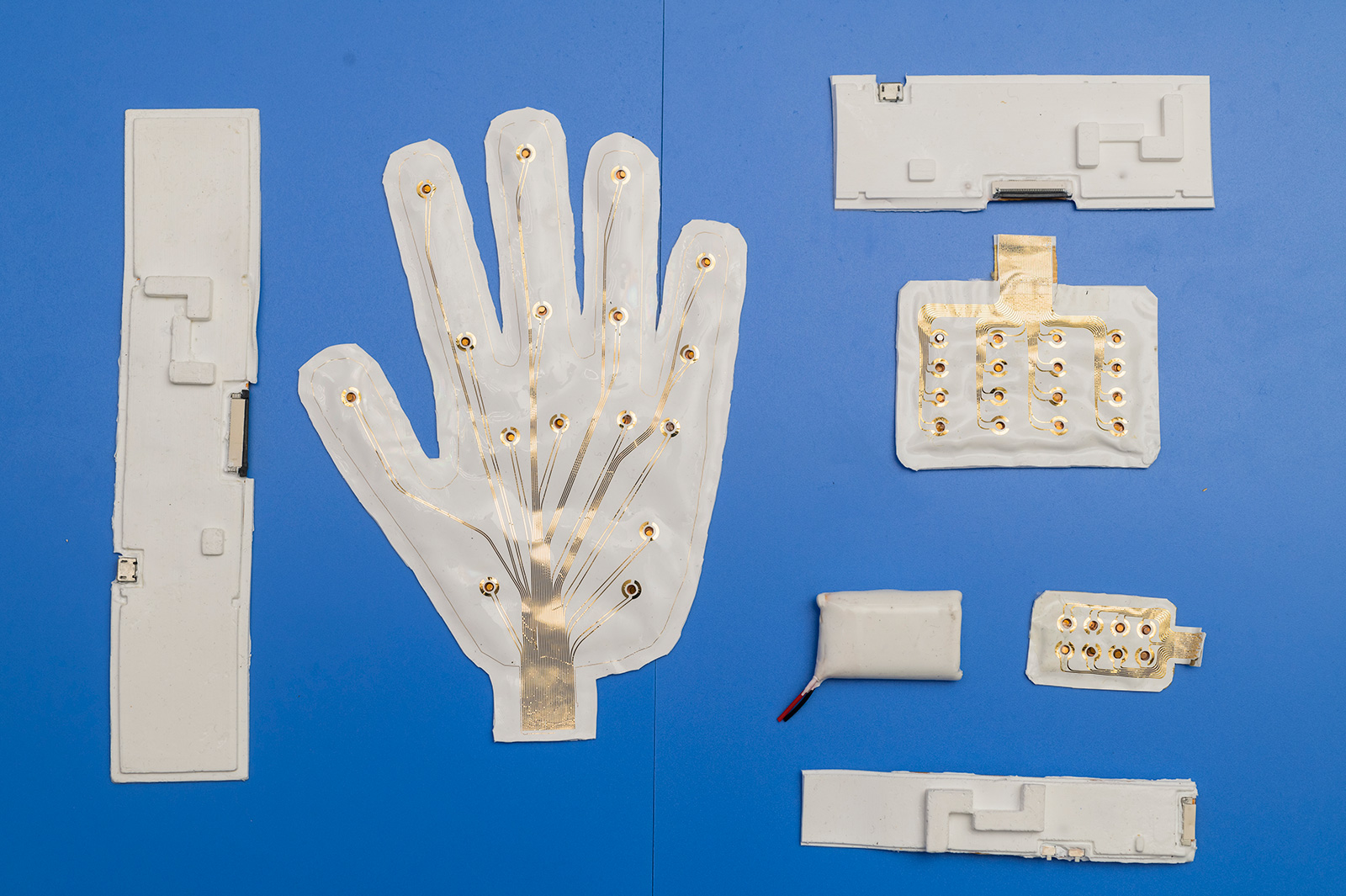
“When mechanical deformation is combined with electrotactile stimulation, the new interface results in improved fidelity of virtual mechanical tactile sensations across a frequency range of 0-250 Hz,” said Professor Yu.
Their research, titled “A skin-integrated multimodal haptic interface for immersive tactile feedback”, has been published in the esteemed scientific journal, Nature Electronics.
The team has submitted a US patent application for this invention. Committed to pushing the boundaries of haptic technology, the research team will continue to focus on the development of high-performance feedback interfaces and their practical applications.
The first co-authors are Dr Huang Ya, Teaching Consultant at BME, Mr Zhou Jingkun, PhD student at BME, Mr Ke Pingchuan, PhD student in the School of Creative Media of CityUHK, and Mr Guo Xu, PhD student at Dalian University of Technology (DUT). The corresponding authors are Professor Yu, Professor Zhu Kening of SCM and the Department of Computer Science, and Professor Xie Zhaoqian of DUT.