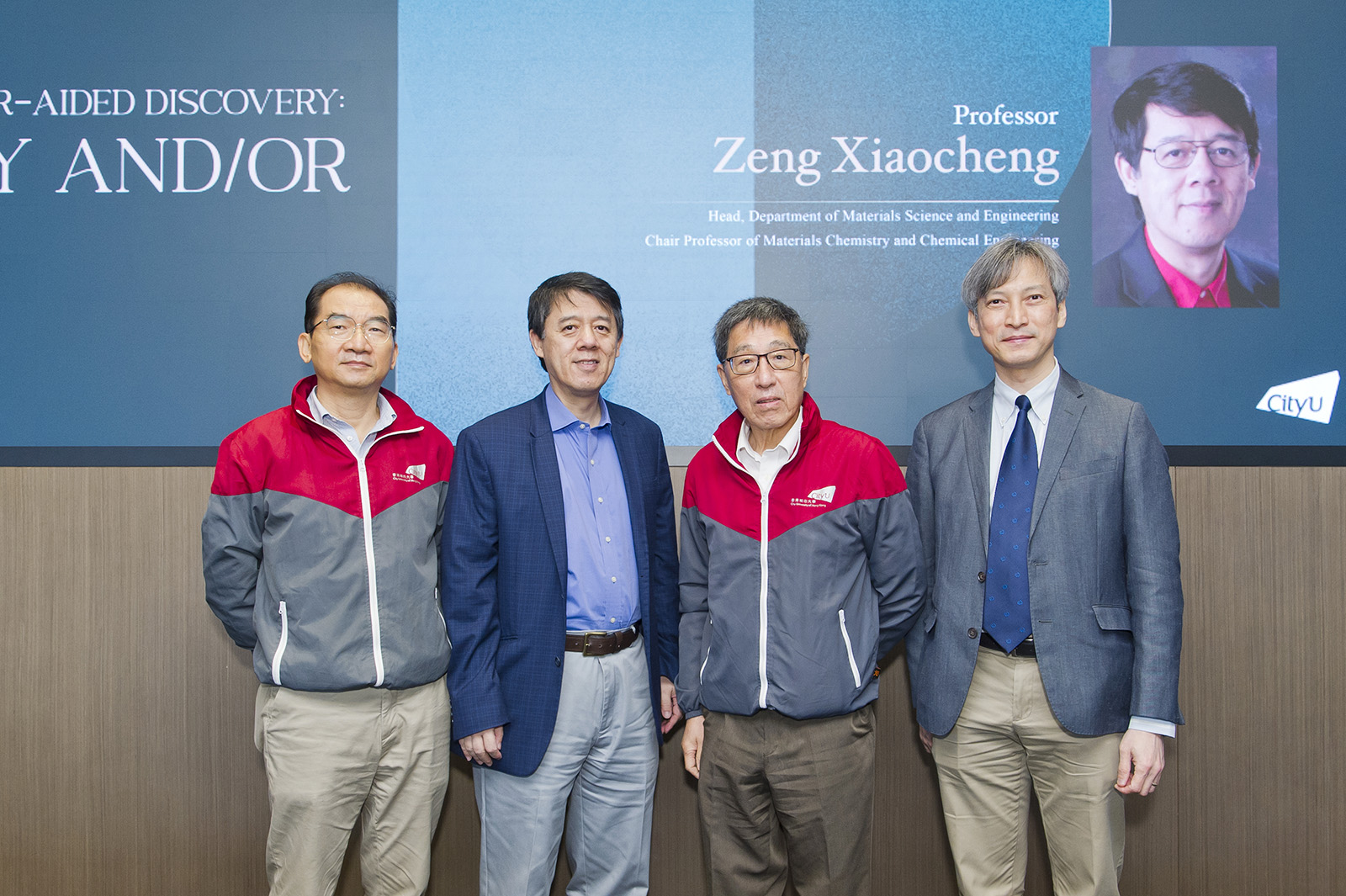
Anecdotes of Computer-Aided Discovery: Serendipity and/or By-design?

How much new knowledge is generated by sheer luck in the lab, and how much through carefully formulated research plans?
In fact, research outcomes often depend on both serendipity and design, according to Professor Zeng Xiaocheng, Head of the Department of Materials Science and Engineering at City University of Hong Kong (CityU).
Speaking at the President’s Lecture Series 50: Excellence in Academia on 1 December at CityU, Professor Zeng shared several stories drawn from his distinguished career in materials chemistry and chemical engineering to illustrate this central thesis.
These tales included the serendipitous discovery of the first metal (gold) cage molecule in nature, the incidental discovery of the first 2D ice in nature, the discovery of the first 1D ice nanotube by design, producing the first molecular-dynamics movie of nano-gold catalysis, and producing a molecular-dynamics movie showing the “Lotus effect” at the nanoscale.
One instance of a degree of serendipity in research was the discovery of the “hollow gold nanocages” in the mid-2000s when Professor Zeng, an elected Fellow of the European Academy of Sciences who joined CityU in July 2022, was part of a team that happened upon 16-atom hollow cages produced when a sheet of gold was vapourised with lasers.
The findings represented the smallest known hollow piece of gold, which was not only unusual in itself (since metal tends to be more compact than the golden cage configuration that was observed) but also highly promising for energy studies: gold is known to act as a catalyst and accelerate certain chemical reactions.
“Catalysis is a critical enabling science for our energy future,” said Professor Zeng, whose talk was titled “Anecdotes of Computer-Aided Discovery: Serendipity and/or By-design??”
Another chance discovery occurred because of a lack of available computational power early on in Professor Zeng’s career at the University of Nebraska-Lincoln, US.
In the late 1990s, he was running experiments on 2D computations because his own computer was not strong enough to cope with 3D studies. But the switch proved rewarding when Professor Zeng was able to predict the theoretical existence of 2D ice, i.e., ice that contracted rather than expanded to form nanoscale ice sheets.
His current research areas, now fully aided by much more powerful computational power, embrace water/ice, the prediction of new ices in an extreme environment, and water surface interaction (wetting)?; gold nanoclusters and nanocatalysis?; and computer-aided nanomaterials design?!
While his experiments are always carefully planned, his message to other scientists is: always to expect the unexpected.