Vision Impossible!
Seeing is believing, they say, but we can’t always believe what we see.
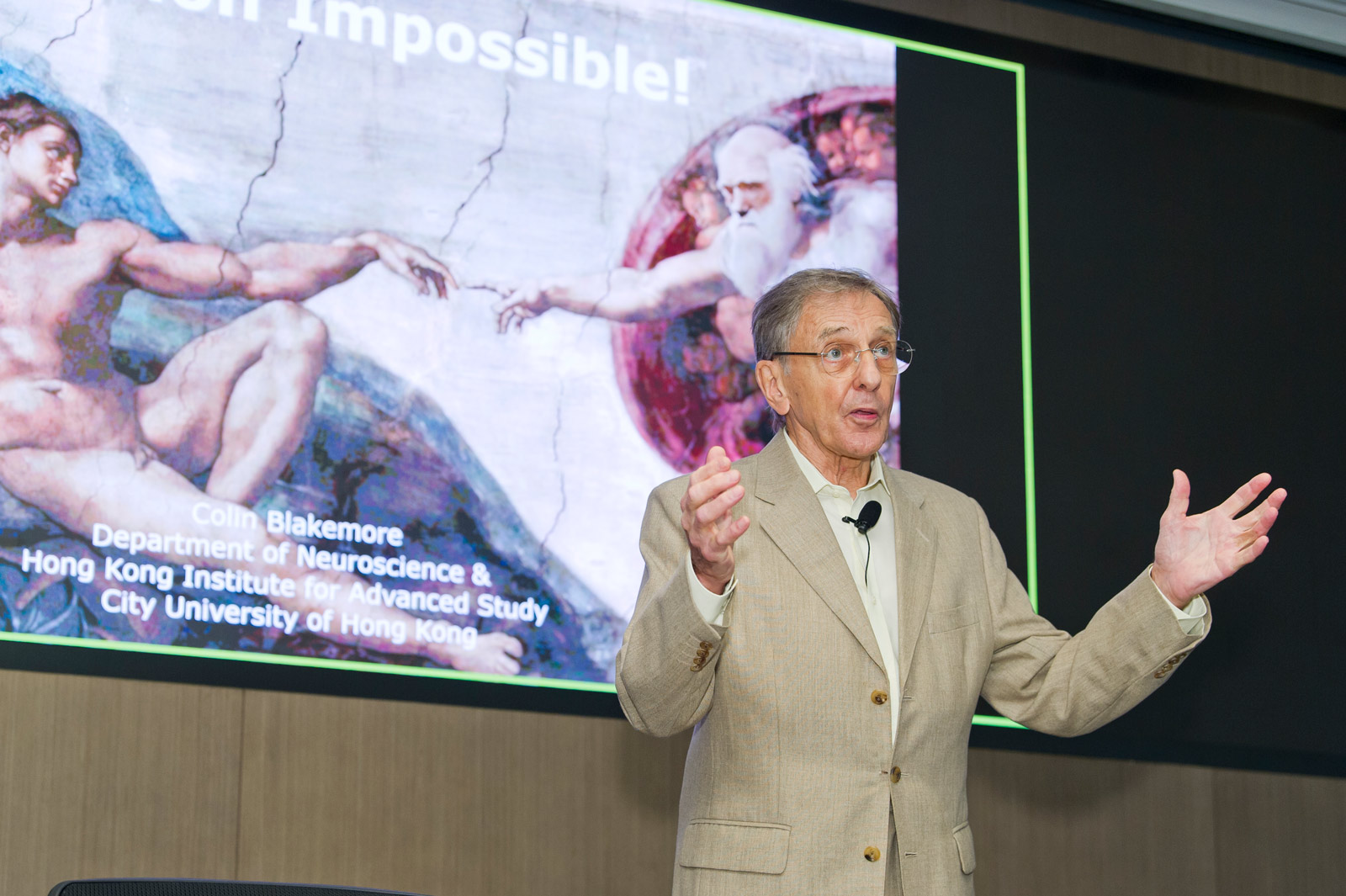
This was a key takeaway at a fascinating talk by Professor Sir Colin Blakemore, an expert in neuroscience, at City University of Hong Kong (CityU) on 19 November.
A Senior Fellow at the Hong Kong Institute for Advanced Study and Yeung Kin Man Professor of Neuroscience in the Department of Neuroscience at CityU, Professor Blakemore demonstrated in his talk, part of the on-going President’s Lecture Series: Excellence in Academia, that what we see is not necessarily what we see.
Using a variety of videos, visual tricks and optical illusions, he showed the audience that although the world seems to be “detailed, seamless, real-time video stream”, the truth is we are aware of a fraction of the data that the eyes pick up.
For example, it was really surprising to realise on a second viewing of a short video that a “magician” and an assistant switched into a different clothing while demonstrating a “magic” card trick. Viewers were so intent on working out how the “magician” could so easily locate a particular card randomly inserted into a full deck that their brains not only didn’t register the clothing changes, they didn’t see that the colour of the cloth backdrop changed half-way through the video, either.
In another piece of visual ambiguity, Professor Blakemore discussed how images in an optical illusion compete for our attention, raising issues about reality and illusion.
Examples included a Salvador Dali painting in which a bust of Voltaire simultaneously depicts several people standing under an arch, like this; and an image of a vase that also projects the facial profiles of two people, similar to this image.
The speaker thus argued that meaning depends on more than just the purely visual element that the brain “sees”.
To stress this point. Professor Blakemore contended that if a verbal hint is given to viewers prior to them seeing a complex image, they could decode that image more easily.
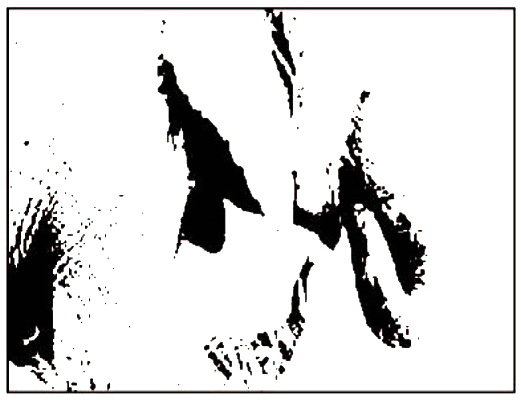
For example, the audience could decipher straightaway an otherwise challenging image after Professor Blakemore gave the hint “An elephant with its trunk in its mouth”. Without this verbal clue, the image could have remained a series of confusing black strokes and squiggles on a white background rather than an image of an elephant drinking/eating, to this correspondent at least (Fig. 1).
“Not everything in the retinal image is seen. Not everything that is seen is caused by an image on the retina,” Professor Blakemore said.
In fact, it was interesting to learn that the eye jumps to a new position 3 times per second while the brain is trying to translate the series of rapid-fire images streaming into the brain when our eyes are open.
This mean the brain has to “invent” some of what we see to make sense of it. Once we appreciate the daunting complexity of this process, it is understandable that illusions, trompe l'oeil and déjà vu occur.
“What we see is dependent on personal experience and is, to a large extent, invented!” Professor Blakemore concluded, implying that, in some sense, vision is almost an impossible phenomenon.