Special ‘ink’ developed at CityU enables world’s first 4D printing for ceramics
Catherine Law
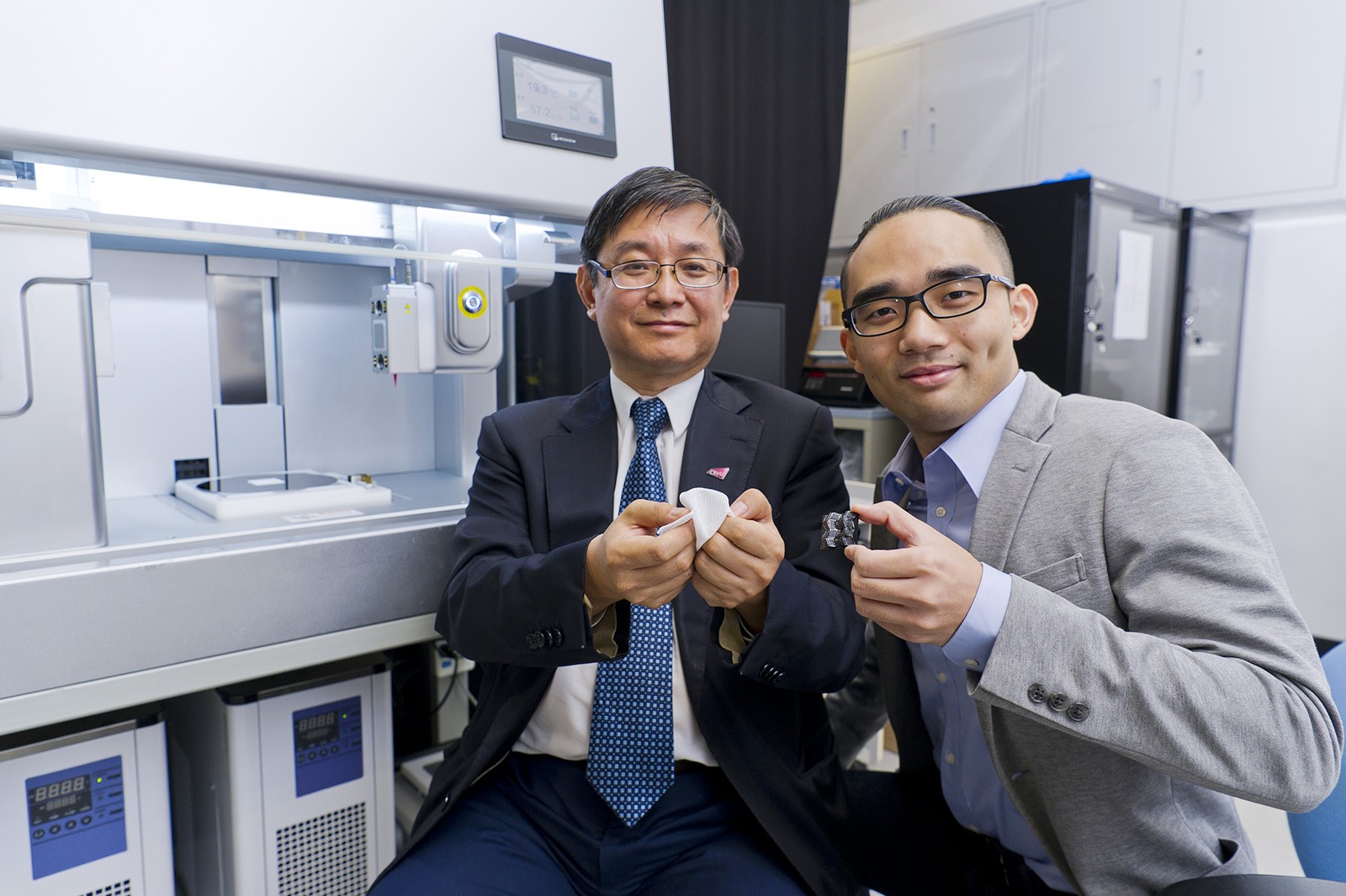
The invention of a novel “ceramic ink” by a research team at City University of Hong Kong (CityU) has made possible the development of the world’s first-ever 4D printing for ceramics. This ground-breaking advancement in materials research could turn a new page in the structural application of ceramics, such as in the manufacture of electronic devices and the aerospace industry and space exploration.
Ceramics cannot be cast or shaped easily because of the material’s extremely high melting temperature. Furthermore, the existing 3D-printed ceramic precursors are usually difficult to deform, hindering the production of ceramics with complex shapes.
Led by Professor Lu Jian, Vice-President (Research and Technology) and Chair Professor of Mechanical Engineering, the CityU team has developed a novel “ceramic ink”, which is a mixture of polymers and ceramic nanoparticles. The 3D-printed ceramic precursors printed with this ink are soft and can be stretched three times beyond their initial length, enabling complex shapes, such as origami folding.
4D printing is conventional 3D printing combined with the additional element of time as the fourth dimension, where the printed objects can re-shape or self-assemble themselves over time with external stimuli such as mechanical force, temperature or a magnetic field.
In this research project, the team made use of the elastic energy stored in the stretched precursors for shape morphing. When the stretched ceramic precursors are released, they undergo self-reshaping. After heat treatment, the precursors turn into ceramics.
The resultant elastomer-derived ceramics are mechanically robust and come in large sizes with high strength compared to other printed ceramics.
“The whole process sounds simple, but it’s not,” said Professor Lu. “From making the ink to developing the printing system, we tried many times and different methods. Like squeezing icing on a cake, there are a lot of factors that can affect the outcome, ranging from the type of cream and the size of the nozzle, to the speed and force of squeezing, and the temperature!”

The innovation was published in the latest issue of the top academic journal Science Advances under the title “Origami and 4D printing of elastomer-derived ceramic structures”. All members of the research team are from CityU, including Dr Liu Guo, Research Assistant, Dr Zhao Yan, Senior Research Associate, and Dr Wu Ge, Research Fellow.
“With the versatile shape-morphing capability of the printed ceramic precursors, its application can be huge,” said Professor Lu. One promising application is for electronic devices. Ceramic materials are better than metallic ones at transmitting electromagnetic signals. With the arrival of 5G networks, ceramic products will start to play a more important role in the manufacture of electronic products. The artistic nature of ceramics and their capability to form complex shapes also provide the potential for consumers to tailor-make uniquely designed ceramic back plates for mobile phones.
This innovation can be applied in the aerospace industry and space exploration. “Since ceramic is a mechanically robust material that can tolerate high temperatures, the 4D-printed ceramic has high potential to be used as a propulsion component in the aerospace field,” said Professor Lu.
The research was supported by the Major Programme of the National Natural Science Foundation of China, the Hong Kong Collaborative Research Fund Scheme and the Theme-based Research Scheme, the Innovation and Technology Commission via the Hong Kong Branch of National Precious Metals Material Engineering Research Centre, the Guangdong Provincial Department of Science and Technology, and the Science and Technology Innovation Commission of Shenzhen Municipality.
Video explaining the research:
https://drive.google.com/open?id=1UEirPdxaDb0dXeE9ezm_bS9bjWbqfZpP