From leftover food to fashion apparel
Terry Lam
? 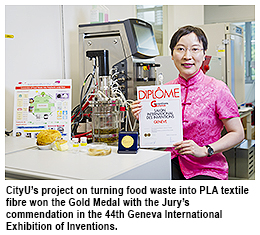 A novel biorefinery process developed by biochemical scientists at City University of Hong Kong (CityU) that turns food waste into textile fibre has won the Gold Medal with the jury’s commendation in the 44th Geneva International Exhibition of Inventions this year.
This groundbreaking technology could be solution to managing the 3,600 tonnes of food waste produced in Hong Kong every day.
Led by Dr Carol Lin Sze-ki, Assistant Professor in the School of Energy and Environment at CityU and a specialist in transforming waste into renewable resources, the research team has successfully converted 100 grammes of food waste into 10 grammes of polylactic acid (PLA) fibre within a week. The new material can be used to manufacture textile and apparel products.
“Utilising food waste to generate PLA is a win-win or even triple-win situation. It reduces the burden on landfills and the environment while providing raw green materials for the textile industry. This also suggests a more sustainable production method for PLA other than the traditional petroleum-based chemical synthesis,” said Dr Lin.
 Bakery and restaurant food waste is collected and treated in the laboratory using a series of procedures including fungal hydrolysis to convert the food into micro molecules such as glucose, free amino nitrogen, vitamins and minerals. Bacterial fermentation then turns these nutrients into lactic acid. PLA is produced via lactic acid polymerization, which is then turned into fibre.
After two years of research effort in the laboratory, the research team has managed to optimise the experimental condition such as types of microorganisms to be used, temperature and pressure, catalyst, recovery and purification techniques, among others.
“The whole process is economically favourable as the food waste is cost-free and the equipment is not expensive. Some waste treatment plants in the mainland have already contacted us to know more about this novel approach to food waste treatment,” said Dr Lin.
The research project was conducted in collaboration with the Hong Kong Research Institute of Textiles and Apparel Limited (HKRITA) and funded by the Innovation and Technology Commission. HKRITA will explore the feasibility of producing PLA fibre from food waste in Hong Kong.
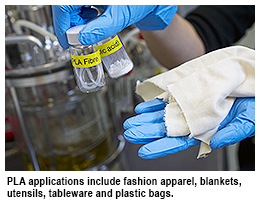
The application of this commonly used bioplastics is not limited to textile and clothing. There is a wide array of PLA products ranging from blankets and utensils to tableware and plastic bags.
In addition to PLA, Dr Lin’s research team has successfully exploited food waste to regenerate other chemicals and materials. For example, bakery waste can be used to produce succinic acid for manufacturing food packaging materials, paint and ingredients for medicine, among others.
Coming up next is another innovative project for recycling textile waste such as unsold or discarded clothes to basic fibre for making new clothes. Approximately 217 tonnes of textile waste are generated per day, accounting for 1.6% of the total solid waste in Hong Kong.
Dr Lin said the abovementioned bioplastics and chemicals produced from wastes were biodegradable, “these projects help alleviate food waste problems via the recovery of nutrients from waste and contribute to a more sustainable society.”
This groundbreaking technology could be solution to managing the 3,600 tonnes of food waste produced in Hong Kong every day.
Led by Dr Carol Lin Sze-ki, Assistant Professor in the School of Energy and Environment at CityU and a specialist in transforming waste into renewable resources, the research team has successfully converted 100 grammes of food waste into 10 grammes of polylactic acid (PLA) fibre within a week. The new material can be used to manufacture textile and apparel products.
“Utilising food waste to generate PLA is a win-win or even triple-win situation. It reduces the burden on landfills and the environment while providing raw green materials for the textile industry. This also suggests a more sustainable production method for PLA other than the traditional petroleum-based chemical synthesis,” said Dr Lin.
After two years of research effort in the laboratory, the research team has managed to optimise the experimental condition such as types of microorganisms to be used, temperature and pressure, catalyst, recovery and purification techniques, among others.
“The whole process is economically favourable as the food waste is cost-free and the equipment is not expensive. Some waste treatment plants in the mainland have already contacted us to know more about this novel approach to food waste treatment,” said Dr Lin.
The research project was conducted in collaboration with the Hong Kong Research Institute of Textiles and Apparel Limited (HKRITA) and funded by the Innovation and Technology Commission. HKRITA will explore the feasibility of producing PLA fibre from food waste in Hong Kong.
The application of this commonly used bioplastics is not limited to textile and clothing. There is a wide array of PLA products ranging from blankets and utensils to tableware and plastic bags.
In addition to PLA, Dr Lin’s research team has successfully exploited food waste to regenerate other chemicals and materials. For example, bakery waste can be used to produce succinic acid for manufacturing food packaging materials, paint and ingredients for medicine, among others.
Coming up next is another innovative project for recycling textile waste such as unsold or discarded clothes to basic fibre for making new clothes. Approximately 217 tonnes of textile waste are generated per day, accounting for 1.6% of the total solid waste in Hong Kong.
Dr Lin said the abovementioned bioplastics and chemicals produced from wastes were biodegradable, “these projects help alleviate food waste problems via the recovery of nutrients from waste and contribute to a more sustainable society.”