President’s talk in Beijing receives overwhelming responses
Yvonne Lee
?Professor Way Kuo, President of City University of Hong Kong (CityU), was invited by Peking University (PKU) and the Nuclear and Radiation Safety Center (NRSC) in Beijing to deliver a keynote speech titled “Critical Reflections on Nuclear and Renewable Energy” on 16 and 17 March, respectively.
Speech at PKU
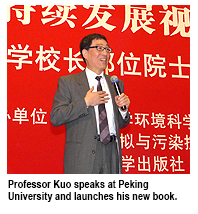
Professor Kuo discussed the supply and usage of energy from the perspective of sustainable development in the modern era in his talk. “When evaluating the energy sources for sustainable development, we must balance such aspects as environmental protection, economic well-being, reliability and sustainability in a reasonable manner,” he stressed.
Professor Kuo argued that environmental pollution, global warming and energy shortage were challenges of the 21st century. The power humans need in their daily lives is mainly generated from hydro, thermal, nuclear, wind, solar, biomass, tidal, and geothermal energy. Professor Kuo coined the term “Rainbow Energy” to describe these energy sources.
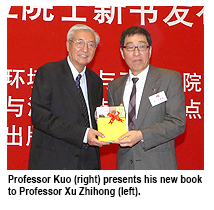

Professor Kuo is renowned for his work in designing the reliability of electronics systems and nuclear energy. He is a pioneer in reliability research of systems at their infant stage, and has set international standards and a theoretical foundation for the testing of the reliability of electronic products. His popular science book Critical Reflections on Nuclear and Renewable Energy was published in 2013 by Commonwealth Publishing Group in Taiwan. The simplified Chinese edition is published by Peking University Press, and a Hong Kong edition was published under a different title. The book has been translated into many languages, and that the English, Japanese, French and Russian editions have been published in Massachusetts in the US, Tokyo, Paris, and Moscow, respectively.
Speech at NRSC in Beijing

Professor Kuo said that it was necessary for nuclear plants to find the “importance element” and strive for improvement, which is an effective way to raise safety levels.
NRSC is a public institution directly under the Ministry of Environmental Protection of China. It is the only public institution specialising in providing technical guarantees for the supervision and administration of nuclear safety and radiation environment in China. Its responsibilities include: providing all-round technical support and assurance to the safety supervision and administration of China’s civilian nuclear facilities and radiation environment, monitoring and supervising nuclear safety and radiation environment, responding to and making assessment on nuclear and radiation emergencies, and conducting scientific research on nuclear safety and radiation protection, among others.