CityU researcher develops novel self-cleaning technology for delicate fibres
Mavis Wong
?  A novel technology developed by Dr Walid Daoud, Assistant Professor in the School of Energy and Environment at City University of Hong Kong (CityU), and his team enables cashmere fibres to clean themselves with nano-sized photocatalysts.
  The project has gained funding from the Innovation and Technology Support Programme of the Innovation and Technology Commission in collaboration with Lora & Festa Limited.
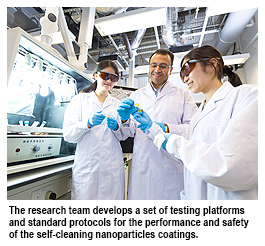
The research team has also developed testing platforms and standard protocols for measuring the performance and health impact of the self-cleaning nanoparticles coatings on human health.
“The breakthrough is that, for the first time, cashmere fibres have been enabled to harvest light to clean themselves. This implies substantial savings on energy, water and petroleum-derived chemicals used in the conventional cleaning process, as well as pricey trips to the dry cleaner,” Dr Daoud explained.
Dr Daoud has been developing efficient self-cleaning, protective materials since 2002, first for cotton and later for wool, in response to the increased demand for hygienic, self-disinfecting and contamination-free surfaces.
The innovation involves applying nano-sized photocatalysts that enable the removal of contamination via a light-triggered oxidation mechanism. But it is a delicate operation because of the risk of spoiling the cashmere in the process.
“Cashmere is a sensitive protein and can be easily damaged. It has poor resistance to oxidation, chemicals and high temperatures. How to apply nano-sized photocatalysts to cashmere and retain its delicate characteristics is a huge challenge,” Dr Daoud said.
“By applying nano-sized catalysts, we can trigger the breakdown of surface contamination upon light exposure to cashmere. The process not only enables cashmere fibres to clean themselves; it has long lasting, durable effect, ” he said.
In addition, the team has developed a set of testing platforms and standard protocols for the performance and safety of the self-cleaning nanoparticle coatings in response to concerns that these coatings could damage human health should they come off and be inhaled or absorbed.
“The project aims at delivering a set of testing systems and standard protocols, including a nano-coating emission chamber for testing stability, nanoparticle performance and safety of nano-coating fabrics under simulated wear, and conditions for safe and up to standard usage,” Dr Daoud said.
Another concern has been the lack of testing methods that grade the performance of different self-cleaning products with respect to effectiveness and durability. The team started to develop the test and protocols in September last year.
“We have tested the performance and wash stability of the self-cleaning nano-coating textiles. Our preliminary study of the interaction of the nano-coatings with the nano-particles shows no harmful effect on cells indicating safety for practical application,” Dr Daoud.
The new findings can facilitate more effective and safer technology transfer of the nano-coating fabrics to the market. This process can help improve the traditional textile industry. The newly developed test and protocols can also be applied as a standard certification method for similar textile and household products containing nano-coatings.