Collector shares tales of precious porcelain
Longgen Chen
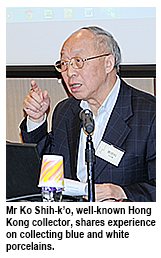
Mr Ko Shih-k'o, the man behind the Foundation, is also a generous exhibiter. The blue and white porcelain he and his family have collected are not locked away in safes or hidden in basement closets. Rather, they are displayed in his home, open to experts and scholars both at home and abroad. His porcelain items are regularly exhibited in Hong Kong, Shanghai and Taipei, and were once loaned to the Shanghai Museum.
He is always willing to share his collection with experts, scholars and collectors in the same sphere, attend academic symposiums, explore ancient kiln sites by scaling hills and crawling into caves, advise on antique porcelain, and give talks on the topic.

On 27 November, Mr Ko shared tales about his collection from the Yuan, Ming and Qing dynasties at a City Cultural Salon at City University of Hong Kong (CityU) with around 30 invited guests who share an interest in cultural and historical relics.
In his talk, Mr Ko recalled that while his exposure to the collection of ceramics came late in his life, luck has invariably favoured him. In 1954, he was living in Luoyang, Henan province, an ancient capital in China. When the Luoyang Tractor Plant was set up there, a number of ancient tombs were discovered on the construction site. Some of the sites were near his home. Later, he moved to Nanjing, another city with a long history, where his place of work happened to be close to the Ming Ancient Palace, where many ceramics had been unearthed by builders.
When he came to Hong Kong in 1982 in his fifties, he found a large quantity of pottery and porcelain from the Yuan, Ming and Qing dynasties in his father’s home. His father, Mr Ko Shih-cao, began to collect ancient porcelain in the 1950s. Helping his father to prepare for an exhibition sparked a deep interest in him for collecting ancient porcelain, too. His knowledge has been enhanced through extensive reading and research.
Mr Ko revealed how his father appreciated that the Asian Studies Institute at Oxford University has cultivated a large number of talented connoisseurs of porcelain over the years. Before he died, he made it clear that he didn’t want his porcelain collection to be locked away or auctioned off. Instead, it should be made accessible to all, which is how the foundation came into being.

The blue and white porcelain from the Yuan dynasty that the City Cultural Salon audience had a chance to view included a plum blossom vase with the decorative pattern of a twig-twined peony, a big jar with the decorative pattern of a lotus pond with fish algae, a big plate with a decorative pattern of plantain, melon and bamboo, a big bowl with the decorative pattern of a lotus pond with a pair of affectionate mandarin ducks, a spring vase in the shape of an octagonal jade pot with the decorative pattern of double-phoenix flowers, a washbasin for ancient rites with a decorative pattern of lotus pond egrets, and a little jug of lotus leaves with a cover with a decorative pattern of twig-twined chrysanthemum.
Talking about what he had gained from collecting the blue and white porcelain, Mr Ko observed that when it came to the issue of distinguishing the blue and white porcelains between Yuan dynasty and end of Yuan and early Ming dynasties, he felt there were more hazy points than clear answers. He quoted a popular story online to explain where he was in his understanding of the blue and white wares.
A German youth wrote a book about China after two years of studies as an overseas student. Later on, he got assigned to work in China for a longer stay. But the comparative long stay in China, strange to say, only rendered him less able to write another book about China. He only managed to have some terse essays published in newspapers and periodicals. But it got worse when he finally settled down in China with a family. Twenty years of living in China had furnished him with thorough knowledge about China, but rendered him unable to write even brief essays about China.
“I find myself in a similar situation,” Mr Ko said. “Seven years after I was exposed to the collection of blue and white porcelain, I was emboldened to write a monograph, Chinese Porcelain: The S.C. Ko Tianminlou Collection, which is still available today. However, as a veteran in this field, I have a mounting suspicion about many hazy points, and I am too intimidated to air my views in print.”
“Take the 28 items of porcelain in our collection as an instance,” he added. “I am really muddle-headed as which of them are real blue and white wares from Yuan dynasty and which of them are genuine blue and white wares from the end of Yuan dynasty and early Ming dynasty.”
Mr Ko went on to explain that there are four commonly acknowledged ways to determine the age of certain porcelain products, namely reliable historical data, the archaeological sites, the kiln sites and porcelain wares from unearthed graves. As long as we have reliable evidence of one or two of the above, we could be fairly comfortable to tell the exact years, he said.
When asked how his collections would be disposed of in the future, Mr Ko remarked that private collectors should have an expansive mind, viewing their collections as a form of cultural enjoyment rather than a financial investment, for investments and collections are two entirely different matters.

He also said that his father had entrusted him with the management of the collection, because his father had been confident of his enthusiasm to preserve the collection and was convinced that he would never sell.
He would follow his father’s example and transfer the preservation of the collection to whosoever in his family would carry on the Foundation. Otherwise he would donate all the entire collections to maximise its functions. As to the particular institute he would donate to, he set the basic requisite: the institute should do its utmost to bring into full play the value and functions of the collection, and would not simply lock the collection up in warehouses.
Professor Cheng Pei-kai, Convener of City Cultural Salon and Visiting Professor of CityU, chaired the session.