Former President talks on the birth and growth of Islam
Allen Zhuang
Professor Chang Hsin-kang, former President of City University of Hong Kong (CityU), reviewed the birth and growth of Islam at a talk on 23 January. The title of his speech was “The Enterprise of a Camel-Carried Tradesman: Birth and Growth of Islam.”

Mecca, a city on the western part of the peninsula, rose as an east-west transportation hub and trading centre. Afterwards, Muhammad (570–632), a local businessman, claimed to have received a revelation from Allah through the Archangel Gabriel. This led to his founding of Islam, a religion that believes in only one God and rejected any form of idol worship. He began to preach, but then came the persecution. Muhammad had to flee Mecca and emigrated to Medina with his followers in the year 622. There, they later established a theocratic Islamic state.
In the next century, by virtue of its control over vital trade routes connecting Europe, Asia and Africa, the Muslim world expanded rapidly, spreading to vast regions across the Arabian Peninsula, west Asia, north Africa, and central Asia, areas that soon became Islamised, parts of which even Arabicized.
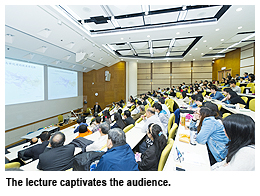
In his talk, Professor Chang also explained the origins of the sectarian division between Sunnis and Shiites, the two main sub-groups within Islam, along with some historical milestones such as the Crusades of medieval Europe, and the Mongolian military expeditions into west Asia and east Europe in the thirteenth century.
By showing some slides made from the photos he had taken himself in travels to many Islamic historic sites, Professor Chang added spice to his lecture.

When winding up his lecture, Professor Chang said he knew little about Islam during his school years. He began to be interested in the Islamic culture in the early 1980s; since his retirement in 2007, his studies and lectures have focused on the history of exchanges between various cultures. He went on to point out that one should have at least some knowledge of the origin and evolution of Islam, whether for the sake of appreciating the beauty and diversity of world civilisations, grasping the current international affairs, or understanding the spiritual pursuits of mankind.
?