European perspective on human rights
Michael Gibb
It was a talk that transcended nationhood, race, gender and personal beliefs. It was a talk about freedom and equality, and the need for fairness. It was a talk about human rights.
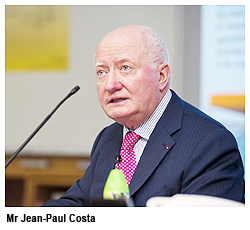
His lecture began with a short presentation on the European Court of Human Rights followed by an assessment of the Court’s actions since its beginning and a general indication of its future development.
By way of background, the European Convention on Human Rights was signed in 1950, Mr Costa explained, a follow-up to the Universal Declaration of Human Rights adopted in 1948 by the General Assembly of the United Nations. The Convention is a catalogue of rights that member states commit to.
“These rights include the right to life, the prohibition of torture and slavery, the right to liberty and security, the right to a fair trial, the right to private and family life, freedom of religion, freedom of expression, and freedom of assembly and association,” explained Mr Costa, who first became a judge of the Court in November 1998.
The Court was set up in 1959 in the French city of Strasbourg, and has seen its caseload grow rapidly in the past decade, from under 8,400 cases in 1999 to 57,000 in 2009, as people have become more familiar with the Court and its work.
Mr Costa pointed out, though, that the work of the Court was not always universally appreciated. National courts can feel marginalised if the Court takes an opposite view on a particular case it has passed judgement on, or the Court might be accused of being too reserved in its assessment.
“Some governments are reproaching the Court for encroaching upon the competences of the national legislators, for shrinking the margin of appreciation and the subsidiarity principle,” he said. One example of this is the case of a prisoner’s right to vote, which is proving contentious with some member nations.
Although retired, Mr Costa is keen to remain active in the field of human rights, citing Article 8 of the Convention as one of his major interests, i.e. the right to privacy in one’s private life, at home, within the family, and in one’s correspondence.
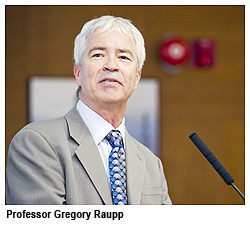
Professor Gregory Raupp, Vice-President (Research and Technology) and Dean of Graduate Studies at CityU, thanked Mr Costa for his talk, praising its universal themes and honourable actions in the pursuit of basic rights for everyone.