CityU project studies knowledge management in China
Michelle Leung
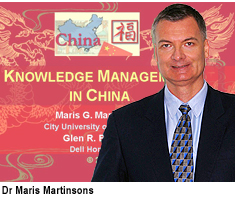
Since 2002 Dr Maris Martinsons, an associate professor in the Department of Management at CityU, has led a research project involving collaborators from industry and universities in mainland China such as Peking University and Shanghai Jiaotong University. The project investigates how knowledge is managed in China. The study has found that knowledge management is distinctive on the mainland when compared to both US and Japanese models.
The research uses a combination of surveys, interviews and longitudinal case studies to collect data from over 100 managers, employees and external parties (customers, suppliers and consultants) associated with more than 20 organizations in the private and public sectors in China. These organizations include Dell, Ericsson and SAP. Interviewees were asked about their involvement in and perceptions of managing knowledge.
“In the four main aspects of knowledge management, namely generation, organization, transfer and use, Chinese business has distinctive patterns which are guided mostly by relationships that often cut across organizational boundaries,” Dr Martinsons said.
“As China’s economy continues to open up and its businesses increasingly face world-class competition, their ability to create their own knowledge and to manage both created and acquired knowledge more systematically become critical success factors”, he said.
In terms of knowledge generation, the study reveals that Chinese managers are active in acquiring new knowledge. They have achieved economies of expertise by leveraging knowledge flow in a complex network of highly-personal inter-organizational relationships. Instead of concentrating on developing and improving internal processes and routines to capture and retain knowledge like the Japanese, the Chinese focus is on strengthening inter-organizational networks to ensure access to external expertise that complements their own internal capabilities.
However, in contrast to the Japanese, knowledge in Chinese societies is shared primarily with in-group members, the study suggests. Consistent with cultural traditions, the Chinese favour informal and implicit forms of communication and strongly prefer to transfer knowledge through interpersonal contact rather than formal and/or written means.
Status-based hierarchies in China also restrict the vertical transfer of knowledge, which means that Chinese managers rarely acquire or accept knowledge from their subordinates. Instead, trusted advisors are relied upon to analyze and interpret the external environment, which makes comprehending novel or foreign situations more difficult.
Despite the widespread application of information technology in many Chinese organizations, personal interaction remains the preferred form of knowledge transfer. Although IT provides a common platform for business transactions in mainland China, knowledge still tends to be managed in a social context that depends more on relationships than on rules. This contrasts with the US where knowledge tends to be managed as an object and is digitally stored in knowledge bases.
The multi-method study concludes that knowledge management in China is becoming more systematic but the use of knowledge within Chinese organizations remains highly constrained by cultural factors.
Dr Martinsons said the problems related to knowledge management in China include a lack of time to share knowledge, failure to use knowledge effectively and the difficulty of capturing implicit knowledge. These problems have been exacerbated by a lack of trust within Chinese firms and by social hierarchies which limit opportunities to create and share knowledge.
The results were presented on 21 June by Dr Martinsons and Mr Glen Burrows, Managing Director of Dell Hong Kong, at an event sponsored by the Hong Kong Knowledge Management Society.