CityU’s
School of Law (SLW), the
Legal and Judicial Training Centre of Macao SAR, and the
Consulate General of France in Hong Kong and Macao
jointly organized “
Present and Future of Civil Law in Greater China — Conference on the 200th Anniversary of the French Civil Code”, 9-10 November. Commencing at CityU, the Conference grants legal scholars and practitioners from
France,
Hong Kong, Mainland
China,
Macao and
Taiwan opportunities to explore topic related to the impact of the French Civil Code in Greater China.
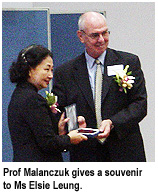
At the Opening Ceremony, Chair Professor Peter Malanczuk, Dean of the SLW warmly welcomed the participants, panelists, and the three officiating guests: CityU's President Professor H K Chang; the Consul General of France, Mr Serge Mostura; and the Hong Kong SAR Secretary for Justice, Ms Elsie Leung.
"Greater China has benefited from all three major
legal systems of the modern world: the civil law system, the common law system, and the socialist system. The civil law system originated, of course, from the great French Civil Code. That Code now stands tall after 200 years, having spread throughout continental
Europe and to other continents," Ms Leung explained. "It influenced the modernisation of the Japanese legal system in the 19th century, and the promulgation of comprehensive codes in
China between 1928 and 1935. Those codes continue to form the basis of the legal system in
Taiwan. In its Portuguese form, the civil law took hold in
Macao. After the reunification of Macau and the mainland in 1999, that system remains in force by virtue of the Basic Law of the Macau SAR. The common law system was introduced in
Hong Kong when it was under British administration. It contributed to
Hong Kong's development by providing a secure legal environment for residents, businessmen and investors. That common law system continues here after reunification by virtue of the Basic Law of
the Hong Kong SAR."
Major topics of discussion at the Conference include: “Greater China, Civil Code, and International Treaties”; “Interaction within Greater China and with Foreign Countries”; Civil Law and Economic Challenges; and The International Role of Civil Law Today”. Panelists for the morning and afternoon sessions of day one were: Professor Wang Guigo, SLW; Professor Remy Cabrillac, University “Montpellier 1”; Professor Jean-Baptiste Seube, University “La Reunion”; Professor Yao Hui, School of Law, Renmin
University;
Professor Philip Yang, SLW, and Chairperson of the Hong Kong International Arbitration Centre;
Mr Han Jian, Secretary-General, Shenzhen Commission of CIETAC;
Dr Priscilla Leung, Associate Professor,
SLW;
Mr Bob Allcock, Solicitor General, Legal Policy Division, Department of Justice, Hong Kong SAR;
Professors Paula Nunes Correia and
Tong Io Cheng, Faculty of Law, University of Macao. Leading the discussions were:
Hans-Gunther Herrmann, Associate, Paul Weiss, Rifkind, Wharton & Garrison LLP; and
Professor Augusto Teixeira Garcia, Faculty of Law,
University of Macao.
Day two of the Conference will be held at the S.T.D.M. Auditorium of the University of Macau from 9 a.m. to 6:30 p.m. on 10 November. Concluding remarks will be given by Professor Malanczuk and Mr Manuel Marcelino Escovar Trigo, Director of the Legal and Judicial Training Centre of the Macao SAR.