波音游戏源码-波音博彩公司评级_百家乐园天将_新全讯网3344111.c(中国)·官方网站

Logistics and artificial intelligence

Gary Lo


In his 2001 Policy Address, Hong Kong's Chief Executive, Mr Tung Chee-hwa, announced the Logistics Hong Kong initiative, which aims to strengthen Hong Kong's status as the preferred regional and international logistics hub, linking the China's mainland with the rest of the world.
The objective of Logistics Hong Kong is to build on the solid foundation provided by Hong Kong's infrastructure to create an even more conducive environment for Hong Kong to develop further as a logistics hub and supply-chain base. In order to achieve this aim, Hong Kong must have a healthy infrastructure and also adequate information technology support to streamline logistic processes and to maximize resource utilization.

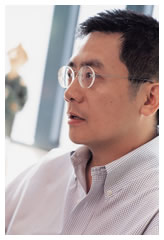
"Potentially, CityU can play an increased role in Logistics Hong Kong, with its advanced technologies and applied R&D experience," said Dr Andy Chun, Associate Professor in the Department of Computer Science and Chief Executive Officer of a spin-off company from CityU, BonVision Technology (Hong Kong) Limited, which is a leading provider of artificial intelligence (AI) applications. Dr Chun is the local expert on logistics scheduling and optimization and supply chain management.

AI gives Hong Kong an advantage
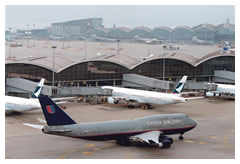
According to Dr Chun, there are several areas where AI can give Hong Kong a leading edge. For example, logistic service providers - whether land, sea or air - all use an enormous number of different resources, such as manpower, equipment, vehicles and space. Given the huge costs associated with using these resources, it makes sense to use them wisely, Dr Chun said. Resource and hence supply chain optimization can be achieved by using advanced AI algorithms and techniques, such as constraint programming, genetic algorithms and simulated annealing. Making use of these techniques will ensure that Hong Kong will be able to offer high-quality service at a very attractive price.

"CityU has a long history of research and applied R&D in these areas," Dr Chun said. In fact, back in 1994 he used AI techniques to optimize how check-in counters were allocated at the old Kai Tak International Airport. As a result, Hong Kong was able to handle thousands more flights each year, prior to the opening of the new airport at Chek Lap Kok.

Today, Dr Chun's Stand Allocation System (SAS) software is used at Chek Lap Kok to allocate parking spaces so that planes are parked at the "best" spot with maximum safety and convenience. The software uses AI and constraint-programming techniques to assign parking stands and schedule aircraft ground movement. In 1999, Dr Chun's system won an Innovative Application Award from the American Association for Artificial Intelligence - a first for Hong Kong. And in 2000, Dr Chun won the award for the second time, for his contributions to the Hong Kong Hospital Authority's Staff Rostering System.

Using AI to maximize resources
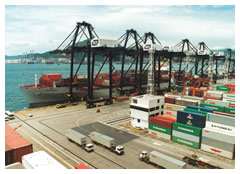
Dr Chun and his team have also applied AI techniques to other cargo handling companies, such as Hong Kong Air Cargo Terminals Ltd, Hong Kong International Terminals, and Modern Terminals Ltd. Using a sophisticated set of AI rules and constraints, such as priority, cargo type, flight schedules, pick-up schedules and resource capabilities, resource assignments are made automatically to handle and process each container within each arriving/departing cargo aircraft. "The system pays for itself by maximizing resource utilization, allowing the terminal operator to handle more business and generate more revenue," Dr Chun explained. CityU has also worked with other transportation-related companies, such as Hong Kong's Mass Transit Railway Corporation and the Kowloon Motor Bus Company to develop AI timetabling algorithms to increase service levels with limited resources.

However, the application of AI techniques to logistics is not limited to resource optimising and scheduling, Dr Chun said. "Logistics require the collaboration of many parties and companies, all with their own peculiar processes, procedures and guidelines." Many companies are beginning to use AI rule-based techniques to help manage and monitor complex business processes and workflows, especially those that span organizational and geographical boundaries. "AI, combined with various e-business XML (Extensible Markup Language) standards, allows logistic companies to operate in real time, or what we refer to as zero latency."

Reaching the goals established by the Logistics Hong Kong initiative won't be easy, Dr Chun said. But he believes that both traditional offline logistics service providers as well as Internet-connected e-logistics service providers will benefit from CityU's technologies and applied R&D expertise. "The advanced computer science and AI techniques we've developed will really give Hong Kong an edge in this demanding knowledge-based society of ours."


YOU MAY BE INTERESTED

Contact Information

Communications and Institutional Research Office

Back to top
百家乐官网桌定制| 聚宝盆百家乐官网的玩法技巧和规则| 大发888bet| 网上现金游戏| 百家乐官网双筹码怎么出千| 澳门百家乐几副牌| 娱乐城注册送18| 免费百家乐官网奥| 香港百家乐马书| 白山在线棋牌游戏| 百家乐官网英皇赌场娱乐网规则 | 大发888账号注册| 澳门百家乐官网网上赌| 宝格丽百家乐娱乐城| 蓝盾百家乐具体玩法技巧| 神农架林区| 百家乐声音不印网| 大赢家百家乐娱乐| 半圆百家乐官网桌子| 威尼斯人娱乐信誉| 百家乐官网ho168平台| 百家乐免费改| 南宁百家乐官网的玩法技巧和规则 | 全讯网22335555| 铂金娱乐| 宾利百家乐游戏| 顶级赌场官网| 百家乐规则技法| 网上娱乐城老虎机| 2404这个房号 风水| 大发888金皇冠娱乐城| 多台百家乐官网的玩法技巧和规则 | 大发888真钱| 丽都百家乐官网的玩法技巧和规则 | 炉霍县| 百家乐三宝| 百家乐官网园36bol在线| 大发888游戏加速| 24山向吉凶详解视频| 百家乐官网有电脑游戏吗| 好运来百家乐官网现金网|