波音游戏源码-波音博彩公司评级_百家乐园天将_新全讯网3344111.c(中国)·官方网站

MSN

Master of Science in
Neuroscience

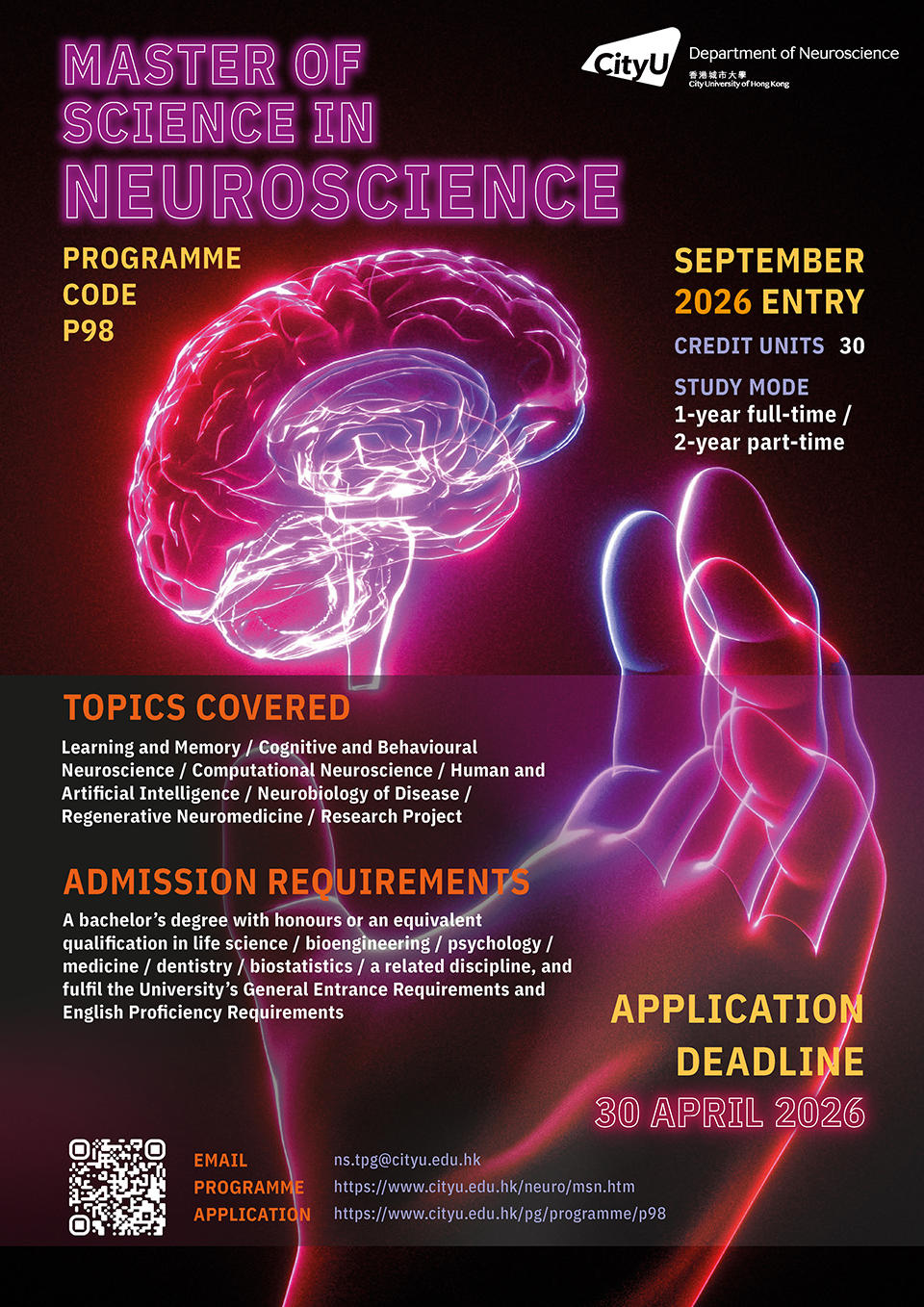
Programme Poster
Programme Poster
(click to download)

What is Neuroscience?

Neuroscience is the study of the nervous system, its functions and structure. The nervous system controls human behavior, emotions, thinking, physical functions, conscious and unconscious movements. Even now, we still do not fully understand this most complex system, and many questions remain to be answered. Moreover, much awaits to be discovered about how the dysfunction of nervous system can lead to neurological and psychiatric disorders.

Award Title
Master of Science in Neuroscience
Mode of Attendance
Combined mode*, Self-financing
Normal Study Period
  • Full-time: 1 year (max. 2.5 years)
  • Part-time: 2 years (max. 5 years)
Graduation Requirements
Minimum 30 Credit Units
Medium of Instruction & Assessment
English
Class Schedule
Classes are held during daytime. Classes may be offered in weekday evenings / Saturdays in special cases.
Tuition Fee
Please refer to SGS Website.
Application
Please refer to the steps and procedures on SGS website.

* Combined mode: Local students taking programmes in combined mode can attend full-time or part-time study in different semesters without seeking approval from the University. For non-local students, they will be admitted to these programmes for either full-time or part-time studies. Non-local students must maintain the required credit load for their full-time or part-time studies and any changes will require approval from the University.

Admission

Entrance Requirements

Applicants must satisfy the University’s general entrance requirements and the following programme entrance requirements:

  • For admission to MSN, applicants should possess a recognised undergraduate degree in Life Science/ Bioengineering/ Psychology/ Medicine/ Dentistry/ Veterinary Medicine/ Biostatistics or a related discipline.
  • Preference for admission will be given to individuals who have completed a holistic undergraduate education with knowledge covering statistics, neuroscience, psychology, physiology, pathology, pharmacology, medicine, animal science, and bioengineering.
  • Additional attention will be paid to students, who have little training in health science-related area to ensure that they can follow the progress of the programme.

English Proficiency Requirements

Applicants whose entrance qualification is obtained from an institution where the medium of instruction is NOT English should also fulfil the following minimum English proficiency requirement:

  • A score of 79 (internet- based test) on the Test of English as a Foreign Language (TOEFL)@#; or
  • An overall band score of 6.5 in International English Language Testing System (IELTS)@; or
  • A score of 450 in band 6 of the Chinese mainland’s College English Test (CET6); or
  • other equivalent qualifications.

@ TOEFL and IELTS scores are considered valid for two years. Applicants are required to provide their English test results obtained within the two years preceding the commencement of the University's application period.

# Applicants are required to arrange for the Educational Testing Service (ETS) to send their TOEFL results directly to the University. The TOEFL institution code for CityU is 3401.

General Information

  • Provide students with diverse background of undergraduate education with updated knowledge and practical techniques of basic and translational neuroscience
  • Provide students with knowledge and encourage them to critically think about emerging neuroscience and neuroscience-related interdisciplinary research, technology, education, and industries, and to prepare them for a career in this growing multi-disciplinary field
  • Educate healthcare and non-healthcare professionals with updated relevant knowledge of neuroscience and neuropsychiatric diseases.

Upon successful completion of this Master Programme, students should be able to:

  1. Understand how the anatomy and physiology of our nervous system enable the various functions such as learning and memory, sensory and motor function, and emotion.
  2. Understand how dysfunction of the nervous system can lead to neurological and psychiatric disorders, and how new therapeutics can be developed to treat them.
  3. Critically evaluate the latest research literature and apply it to provide solutions to current issues in nervous system health.
  4. Critically analyse, interpret, discuss and justify neuroscientific data.
  5. Communicate effectively, manage skillfully, and work closely with people from diverse education and professional background and experience. Communicate complex translational neuroscience concepts effectively to a variety of audience.

After graduating from this programme students will have the skills to work in a range of disciplines and settings such as:

  • Education and Research
  • Private sector (health care organisations, pharmaceutical industry and consulting)
  • PhD studies in Neuroscience

Programme Curriculum

Undeclared Stream

Programme Core Courses (15 credit units)

Course Code Course Title Credit Units
NS5001 Research Methodology and Ethics 3
NS5002 Neurobiology of Disease 3
NS5003 Neural Basis of Learning and Memory 3
NS5004 Molecular and Cellular Neuroscience 3
NS8002 Advanced Neuroscience 3

Electives

5 electives (a total of 15 credit units) or
NS6001 + 3 electives (a total of 15 credit units)

Course Code Course Title Credit Units
NS5005 Sensory and Motor Neuroscience 3
NS5006 Cognitive and Behavioral Neuroscience 3
NS5007 Human and Artificial Intelligence 3
NS5008 Neuropharmacology 3
NS6001 Research Project in Neuroscience 6
BMS8106 Stem Cell and Regenerative Medicine 3
BMS8110 Genomics and Bioinformatics 3

Human and Artificial Intelligence Stream

Programme Core Courses (15 credit units)

Course Code Course Title Credit Units
NS5001 Research Methodology and Ethics 3
NS5002 Neurobiology of Disease 3
NS5003 Neural Basis of Learning and Memory 3
NS5004 Molecular and Cellular Neuroscience 3
NS8002 Advanced Neuroscience 3

Electives
(12 + 3 credit units / 12 + 6 credit units)

Major Stream Elective Courses (12 credit units)

Course Code Course Title Credit Units
NS5007 Human and Artificial Intelligence 3
NS5009 Ethical Application of Artificial Intelligence in Biological Sciences and Healthcare 3
NS6002 Advanced Computational Neuroscience 3
NS6003 A Mathematical Introduction to Neural Networks 3

Register for 1 elective course from the list below (3 credit units / 6 credit units).

Course Code Course Title Credit Units
NS5005 Sensory and Motor Neuroscience 3
NS5006 Cognitive and Behavioral Neuroscience 3
NS5008 Neuropharmacology 3
NS6001* Research Project in Neuroscience 6
BMS8106 Stem Cell and Regenerative Medicine 3
BMS8110 Genomics and Bioinformatics 3

* Students who choose NS6001 are required to pay a total of 33 credit units in tuition fees.

Remarks

  • Elective courses will be offered subject to sufficient enrolment.
  • Some of the elective courses will be offered in every two years.

Useful Information for Current Students

Contact Us

Programme Leader: Prof. Geoffrey Lau

Admissions Tutor: Prof. Youngjin Lee

MSN programme enquiries: ns.tpg@cityu.edu.hk

Application enquiries: SGS Contact

Visa matters: GEO Contact

20 March 2025

圣淘沙百家乐官网的玩法技巧和规则| e世博百家乐官网攻略| 网上百家乐好玩吗| 德州扑克算牌器| 百家乐官网路单破| 开花财娱乐城| 百家乐神仙道官网| 百家乐官网玩法守则| 百家乐送彩金网络| 优博百家乐官网娱乐城| 百家乐官网电子游戏试| 月亮城百家乐的玩法技巧和规则| 稳赢的百家乐官网投注方法| 威尼斯人娱乐城玩百家乐| 百家乐官网投注之对冲投注| 百家乐智能系统| 777博彩| 百家乐最佳下注方法| 百家乐官网有几种打法| 百家乐大路小路| 百家乐官网的赚钱原理| 正规百家乐平注法口诀| 百家乐娱乐网备用网址| 百家乐官网开户导航| 皇冠网代理| 百家乐官网必赢| 汕头市| 网上百家乐有人赢过嘛| 赌百家乐官网容易的原| 百家乐官网免費游戏| 大发888出纳柜台 2014| 澳门百家乐大揭密| 网上百家乐官网赌场娱乐网规则 | 老虎机游戏| 百家乐看大路| 百家乐案件讯问| 百家乐官网群b28博你| 百家乐官网能赢到钱吗| 兴义市| 六合彩特码| 大发888的微博|