
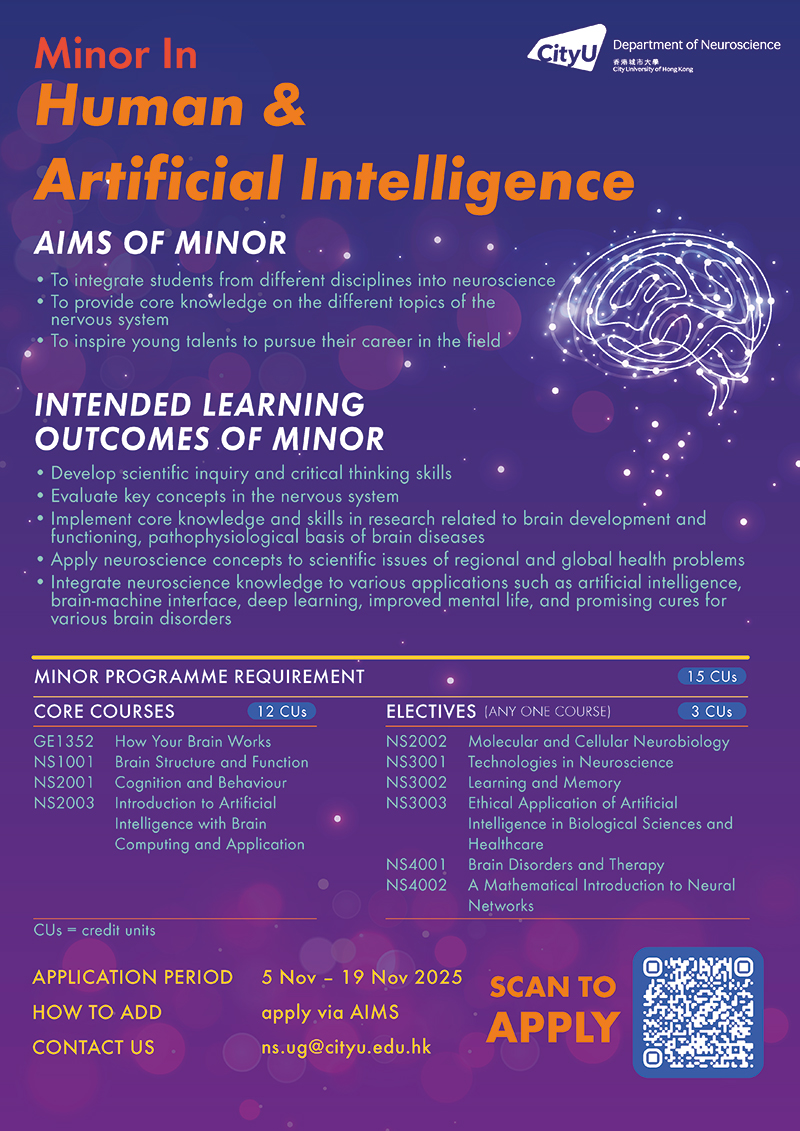
(click to download)
Aims of Minor
Our understanding of brain function and diseases has rapidly advanced during the past decade. The vast new knowledge on the nervous system has led to an evolutionary change in the view on neuroscience world-wide. With its inter-disciplinary nature, the many branches of neuroscience have now integrated to various exciting applications, ranging from artificial intelligence, brain-machine interface, applied psychology, improvement of mental life, understanding people decisions in media, to promising cures of brain disorders. The growth of applying basic neuroscience techniques to practical problems in our daily life comes with a surge in number of people taking on neuroscience-related jobs. Thus, there is a pressing need to provide a solid, all-rounded education on this subject to people in Hong Kong. This Minor program aims to integrate students from different disciplines into neuroscience, with the mission to provide core knowledge on the different topics of the nervous system and inspire young talents to pursue their career in the field. As the only Neuroscience Department in Hong Kong, we are in a unique position to offer highly specific training on a diversity of topics from molecular, behavioral, cognitive to computational neuroscience. Supported by state-of-the-art equipment for the study of modern neuroscience, we will provide valuable experiential learning to the students, with strong focus on experimental approaches and hands-on practical sessions.
Intended Learning Outcomes of Minor (MINILOs)
Upon successful completion of this minor, students should be able to:
- Develop scientific inquiry and critical thinking skills, including the ability to understand and evaluate key concepts in the structure and function of the nervous system
- Implement the core knowledge and skills for the pursuit of research related to brain development and functioning, as well as the pathophysiological basis of brain diseases
- Apply concepts of neuroscience to scientific issues of regional and global health problems
- Participate in the generation, interpretation, application and dissemination of neuroscience knowledge
- Communicate neuroscience knowledge effectively orally and in writing
3 June 2025