波音游戏源码-波音博彩公司评级_百家乐园天将_新全讯网3344111.c(中国)·官方网站

NEWS

13 December 2022

Research Team co-led by Dr Geoffrey Lau discovers a new drug candidate for epilepsy treatment

.
.
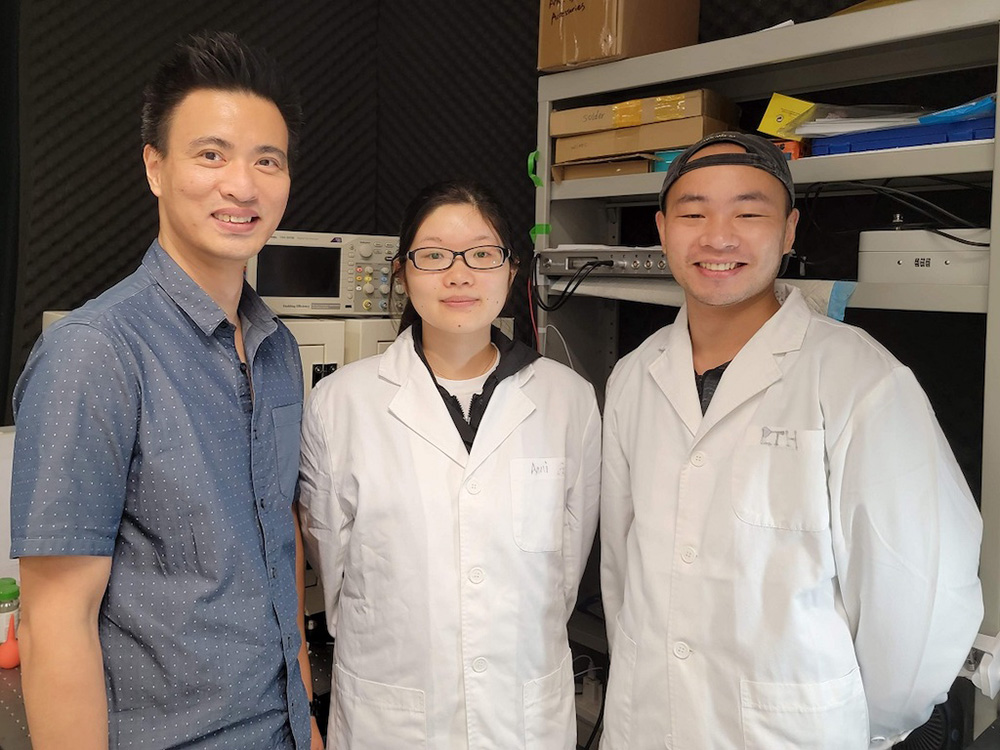
Dr Geoffrey Lau Chun-Yue (left) with his research team members Dr Guo Anni (centre) and Mr Li Huanhuan.

A research team co-led by Dr Geoffrey C. Y. Lau, Assistant Professor at the Department of Neuroscience, City University of Hong Kong (CityU), has recently identified and developed a new drug for treating temporal lobe epilepsy (TLE).

TLE is one of the most common types of epilepsy worldwide. Although patients can be treated by existing medications, many of them remain unresponsive to drug treatment. Hence, new medications and drug targets are needed. Connexin-based gap junctions and hemichannels in brain glial cells are implicated in TLE, but blocking gap junctions can lead to undesirable side effects.

Dr Lau’s research group identified a new small-organic molecule called D4, which selectively blocks connexin hemichannels (but not gap junctions). They investigated its effect in treating TLE using a mouse model. Dr Lau’s team found that D4 strongly suppresses the TLE-induced neuroinflammation, curbs TLE seizures, and increases animal survival rate.
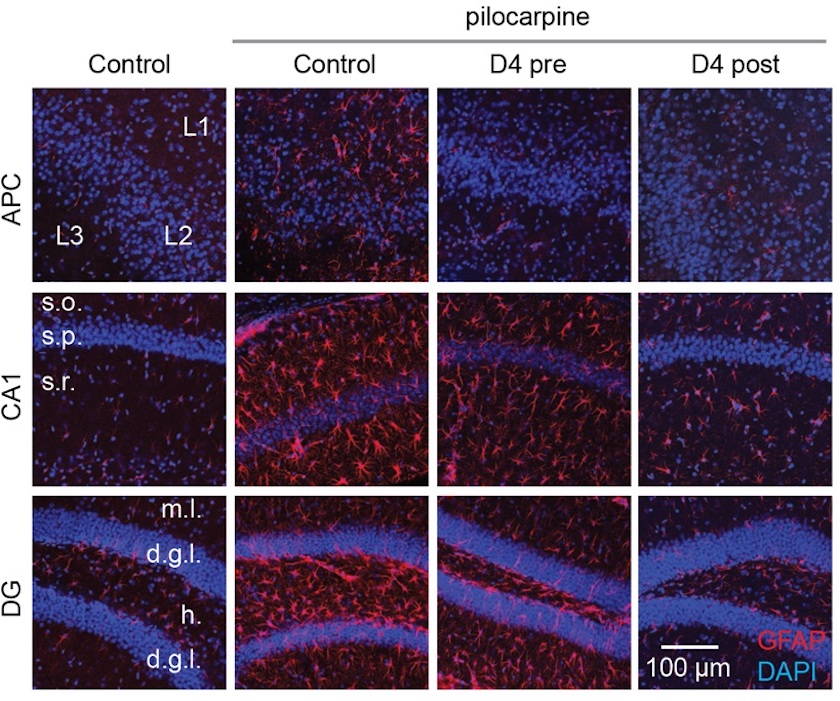
D4 treatment decreases proliferation and activation of astrocytes in two different brain regions. Pilocarpine was injection into mice intraperitoneally to induce seizures. Seven days after pilocarpine-induced seizures, we observed a chronic elevation of the number of astrocytes. Pre-pilocarpine or post-pilocarpine, single injection of the new hemichannel antagonist D4 significantly curbs the proliferation of astrocytes, thus reducing neuroinflammation. APC, anterior piriform cortex; CA1, cornu ammonis area 1 of the hippocampus; DG, dentate gyrus area of the hippocampus; GFAP, glial fibrillary acidic protein (marker of astrocytes); DAPI, marker of cell nuclei; L1, L2, L3, layers 1, 2 and 3 of APC; s.o., Stratum oriens; s.p., Stratum pyramidale; s.r., Stratum radiatum; m.l., molecular layer; d.g.l., dentate granule cell layer; h, hilus.

This research is the product of a collaboration between the corresponding authors, Dr Geoffrey Lau (CityU Neuroscience) and Dr Juan C Saez (University of Valparaíso, Chile). The findings entitled, “Inhibition of connexin hemichannels alleviates neuroinflammation and hyperexcitability in temporal lobe epilepsy”, is published at a leading international journal, Proceedings of the National Academy of Sciences of the United States of America (PNAS) (https://www.pnas.org/doi/10.1073/pnas.2213162119).

The first author is Dr Anni GUO, a postdoc in Dr Lau’s lab who graduated and obtained her PhD from CityU’s Interdisciplinary PhD Programme in Veterinary Medicine in collaboration with Cornell University. Funding on the CityU side is provided by the Hong Kong Research Grants Council (ECS 21103818, GRF 11104320 and GRF 11104521 to C.G.L.), Shenzhen General Basic Research Program (JCYJ20190808182203591 to C.G.L.), a grant from ITF-InnoHK, and internal funds from City University of Hong Kong (to C.G.L.).

News Coverages

CityU Research Stories

CityU neuroscientists discover a new drug candidate for treating epilepsy

城大研究

城大神經(jīng)科學(xué)家發(fā)現(xiàn)治療癲癇的新候選藥物

香港城大研創(chuàng)

香港城大神經(jīng)科學(xué)家發(fā)現(xiàn)治療癲癇的新候選藥物

Nature Reviews Neurology

Targeting connexin hemichannels to treat temporal lobe epilepsy

邏輯神經(jīng)科學(xué) (Logical Thinking Neuroscience)

PNAS︱劉俊宇團(tuán)隊(duì)揭示連接蛋白半通道在減輕顳葉癲癇發(fā)病過(guò)程中的神經(jīng)炎癥和過(guò)度興奮的重要作用

EurekAlert!

CityU neuroscientists discover a new drug candidate for treating epilepsy

More News
缅甸百家乐官网赌场娱乐网规则 | 伊春市| 累积式百家乐官网的玩法技巧和规则| 真人游戏网站| 洛克百家乐官网的玩法技巧和规则| 百家乐官网好不好| 大发888信用| 网上百家乐官网乐代理| 大发888赌场 游戏平台| 线上百家乐官网开户| 百家乐官网正负计算| 机器百家乐软件| 打百家乐官网的技术| 百家乐翻天快播粤语| 大发888 的用户名| 百家乐官网论坛香港马会| 百家乐家| 网上百家乐官网真的假| 速博国际网上娱乐| 百家乐怎打能赢| 百家乐官网园小区户型图| 百家乐的注码技巧| 百家乐官网赌场论坛| 海兴县| bet365娱乐场下载| 百家乐牌数计算法| 电投百家乐官网网站| 境外赌博下| 大发888游戏平台df888| 百家乐百家乐视频游戏世界| 累积式百家乐官网的玩法技巧和规则| 真人百家乐官网宣传| 威尼斯人娱乐城送38| 百家乐游戏免费| 百家乐官网入庄闲概率| 百家乐官网玩法的技巧| 英伦国际| 百家乐平注赢钱法| 澳门百家乐官网几副牌| 真人游戏网| 百家乐技巧介绍|