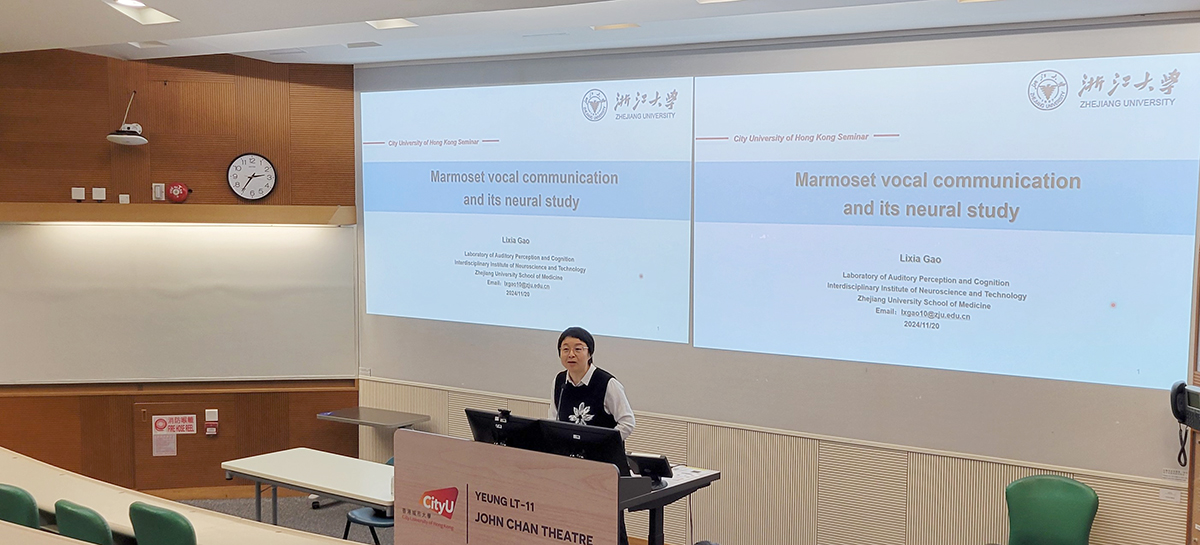
On November 20, 2024, the Department of Neuroscience invited Prof. GAO Lixia, a professor of Zhejiang University, to present a lecture entitled “Marmoset vocal communication and its neural study”. Prof. Gao received her PhD from the Institute of Neuroscience (ION), CAS. She has worked as a professor at Zhejiang University since 2017.
The main research interests of Prof. Gao are (1) cortical feedback modulation on subcortical regions in awake marmosets; (2) marmoset vocal development and vocal communications; (3) establishment of marmoset models of human mental diseases.
Prof. Gao introduced a type of new world monkey, the marmoset. Marmosets are highly related to humans. Phee calls are basic communication approaches of marmosets. She presented two recent works on the vocal communication of marmosets. The first one was a study on the development of turn-taking in vocal communication of marmosets. They discovered that the vocal production of marmosets was largely innate since postnatal 1-day marmosets were able to produce various types of calls and demonstrated phee-phee call interaction. Marmosets raised in normal or isolated conditions showed different patterns of phee-phee interaction on inter-call intervals, and call usage was scenario-dependent. This work provided solid evidence addressing a long-standing question: whether marmosets' vocal production is innate or learned.
Another work focused on the neural representation of conspecific vocalizations in amygdala of awake marmosets. This work showed that some neurons (47/262) in the amygdala distinguished phee calls from other marmosets and even different phee calls with similar features. Moreover, activation of these specific neurons required the integrity of calls. This work emphasised and advanced the understanding of amygdala in processing conspecific calls.
Prof. Gao’s lecture inspired the audience and sparked extensive discussion.
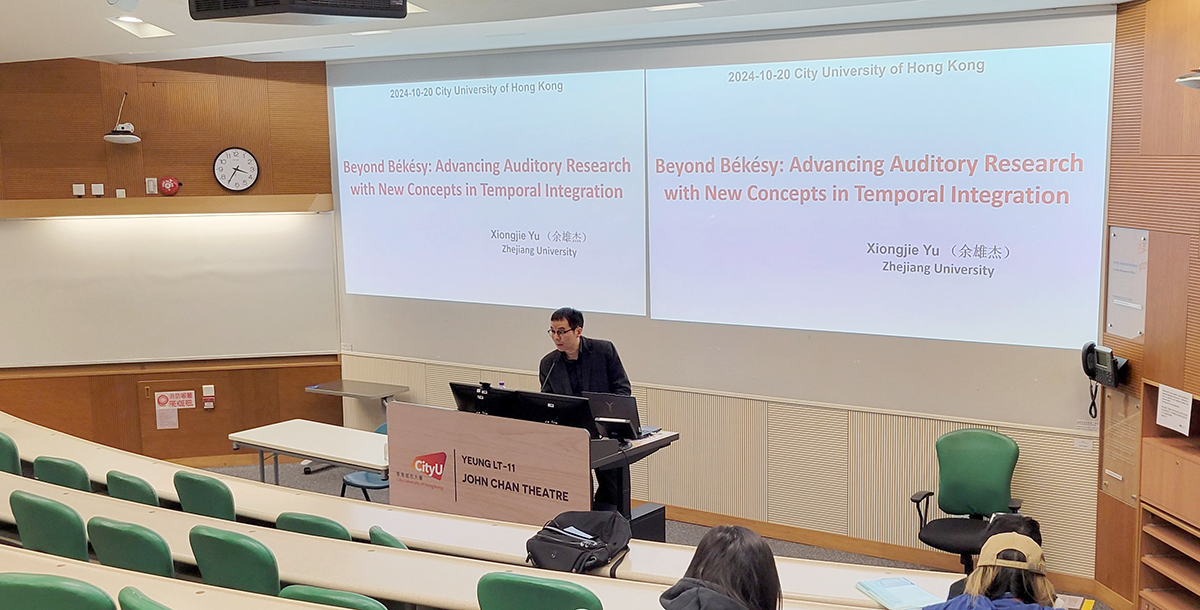
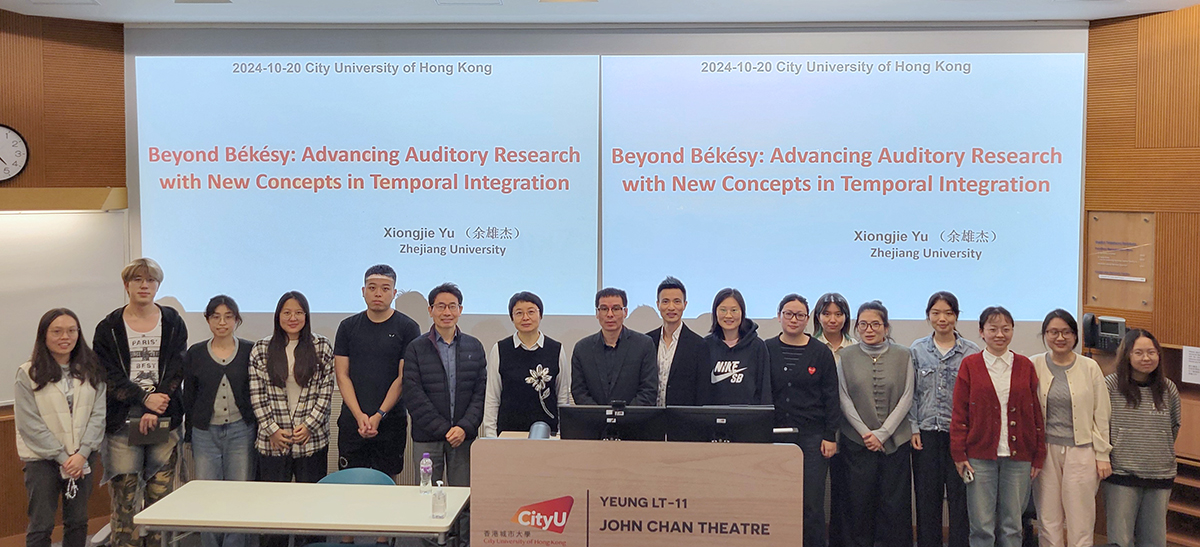
On November 20, 2024, we were honored to have Prof. YU Xiongjie present his group’s latest research in a talk entitled, “Beyond Békésy: Advancing Auditory Research with New Concepts in Temporal Integration.” Prof. Yu earned his bachelor’s degree from Wuhan University in 2003 and completed his PhD at the Institute of Biophysics, Chinese Academy of Sciences. Following this, he undertook postdoctoral research at Hong Kong Polytechnic University, Washington University in St. Louis, and Baylor College of Medicine. He joined Zhejiang University in 2014, where he established China’s first macaque auditory cognition laboratory. His research focuses on auditory cognition, and his work has been published in leading journals like Nature Neuroscience, PNAS, and eLife, receiving significant attention and citations.
One of the key challenges in auditory research is understanding temporal integration—the process of merging discrete auditory events into unified perceptual experiences. Despite its importance, the underlying mechanisms remain largely unexplored. Prof. Yu’s team discovered a novel signal, termed the temporal merging-related signal, using a click-train model. They meticulously analyzed its characteristics, such as precision, duration, and variability. This signal, marked by a “switch response” to transitional click trains, was identified as a key indicator of temporal merging during neuronal adaptation, with its origin confirmed to be in the auditory cortex.
To validate their findings, they conducted psychological studies and EEG recordings, revealing similar signals in rats, suggesting the mechanism might be evolutionarily conserved. A comparative study of the auditory pathway, from the inferior colliculus (IC) to the primary auditory cortex, indicated that temporal configuration representation emerges in brain regions after the IC. Further, they introduced the Temporal Integration During Synchronization (TIDS) concept, supported by single-cell evidence showing representations of multiple temporal configurations. Using an oddball paradigm with click sequences, the team also explored temporal processing across various scales, unveiling a hierarchical organization in the auditory pathway, where different regions specialize in processing distinct temporal scales.