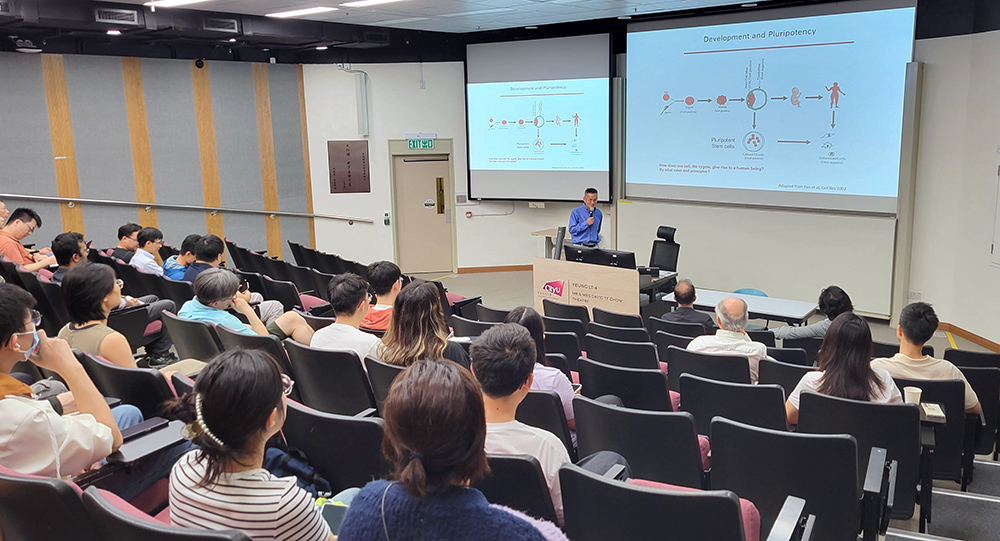
On 13 May 2024, we were honored to invite Professor Duanqing PEI to give a lecture entitled "Regenerating Human Somitogenesis in vitro". Prof. Pei was the first in China to create mouse iPSCs using a non-selective system, and then improved the iPS process systematically. Prof. Pei received his PhD from the University of Pennsylvania in 1991. From 1991 to 1996, he engaged in postdoctoral research at the University of Michigan Medical School. From 1996 to 2004, he worked in the Department of Pharmacology at the University of Minnesota Medical School, serving as an Assistant Professor and Associate Professor (Tenured). He returned to China in 2002 and was recruited by Tsinghua University. In 2004, he was recruited by the Guangzhou Institute of Biomedicine and Health, Chinese Academy of Sciences, and served as a Deputy Director and Director. Starting from 2015, he began to prepare for the establishment of the Guangzhou Institute of Regenerative Medicine and Healthy Guangdong Provincial Laboratory. He is now a Professor and an Associate Vice President of Westlake University.
Prof. Pei presented their recent research on vertebrate somites. One of the main features of vertebrates is the vertebral column, which is formed by connecting somites one by one. Despite the diversity of vertebrates, the structure and formation of somites appear to be a very conserved process. However, the rhythm of somite development is specific to each species. For example, mice cycle to form a somite every 150 minutes, and chickens cycle every 90 minutes. Due to technical difficulties and ethical reasons, the pluripotent cells present during the development of human somites cannot be directly studied and their formation mechanism is unclear. Therefore, establishing an animal model with a stable in vitro culture system of stem cells during somite development is crucial for studying the mechanism of somite development. Prof. Pei first reprogrammed human urine epithelial cells to a presomitic mesoderm (PSM) state capable of long-term self-renewal and formation of somitoids with an anterior-to-posterior axis. By inserting the RNA reporter Pepper into HES7 and MESP2 loci of these iPSM cells, both transcripts oscillate in the resulting somitoids are at ~5 h/cycle. GFP-tagged endogenous HES7 protein moves along the anterior-to-posterior axis during somitoid formation. The geo-sequencing analysis further confirmed anterior-to-posterior polarity and revealed the localized expression of WNT, BMP, FGF, and RA signaling molecules and HOXA-D family members.
Prof. Pei’s study demonstrates the direct reconstitution of human segmentation clock from somatic cells, which may allow future dissection of the mechanism and components of such a clock and aid regenerative medicine.
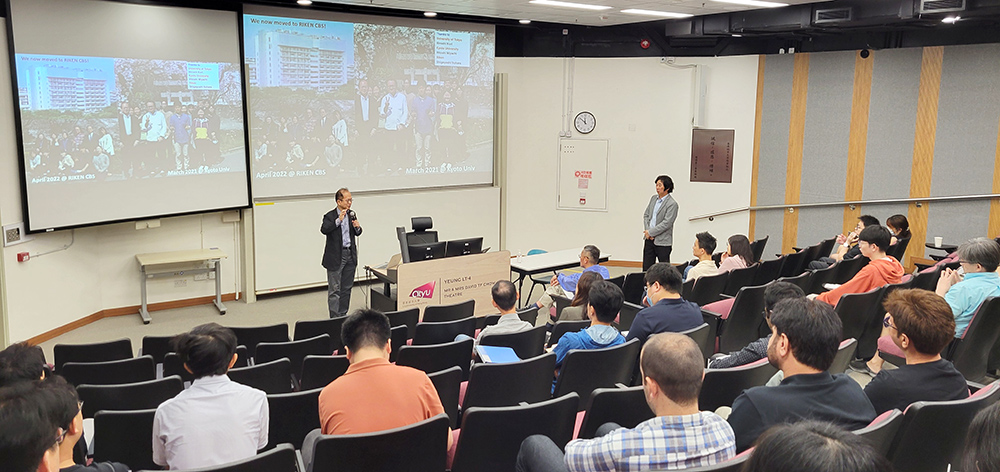
On 13 May 2024, the Department of Neuroscience invited Professor Ryoichiro Kageyama, the director of the RIKEN Center for Brain Science, to present a talk entitled “Dynamic Transcriptional Control of Active Versus Quiescent Neural Stem Cells”. Professor Ryoichiro Kageyama received his M.D. in 1982 and Ph.D. in 1986 from Kyoto University. In this lecture, Professor Ryoichiro Kageyama introduced his current research involving studies on the dynamics of gene expression during cellular proliferation and differentiation.
In the beginning, Prof. Ryoichiro Kageyama gave a background about active and quiescent neural stem cells (NSCs). Adult NSCs cannot regenerate in the diseased or damaged brain. Next, Prof. Ryoichiro Kageyama presented his research about the genes Hes1 and Mash1/Ascl1 oscillations. Oscillating expression of Mash1/Ascl1 activates proliferation of NSCs, whereas sustained expression induced neuronal differentiation. They found that Tbr2 in NSCs suppresses Hes1 oscillations and Hes1 expression is up-regulated in NSCs of Tbr2 cKO mice. Hes1 regulated cell proliferation depends on their temporal dynamics, and CDK inhibitor p21 expression is repressed by oscillatory Hes1 but up-regulated by high and sustained Hes1 via p-Erk1/2. His group developed a time-lapse imaging system and a light-controlled gene expression system to analyze the functional significance of oscillatory gene expression in many biological events.
Moreover, Professor Ryoichiro Kageyama demonstrated his work about the role of newly born neurons in the adult brain and declining neurogenesis with aging and rejuvenation of NSCs. His group developed a new method to rejuvenate aged NSCs. They found that neurogenesis increases the total granule cell number in the dentate gyrus of the adult brain, and continuous neurogenesis is required for various brain functions. They used the Barnes maze to show that spatial memory is impaired after blockage of neurogenesis. Adult neurogenesis declined during aging, but activation of Mash1/Ascl1 oscillations using their newly invented method, iPaD, in aged NSCs improves cognitive function of aged mice. They also confirmed the effects on various mouse disease models, indicating that activation of adult neurogenesis can ameliorate many neuropsychiatric disorders, such as Alzheimer's disease, Huntington’s disease, depression and post-traumatic stress disorder (PTSD).
In summary, Professor Ryoichiro Kageyama illustrated the importance of Hes1 and Mash1/Ascl1 oscillations for inducing the active state of NSCs. High Hes1 and resultant Mash1/Ascl1 suppression lead to a quiescent state of NSCs, while Mash1/Ascl1 oscillations can reactivate quiescent NSCs in the adult brain. His discovery that iPaD enhances neurogenesis and ameliorates cognitive functions of aged or diseased mice can lead to new promising treatments for neurological disorders.