
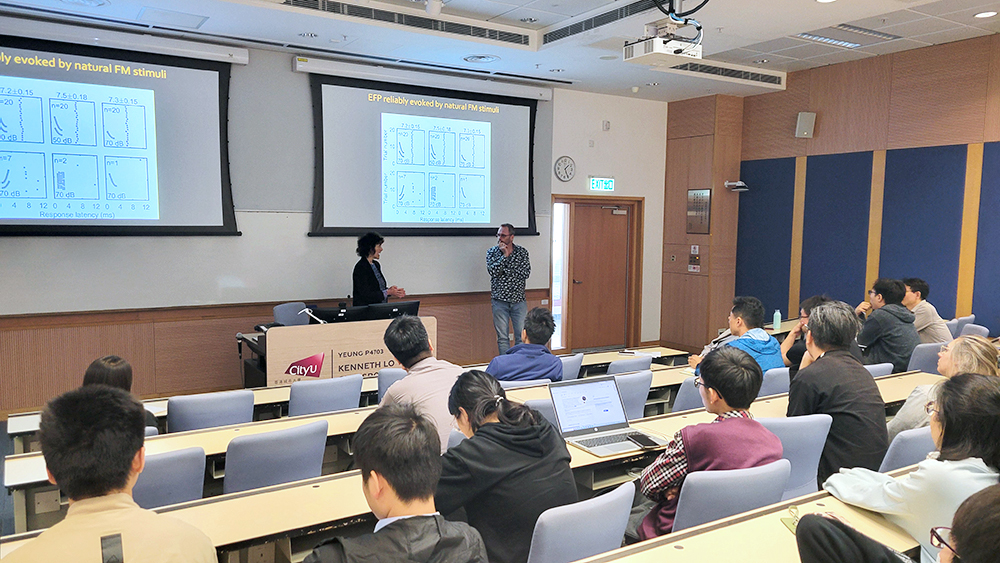
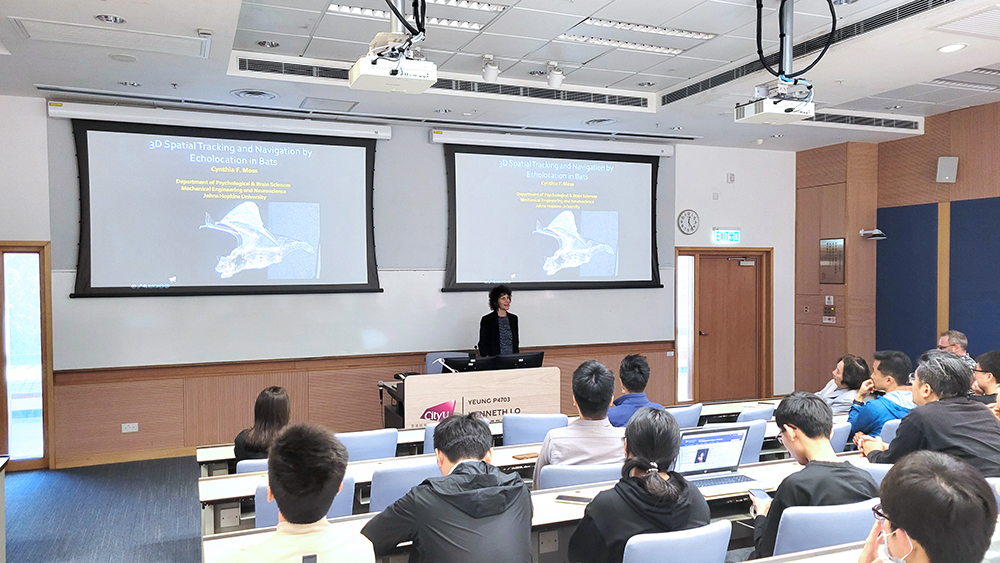
On 19 January, 2024, Prof Moss from Johns Hopkins University delivered a seminar entitled ‘3D Spatial Tracking and Navigation by Echolocation in Bats’. The seminar reviewed a large body of research from her group studying echolocation abilities in big brown bats using behavioral and physiological techniques. Brown bats produce FM echo pulses with a harmonic frequency that sweeps from 60 kHz down to 20 kHz in just a few milliseconds. They use binaural cues to localize the echos from these pulses in the horizontal plane, spectral cues for determining direction in the vertical plane, and echo delay for range finding. They are able to time echo pulses with a few tens of microseconds accuracy, giving them distance information that is accurate to a few centimeters.
By studying bats hunting or prey tracking in a laboratory space equipped with microphone arrays and infrared cameras, Prof Moss’s team was able to reconstruct the sonar beams emitted by the bats during these behaviors. They were able to show that bats direct these beams predictively, anticipating where an insect may re-emerge when it disappears behind an occlusion. Bats also adjust their sonar beams during the final approach, making them shorter to enhance the gap between outgoing pulse and echo.
Recordings of multiunit activity in the inferior colliculus (IC) of these animals show that many neurons there are highly selective in their responses, responding only to sonar pulses but not time inverted copies, and they represent the timing of the pulses by very accurate and reproducible timing of the responses.
To demonstrate a causal relationship between IC responses and successful echolocation behavior, Prof Moss’s team started using designer receptors (DREADDs) which are transfected into IC neurons to allow a temporary, reversible deactivation of those neurons. Curiously, the effects observed in preliminary results were more modest than one might think, given the pivotal role the IC is thought to play in auditory processing in mammals. DREADD-mediated deactivation of IC appeared to lower the animal’s auditory sensitivity by only a handful of decibels, and animals appeared to compensate for this by making their pulses slightly longer, increasing the amount of acoustic energy available. It seems likely that the technique may need further refinement, as it currently probably provides only a partial block of IC activity, but once optimized this approach should be very promising, given that it is possible to target different neuron types by choosing appropriate promoters, and dissect their respective contributions to a highly complex sensorimotor behavior.
Overall Prof Moss’s presentation was very inspiring, showcasing how combining a wide range of techniques from bioacoustics to molecular biology can provide deep insights into seemingly miraculous sensory abilities, such as that of bats to navigate and hunt by flight in complete darkness, relying solely on their ultrasonic hearing.