

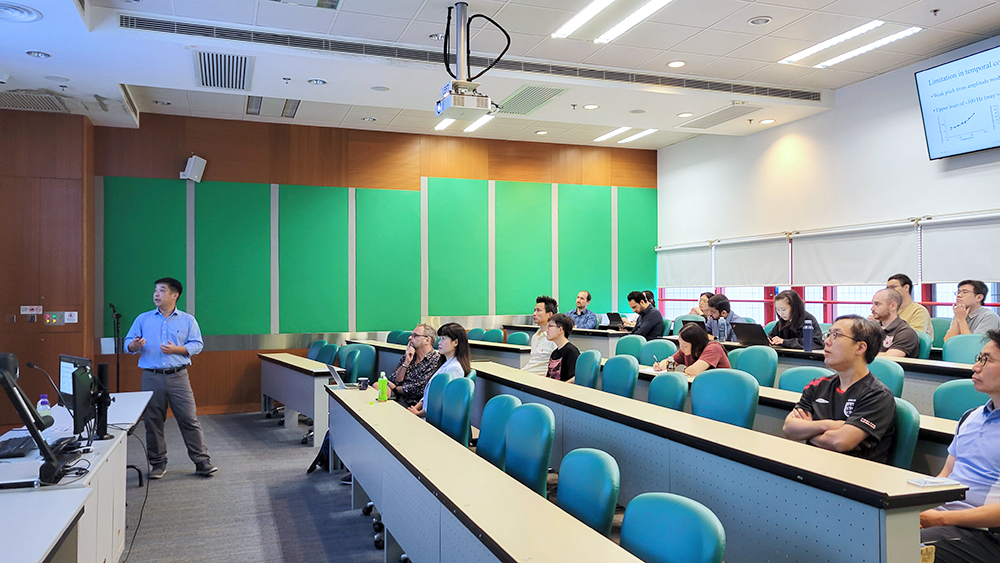
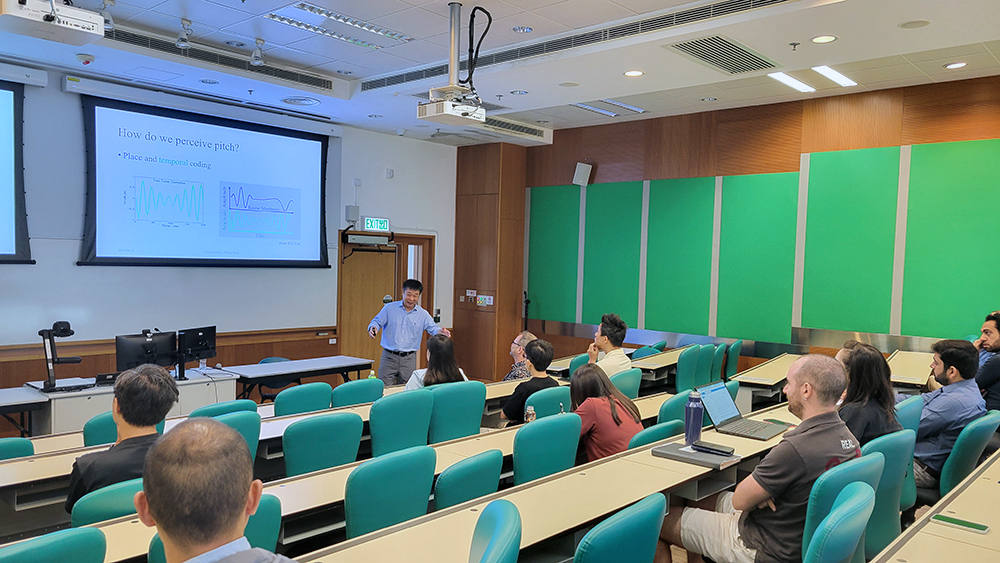
On 31 August 2023, Dr Xin Luo, Assistant Professor at the Auditory Implant Lab, Speech and Hearing Science, Arizona State University gave a presentation entitled Understanding and Enhancing Pitch Perception with Cochlear Implant.
Before diving into his research work, Dr Luo started by introducing the importance of pitch perception and the challenges faced when delivering pitch to hearing-impaired people with cochlear implant. The cochlear implant (CI) is a hearing prosthetic which sends electric stimulation directly to the cochlear based on envelope-based signal processing. Due to its limited number of excitation points, there are limitations in both place and temporal coding of pitch, which leads to poor pitch-related task performance of CI users. Dr Luo’s research aims at finding electrophysiological measures of the neural health of CI users, which would be important for the reliable performance of such difficult tasks, and CI stimulation strategies that would enhance pitch perception.
Dr Luo investigated the relationship between pitch sensitivity and neural health with CI users, and used a number of measures to assess the function of surviving spiral ganglion neurons (SGNs). Cathodic pulses are more likely to stimulate the peripheral processes of the SGNs, while anodic pulses directly activate the central axons. Dr Luo measured the polarity effect by subtracting the detection threshold for both pulses, and a large polarity effect indicates neural degeneration starting from the peripheral processes. The second metric used was multipulse integration (MPI), measured by contrasting the detection threshold for low and high rate pulses, correlates with speech recognition performance. It is also shown that electrically evoked compound action potential (ECAP), amplitude growth function (AGF) and interphase gap (IPG) offset are, in different degrees, indicators of SGN health, but other non-neural factors may have played a role in these measurements.
Dr Luo’s study revealed that thresholds for amplitude modulation frequency ranking (AMFR) and virtual channel ranking (VCR) were notably poorer on basal electrodes compared to apical and middle electrodes. This suggests that CI users face challenges in perceiving and discriminating pitch changes in the lower frequency range.
Finally, Dr Luo shared his work on the effect of pulse shape of electrical stimulation on pitch perception with CIs, in which he investigates whether the polarity effect has an effect on pitch sensitivity, and the effect of pulse shape on AMFR thresholds.
Dr Luo’s seminar showcased pioneering research, providing fresh insights into the intricate connections among neural health estimates, pitch sensitivity, and CI performance. His innovative work holds promise for advancing our understanding of auditory perception and improving the effectiveness of CI programming for individuals with hearing difficulties.