A research team led by scientists from City University of Hong Kong (CityU) has achieved a significant breakthrough by inventing a new class of near-infrared-activated photo-oxidants that can effectively kill cancer cells without requiring oxygen. The photo-oxidants induce a unique form of cancer cell death that can overcome cancer cell resistance. The findings offer a new strategy, called ‘photo-oxidation therapy’, and provide a promising direction for the development of anti-cancer drugs.
Photodynamic therapy, an innovative cancer treatment approach, utilizes photosensitizers to generate reactive oxygen species (ROSs), which when irradiated by light, selectively kill cancer cells. However, most existing photodynamic therapies rely on the presence of oxygen, while solid cancer tumours often feature a hypoxic microenvironment with very low oxygen levels, limiting the therapeutic efficiency of this approach.
To address this limitation, a research team led by Professor Guangyu Zhu, in the Department of Chemistry, and Professor Mingliang He, in the Department of Biomedical Sciences (BMS) at CityU, discovered an effect called “metal-enhanced photo-oxidation”. By conjugating metals like platinum with organic photosensitive ligands, they significantly enhanced the photo-oxidation capability. This breakthrough led them to develop a new class of near-infrared-activated platinum(IV) photo-oxidants (Pt(IV) photo-oxidants) that can be activated by near-infrared (NIR) light to directly oxidize biomolecules and effectively kill cancer cells without the need for oxygen.
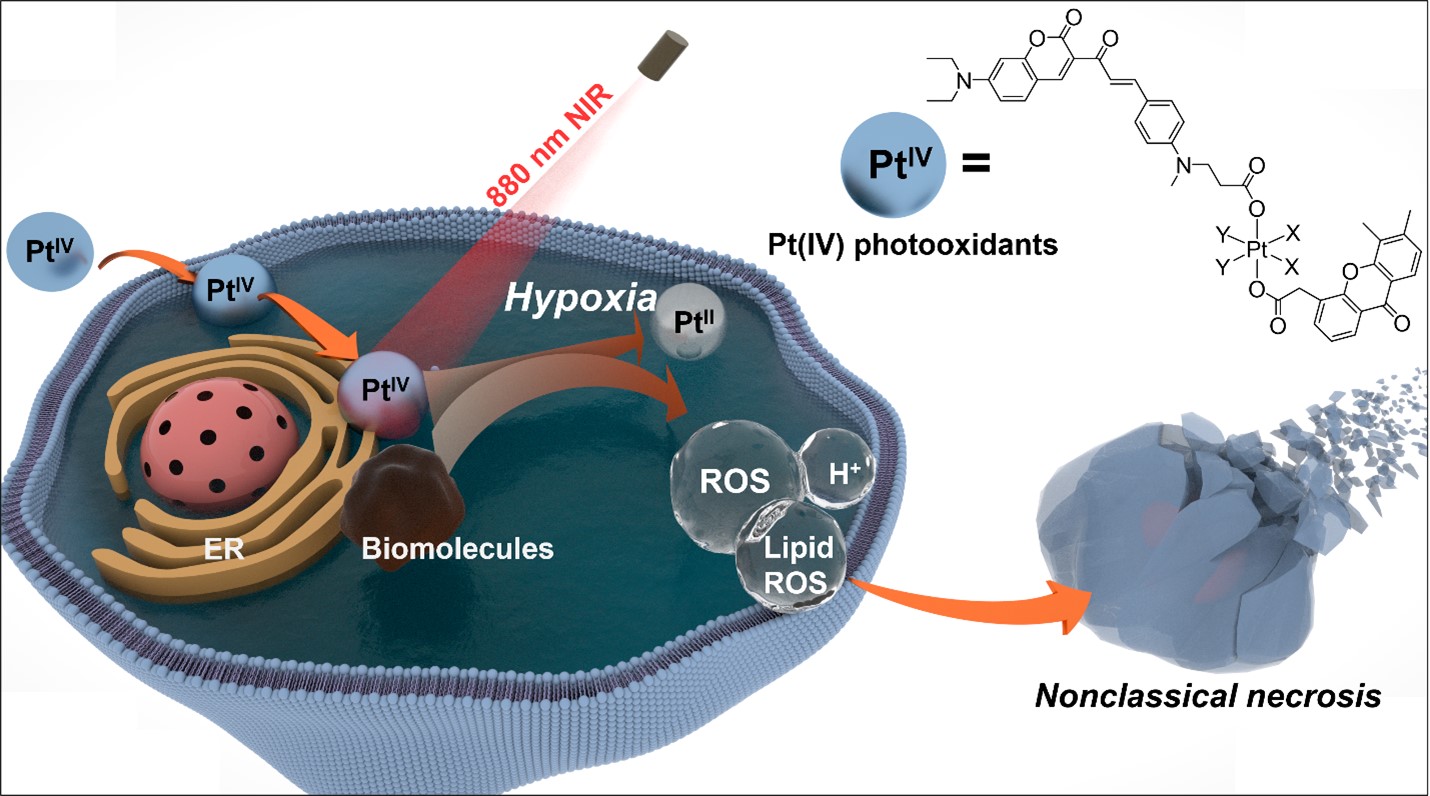
(Photo source: Deng, Z. et al., source: https://www.nature.com/articles/s41557-023-01242-w)
In their experiments, the team administered Pt(IV) photo-oxidants to mice with tumours through intravenous injection. Four hours later, they applied near-infrared radiation to the mice to activate the photo-oxidants to attack the cancer cells. The results demonstrated a significant reduction in tumour volume and weight of 89% and 76%, respectively, indicating the potent tumour-inhibitory effect of the Pt(IV) photo-oxidants.
“Intriguingly, we found that the ‘death mode’ of cancer cells induced by the Pt(IV) photo-oxidants differs from that of any other anticancer agents,” said Professor Zhu. “A unique mode of cancer cell destruction was initiated through the dual-action effect of strong intracellular oxidative stress and reduced intracellular pH value.”
Their experimental data show that after the Pt(IV) photo-oxidants that accumulated in the endoplasmic reticulum inside the cancer cells were activated by near-infrared radiation, they vigorously oxidized crucial biomolecules inside the cancer cells without requiring oxygen, generating ROSs, lipid peroxides and protons. The ROSs and lipid peroxides then triggered intensive oxidative bursts, while the protons lowered the intracellular pH value, creating an unfavourable acidic microenvironment for the cancer cells.

Moreover, their experiments confirmed that Pt(IV) photo-oxidants effectively activate the immune system in both in vitro and in vivo settings. The Pt(IV) photo-oxidants triggered immunogenic cell death, stimulating the proliferation and activation of immune cells. The number of T helper and T killer cells, which are crucial for triggering the body’s immune response, in the mice treated with photoactivated Pt(IV) photo-oxidants increased by 7- and 23-fold, respectively, compared to the control group.
“By inducing nonclassical necrosis, Pt(IV) photo-oxidants can overcome the resistance of cancer cells to traditional photodynamic therapies and chemotherapy agents, activate the immune system, and effectively eliminate cancer cells,” explained Professor Zhu.
“These findings serve as proof of concept and suggest that the development of photo-oxidants based on metal-enhanced photo-oxidation is a promising new direction for developing metal-based anticancer drugs,” said Professor He.
The research team plans to conduct preclinical studies to fully characterize the chemical, biological and pharmaceutical properties of the newly invented Pt(IV) photo-oxidants. Their ultimate goal is to identify lead compounds for clinical testing.
The paper, titled “Near-infrared-activated anticancer platinum(IV) complexes directly photo-oxidize biomolecules in an oxygen-independent manner”, was published in the scientific journal Nature Chemistry.
The co-first authors of the study are Dr Zhiqin Deng and Dr Huangcan Li, both from CityU. The corresponding authors are Professor Zhu and Professor He. Collaborators from CityU include Professor Michael Mengsu Yang, Professor Jian Lu, Professor Yangyang Li, Professor Pui-chi Lo, Professor Dangyuan Lei, Dr Weihui Ou, Dr Na Wang, Dr Shu Chen and PhD students Mr Gongyuan Liu, Mr Feijie Xu and Mr Xiong Wang.

The study received support from various funding sources, including the Hong Kong Research Grants Council, the National Natural Science Foundation of China, and the Science Technology and Innovation Committee of Shenzhen Municipality.
This research article originated from CityU Research Stories.