


A Complicated Relationship between Humans and Technology
Kim Ki-joon’s investigations focus on socio-psychological effects of human-technology interfaces and the CLASS New Researcher awardee is already planning his next step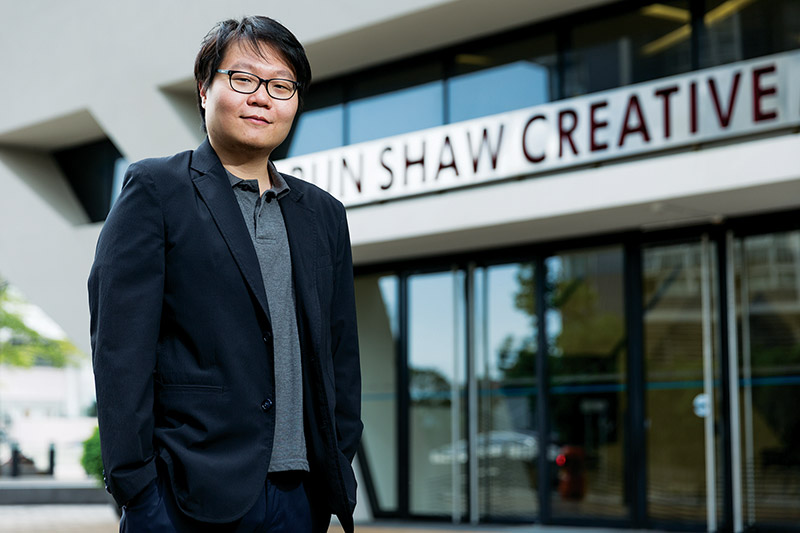
Researchers everywhere are inclined to describe their work as “cutting edge”, but in the case of Dr KIM Kijoon of the CityU CLASS Department of Media and Communication, that term is definitely appropriate.
His investigations focus on the socio-psychological effects of human-technology interfaces, in particular the changing processes that accompany the greater use of smartphones, social media, smart watches and the internet of things (IoT), and their consequences.
Broadly speaking, that involves examining how humans respond to various “affordances” – a term covering different types of modality, agency, interactivity or navigability – which are an integral part of using digital media.
More specifically, it means exploring the ways in which these affordances influence behavioural and psychological outcomes in technology-mediated communication.
Along the way, Kim develops theoretical paradigms to understand and explain how human interactions with the latest technologies, such as wearable devices, are perceived as socially meaningful and become an accepted, or even pervasive, aspect of everyday life.
“What’s really new is not the content or information, but the convenience and the different ways it can now be delivered to users,” Kim says. “To put it simply, these technologies are powering a new form of interaction and reshaping the nature of communication.”
At one level, he has studied how features like screen size and shape can influence user perceptions, as can the tone and type of voice used for pre-recorded instructions and standardised updates.
“Things like weather and stock reports are more effective if communicated by a male voice, whereas entertainment news is more effectively conveyed by a female voice. That difference is already found in human-human interaction, but my research studies the implications across different media platforms. We can then adapt the paradigms so that the norms and basic structures of ‘traditional’ human communication can be applied to human-computer interaction.”
At another level, he is also looking at how computers and smartphones are increasingly regarded as “social actors”. When using them, individuals are quick to credit them with a “social presence” and follow the norms that guide exchanges with other people. Such behaviour leads to all sorts of questions about the wider impact of these new technologies, not least within the realm of social psychology.
“In our field, we say we now live in a world of pervasive digital presence,” Kim says. “I guess it’s inevitable, unless we can totally separate ourselves from these developments, but there is still much to learn.”
He emphasises that his work is interdisciplinary by nature. It might draw primarily on insights and theories from the areas of human-computer interaction and communication, plus there are close links with disciplines such as design, engineering, psychology, sociology and information systems.
As a result, his findings and viewpoints instruct students and fellow researchers across the spectrum. They also provide practical guidelines for professionals designing, programming and disseminating the next generation of communication technologies.
Kim, a native of Seoul, attended boarding school in Cleveland, Ohio and later completed a first degree in psychology and media studies at Washington University in St Louis.
Back in South Korea, he worked in the non-profit sector and took a job in university administration. Assigned to a new department which would teach interactive science and design engineering, his main task was to help recruit bigname professors from the United States and world-renowned scholars in communications.
His abilities caught the eye and he was invited to change track and join the PhD programme instead.
“I had always been an ‘early adopter’ of the latest iPhone technology, but began to ask myself if all the new features and fancy functions really mattered and whether they provided a more satisfactory user experience. I wanted to address and explore that topic from the perspective of human-computer interaction.”
On completing the PhD, he became a faculty member and, two years later in 2016, moved to CityU and gained broader international experience. He now combines undergraduate and postgraduate teaching duties with research projects, which can be inspired by questions raised in class and may involve close collaboration with students.
“For any research paper, the topic must be timely and currently important,” says Kim, whose recent work has looked at the use of different voices for a range of IoT-linked devices in the home. “One of the issues now is privacy as IoT devices are constantly collecting information, so my research is also extending into that area.”
Regarded as one of the most prolific scholars in his field, Kim has published more than 70 peer-reviewed research articles. His findings and their implications are regularly cited in other leading studies on the social and psychological effects of communication technology.
For the originality and relevance of his work, Kim was presented with the CLASS New Researcher Award in March 2018. He plans to use part of the prize money to invite eminent international speakers to lecture and lead seminars in Hong Kong. What remains will be put towards travel expenses for presenting his own groundbreaking papers at conferences overseas.