CityU antenna pioneer elected as fellow of the UK Royal Academy of Engineering
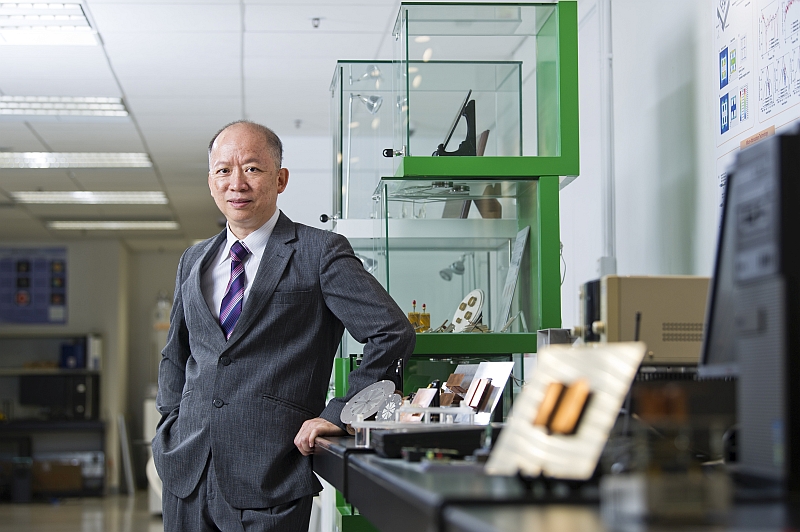
One of the top scientists at City University of Hong Kong (CityU) has been elected as a Fellow of the Royal Academy of Engineering in the UK in recognition of his profound contributions to advancing the development of antennas.
Professor Luk Kwai-man, Chair Professor in the Department of Electronic Engineering (EE), is renowned for spearheading the development of innovative antennas that enable data transmission at speeds and efficiency not possible before. He is one of the very few locally groomed scientists to be awarded this Fellowship, which is considered to be one of the highest honours an engineer can receive in the UK.
“I am delighted to be elected. It is a recognition from the whole UK engineering sector. It represents that the antennas research work by our entire team is acknowledged by the engineering sector as a world-leading contribution. I am very grateful,” said Professor Luk, who is the founding director of CityU’s State Key Laboratory of Terahertz and Millimeter Waves (SKLMW). “It’s a very competitive fellowship because the UK has achieved many brilliant engineering innovations and they have numerous engineers leading in a diverse range of disciplines. Many owners of successful innovative startups or enterprises are also competing for this honour. I am very delighted to be elected.”
Having worked at CityU for more than 28 years, Professor Luk said he was grateful to the University and its community. “CityU is where my career expanded and where my research gathered world-wide attention. This would have been impossible without the support of the University. Also colleagues like Chair Professor Stella Pang, Head of EE, and Chair Professor Chan Chi-hou, Director of SKLMW, as well as many former and present professors in the department, have long supported me,” he said.
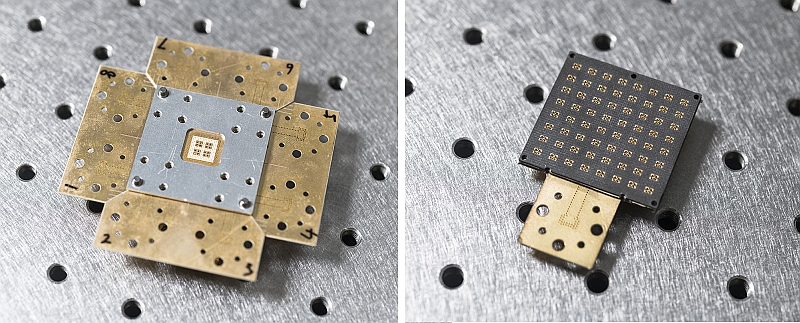
Over the past three decades, Professor Luk played a highly influential role in the field of antennas research. The L-shaped probe fed microstrip antenna and the magneto-electric dipole antenna that e and his team successfully invented in 1998 and 2006, respectively, were groundbreaking inventions because they allowed for more efficient wideband transmission. Other inventions by them including the design of microstrip antennas, small antennas, dielectric antennas and complementary antennas have been deployed globally in wireless communications.
Stay Connected
Professor Luk believes that a close cooperation with various industry players have driven them to keep exploring in the antenna research and innovation. “Engineers always need to think ahead,” he said. “We have enjoyed collaborating with the industry since early years.”
He recalled at that time the traditional probe fed microstrip antennas usually had a narrow bandwidth, ranging from 2 to 3% only. So their research focused on how to increase the bandwidth to allow the antennas to receive more channels. They successfully invented the L-shaped probe fed microstrip antenna, which increased the bandwidth to 30% while keeping reasonable radiation properties.
But after discussing the technology with the industry, they found that merely increasing the bandwidth of antennas was not enough. The industry found that when the antennas pointed forwards, the back radiation had to be reduced, so as not to affect the signal of other antennas at the back and render the antenna impractical. He strived to work out a new technology and came up with the magneto-electric dipole antenna.
Another example is the phased array antennas required by the industry for the upcoming 5G-wireless communications which will use frequency spectrum in the millimetre-wave frequency range. Professor Luk explains that since millimetre wave can be easily absorbed by air and the energy released by the current integrated circuit is insufficient, a high gain antenna is needed in order to enhance the transmission distance. But the high-gain antenna is directional which transmits signal to a very particular direction. Mobile phone users, however, would be moving around in different directions. So antennas in mobile phones have to be able to scan constantly like a radar so as to connect with the transmitters, and that is one of the key properties of phased array antenna. And how to ensure the scanning angle of the phase antennas to be wide enough is one of the challenges ahead.
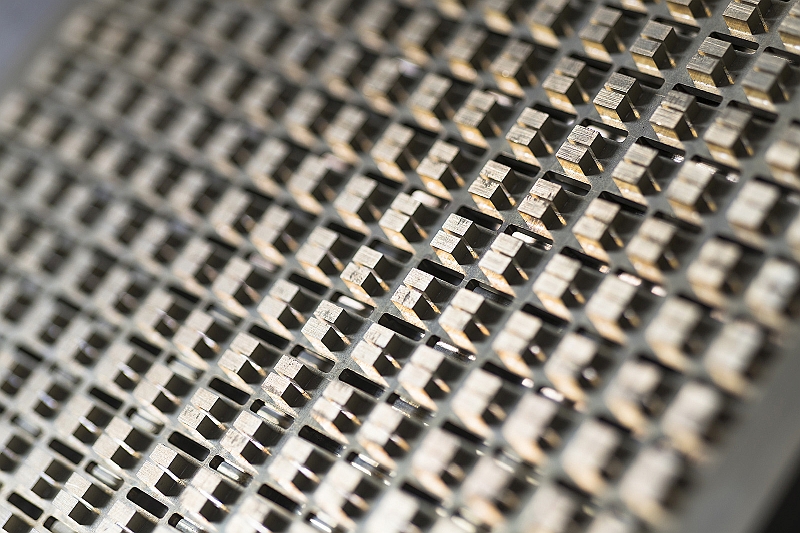
Professor Luk believes that keeping a close contact with the industry is a great way to learn about current and future market needs. The practical feedback he received helped to refine his designs, while the exchanges provided him with important insights about future trends. “Don’t be shy when others laugh at you. What you have to do is strive to improve as much as possible.”
In fact, although only now on the horizon, 5G communication constituted part of the work Professor Luk and his EE colleagues pursued ten years ago. Likewise, the terahertz technology that Professor Luk and the other members of SKLMW have mastered will contribute significantly to future communications.
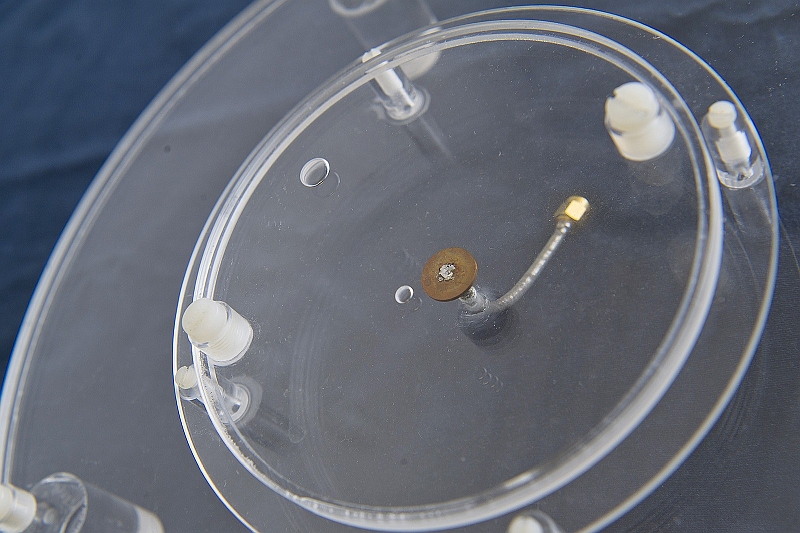
“The future antennas requires not only wider bandwidth, but also other features, such as multiple output and multiple input (with many antennas receiving signals and picking the strongest one rather than only relying on a single antenna), phased array and antenna miniaturisation,” he added. Some of Professor Luk’s recent research projects include non-metal antennas, water antennas and 3D antennas, all of which open up further possibilities in wireless communication.
Looking back to his career in scientific research, Professor Luk originally did not focus on antennas. “My research topic during PhD study was microwave measurement, but I felt that the related study at that time was already mature and hard to have further development. After the PhD study, he joined CityU and met antenna expert Professor Lee Kai Fong. Under the guidance of Professor Lee, he started the research relating to microstrip antenna which just began to draw attention at that time. Microstrip antenna is different with the traditional antenna (the fishbone-like antenna) that it is extremely thin and the best one should be transparent while not affecting the original performance of the device. “I would never have imagined the importance of antennas to be that high. But with the emergence of mobile phones, it has become more and more important,” he added.
Desire to innovate
Professor Luk said research engineers harboured a constant desire to find innovative solutions to pressing problems. His latest explorations on antenna will continue but his focus will shift from communications to medicine.
“We are working with local medical professionals on a few applications using radio waves, including a study on electromagnetic interference, electromagnetic body imaging to detect abnormalities in the body and dissolving blood clots in stroke patients,” he said.
While there are still a lot of challenges in related antenna research awaiting solutions from different parties, Professor Luk believed that “crossing that bridge when one comes to it” and there will always be a way out for obstacles. “Just like the time when we introduced the L-shaped probe fed microstrip antenna to the industry, they commented that it was still not ideal, which impeded the research progress. However, the negative comments motivated me to fine-tune my design and I always believe that I can reach a breakthrough with my own ability. Therefore, after solving the problem and successfully inventing the magneto-electric dipole antenna, I was very delighted.”
He wishes to become a role model for students through this fellowship recognition and brings up the message that scientific research can lead to a promising future, so as to attract more young people to join the research field.
Professor Luk has received numerous accolades over the years: the IEEE AP-S John Kraus Antenna Award in 2017, the State Technological Invention Award (second honour) in 2011, the Croucher Award in 2001, and the Microwave Prize at the 1994 Asia Pacific Microwave Conference.
He is a Fellow of the Hong Kong Institute of Engineer, the Chinese Institute of Electronics in China, the Institution of Engineering and Technology in the UK, the Institute of Electrical and Electronics Engineers in the US, as well as the Electromagnetics Academy, also in the US.
Founded in 1976, the Royal Academy of Engineering brings together the most successful and talented engineering researchers, innovators, entrepreneurs, business and industry leaders to advance and promote excellence in engineering for the benefit of society.