Some 20 archeologists, scholars, researchers and curators from the mainland,
Hong Kong, Taiwan,
South East Asia and
Australia gathered at CityU, 24 and 25 June, to present and exchange their findings on China’s 12
th to 15
th century ceramics and maritime trade. Jointly organized by CityU’s
Chinese Civilisation Centre (CCIV) and the HKSAR
Antiquities and Monuments Office, the Conference generated a multi-disciplinary approach to studying this aspect of relatively unexplored
Chinese history.
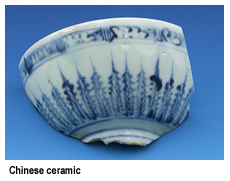
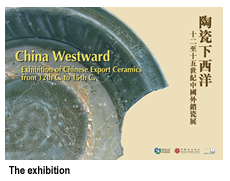
Preceding the Conference was an exhibition of some 200 relics displayed in the CityU Gallery in January this year, offering viewers a rare glimpse into porcelain as a maritime export and a cultural conduit between China and the West. The relics were gathered from archeological sites and institutes scattered throughout Southeast Asia, mainland China, and Hong Kong, reminiscent of the historical westward route of Chinese porcelain trade.
The
CCIV conducted the China Westward Project with CityU’s
Department of Physics and Materials Science (AP), mainland
China's Quanzhou Maritime Museum, Taiwan's
National Palace Museum, and the
University of Heidelberg,
Germany. “Porcelain itself is a diffusion of technology and artistic creativity,” said CityU President
Professor H K Chang, echoing the theme of interdisciplinary study.
Focus on Quanzhou
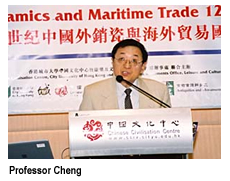
Professor Cheng Pei-kai, CCIV Director and Principal Investigator of the China Westward Project, introduced the background of the study. Porcelain, he said, is a durable and crucial resource for reconstructing China’s involvement in medieval East-West maritime
trade. The 12
th to 15
th century marked the pinnacle of
Quanzhou, in Fujian province, as
China’s most prosperous trading port. Porcelain relics excavated in Quanzhou and nearby ceramic production sites thus became a major focus of Cheng's Project.
Another researcher, Professor Peter Yu of the AP, illustrated Thermoluminescence (TLD) and X-ray Fluorescence (XRF) used for porcelain dating and testing. “Using heat, light and x-rays establishes a more scientific basis of judgment than the traditional approach based on shape, color and glaze,” he said. Using TLD, AP’s Ancient Ceramics Scientific Authentication Centre led by Dr Leung Po-lau, Adjunct Professor, also one of the Project researchers, has authenticated more than 700 ceramic shards for local dealers, collectors and archaeologists since its establishment in 1991.
The opening ceremony also featured a case study of Chinese ceramics excavated from Angkor Thom, Cambodia, presented by Ms Maggie Wan, CCIV Tutor. Based on a collection of Chinese ceramic shards unearthed by the archeological unit of the Japanese Government Team for Safeguarding Angkor, the research team suggested that maritime trade between China and the Khmer Empire had prospered from the 12th to the 15th century.
Also invited to kick off the two-day conference was Mr Edward Ho, Chairman of the Antiquities Advisory Board. “Globalization has become a way of life,” he said. “The world has always been connected through international trade and maritime trade was an important forerunner.” He reminded the audience not to overlook the importance of Hong Kong in the history of China’s porcelain trade.