
Breakthroughs in materials development, which are essential for advances in technology, are based on scientists’ understanding of material structure and dynamics. Neutron scattering is one of the most powerful techniques for exploring the nature of materials. At CityU, an expert in neutron-scattering measurements has applied this state-of-the-art experimental technique to find out the deformation and transformation behaviours in complex materials, in particular at ultra-low temperatures, opening up a new area of materials research.
“Neutron scattering is like a giant microscope,” explained Professor Xunli Wang, Chair Professor and Head of the Department of Physics, and also a Fellow of the Neutron Scattering Society of America. “It can reveal the structure and dynamics of a material, such as how the atoms are packed and how they move, thus enhancing our understanding of a material’s properties. It can be applied to physics, chemistry, biology, biomedical science, materials science and engineering.”
A giant microscope for materials
Neutrons are uncharged particles, so they can easily pass through material. The ways in which they bounce off a material and scatter provide scientists with important information about the material’s structure and properties.
For example, experimental studies on the physical properties of amorphous materials have been very difficult owing to their disordered atomic arrangement. But using the neutron-scattering technique, Professor Wang led an international research team to overcome this challenge, and measured the atomic dynamics in zirconium-copper-aluminium metallic glass. They demonstrated the existence of high-frequency transverse phonons in metallic glass for the first time. Their findings have provided new insight into understanding the atomic structure-dynamics relationship in disordered materials.
Unveiling HEA deformation at ultra-low temperature
With the neutron-scattering instrumentation, Professor Wang and his team also discovered that high-entropy alloys (HEAs), a new class of structural materials consisting of multiple principal elements, exhibit exceptional mechanical properties at ultra-low temperatures owing to the coexistence of multiple deformation mechanisms. They revealed the sequence of deformation mechanisms in HEAs at ultra-low temperatures for the first time, opening up new terrain that very few have examined.
Professor Wang was awarded the Croucher Senior Research Fellowship 2021 and will use the grant to conduct an in situ neutron diffraction study to pursue his research on phase transformation and deformation behaviours in HEAs at ultra-low temperatures.
Advantage of close proximity to a neutron source facility
Riding on Hong Kong’s proximity to the China Spallation Neutron Source (CSNS), Professor Wang has dedicated his efforts to establishing Hong Kong as a hub for neutron-scattering science in the region.
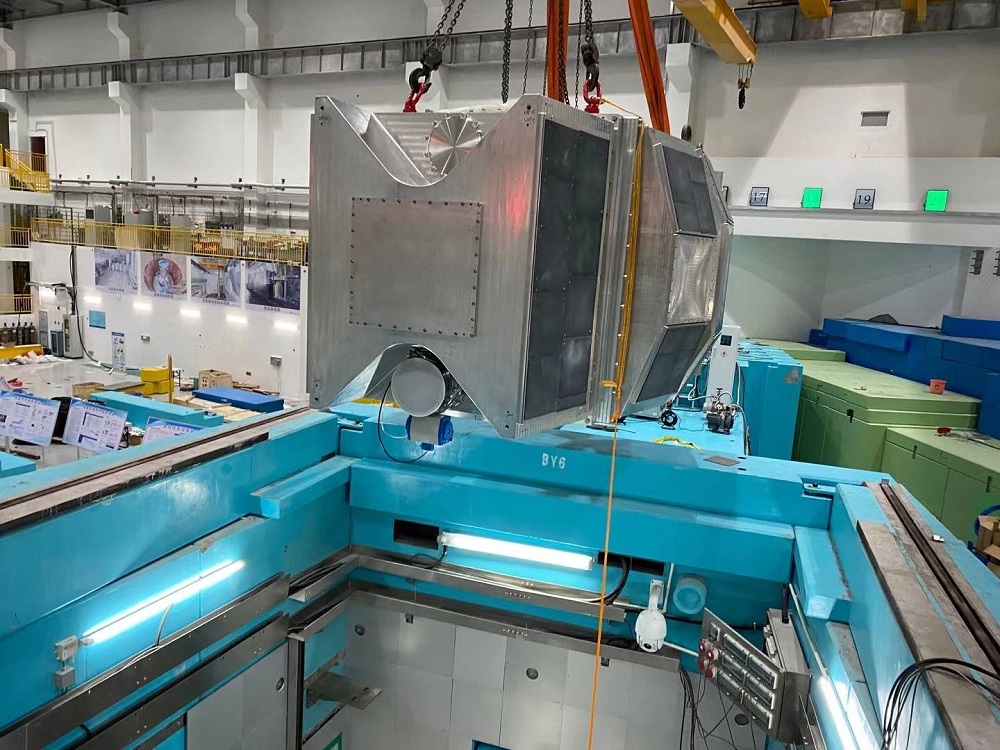
Therefore, he and his collaborators have supported the construction of a multiphysics instrument (a total scattering diffractometer) at the CSNS, with the support of the Collaborative Research Fund (CRF), in exchange for dedicated access to a suite of instruments there. “This will greatly enhance education and research activity in Hong Kong and encourage the rapid growth of a strong user community,” he said.
Promoting neutron-scattering research
Professor Wang and Professor Hesheng Chen, of the Institute of High Energy Physics of the Chinese Academy of Sciences (CAS), co-founded the Joint Laboratory on Neutron Scattering at CityU, with sponsorship from the CAS and the Croucher Foundation, to carry out a variety of cutting-edge research projects. Supported by Joint Laboratory Funding from the University Grants Committee, Professor Wang and his collaborators are developing an isotope labelling platform for functional materials, which will enable precise structure identification at the CSNS. The project aims to enhance the research infrastructure of Hong Kong laboratories, utilising the neutron source at CSNS to study structural and energy materials.
Previously, with the support of the Croucher Foundation, Professor Wang started the biennial Croucher Summer Course on Neutron Scattering. “I enjoy the interaction with young researchers from different backgrounds,” he said. “By boosting collaboration between the Hong Kong scientific community and the CSNS and nurturing more scientists to work in neutron scattering, we hope Hong Kong can benefit from the enhancement of this science and technology research.”
This research article originated from CityU RESEARCH.