
A research team comprising physicists from City University of Hong Kong (City U) and other universities has successfully achieved a physical phenomenon called “exceptional point” using a simple resonator system. The recent findings provide the foundation for developing ultrasensitive optical sensors in the future.
In real life, many systems have loss: signals get attenuated while propagating in an optical fiber; heat is generated when electric current flows in a conductor. In physics, they are referred to as non-Hermitian systems. One distinct feature of non-Hermitian systems is the emergence of “exceptional point”, when the mutual couplings between different parts of the system are balanced by their loss contrast. At the “exceptional point”, numerous counter-intuitive phenomena can happen, such as the loss-induced revival of lasing and unidirectional transport of light. Of particular interest is the nonlinear response of the system to external small perturbations. Compared with conventional systems, non-Hermitian systems at or near the exceptional points are demonstrated to be highly sensitive to external small perturbations, and the sensitivity enhancement is proportional to the order of the exceptional points.
Given this, high order exceptional points can potentially be applied to develop optical sensors with ultra-high sensitivity. However, they are usually very difficult to achieve, requiring simultaneous fine-tuning of many parameters in a system. The higher the order of the exceptional points, the more parameters need to be adjusted at the same time, thereby posing enormous challenges to their realization.
Teamed up with Professor Bo Hou from Soochow University and Professor Che-Ting Chan from the Hong Kong University of Science and Technology, Dr Shubo Wang, Assistant Professor of Department of Physics from CityU has recently proposed using a coupled resonator system with photonic spin-orbit interaction to achieve exceptional points of arbitrary order. This novel system enables exciting opportunities for the development of ultrasensitive optical sensors. The research findings are published in Natural Communications, titled "Arbitrary order exceptional point induced by photonic spin-orbit interaction in coupled resonators".
The proposed system can be used to realize arbitrary order exceptional points without fine-tuning of any parameters, and the key lies in the unidirectional coupling of the resonators induced by the spin-orbit interaction of light. With such a mechanism, the Hamiltonian, a quantity that describes the energy of a system, is in the form of a triangular matrix. Simple calculation demonstrates that all eigenvalues are identical, meaning that an exceptional point appears naturally. The research team carried out experiments to confirm that this mechanism can give rise to exceptional points. They not only explored the properties of exceptional points theoretically and experimentally, but also successfully identified the spin-dependent monotonic excitation phenomenon of the resonators. They also revealed the perturbation behaviour of an exceptional point of order 10, and demonstrated the enhancement of sensitivity to external perturbations.
“The importance of this research is twofold. Firstly, it proposes a novel physical mechanism to realise high order exceptional points, which can contribute to the future development of ultrasensitive optical sensors for detecting tiny particles or molecules. Secondly, it provides a simple and easy-to-implement resonator system which can be integrated into photonic chips for studying and exploring the physical properties of exceptional points,” said Dr Wang.

(a) Two spherical dipole resonators are coupled through a waveguide. The unidirectional coupling is induced by the spin-orbit interaction of the plasmon.
(b-k) The evolution of the electric dipole moments (p1 and p2) when the distance between the resonators changes. The distance changes by one wavelength from top to bottom. Throughout the process, p1 remains unchanged whereas p2 undergoes enhancement and attenuation due to interference.
(i) The evolution of coupling coefficient on the complex plane when the distance between the resonators changes.

(a) A model system consisting of five spherical resonators
(b) The electric dipole moments of the resonators at the exceptional point
(c) At the resonance frequency, the electric dipole moment exhibits a spin-dependent monotonic trend

Again, due to the exceptional point, the electric field in the waveguide gradually intensifies from left to right. As the electric field on the right end of the waveguide becomes very strong, any small external perturbation can lead to significant effect. This is why the system becomes highly sensitive.
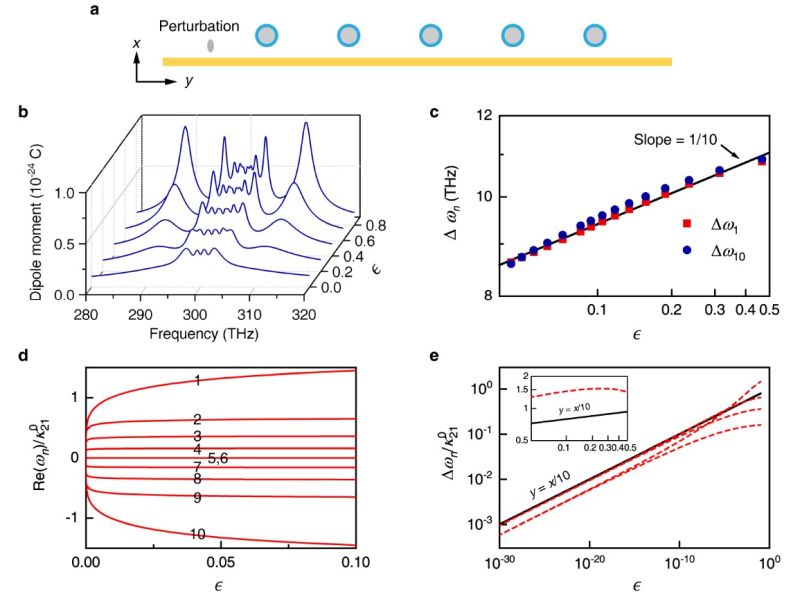
(a) Introduction of perturbation particle in the resonator system
(b) Perturbation leads to the splitting of dipole resonance peaks
(c) The spitting of resonance peaks and perturbations exhibits a linear relationship with a slope of 1/10 in the log–log scale
(d) Analytical results of resonance peak splitting
(e) Analytical results of the relationship between resonance peak splitting and perturbations

(a) Microwave experimental setup for realising and observing exceptional points
(b) The magnetic field magnitude of the magnetic dipoles changes with coupling distances
(c) The comparison between the experimental and analytical maximum/minimum in (b)
(d)The evolution of coupling coefficient on the complex plane when the distance between the resonators changes

DOI number: 10.1038/s41467-019-08826-6
This research article originated from CityU Research Stories.