Developing high-performance MXene electrodes for next-generation powerful battery
Two-dimensional MXene has been a rising star in the energy world as this material can store energy fast. But their unstable voltage output limits their applications. A collaborative research team led by scientists from City University of Hong Kong (CityU) has recently developed battery-like electrochemical Nb2CTx MXene electrodes with stable voltage output and high energy density by using a high-voltage scanning strategy. These latest findings may lead to a breakthrough in inventing the powerful battery of the next generation.
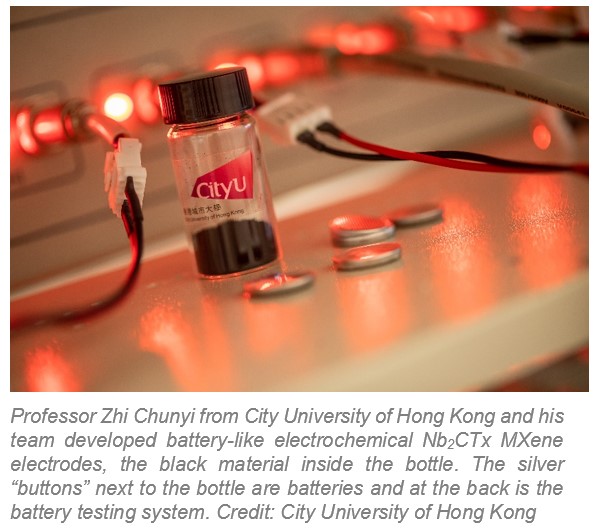
The research was jointly led by Professor Zhi Chunyi and Assistant Professor Dr Fan Jun from the Department of Materials Science and Engineering (MSE). Chair Professor Chen Furong from MSE also made a huge contribution to this research. The findings have been published in the scientific journal Joule, with the title of “Intrinsic voltage plateau of a Nb2CTx MXene cathode in an aqueous electrolyte induced by high-voltage-scanning”.
Rising star in the energy world
MXene is a large family of two-dimensional nanomaterials, and has been the research focus of 2D materials in the energy storage field in the past decade. Because of the excellent electronic conductivity and large surface area, MXene features fast surficial redox and demonstrates high-rate energy storage.
But the biggest challenge of MXene energy storage is that all reported MXene electrodes lack a distinct discharge voltage plateau, which means they discharge with a rapidly descending output voltage. This shortcoming deteriorates Mxene’s energy density and the stable energy output at desired high voltage regions, leading to limited energy density, usually less than 100 Wh kg-1.

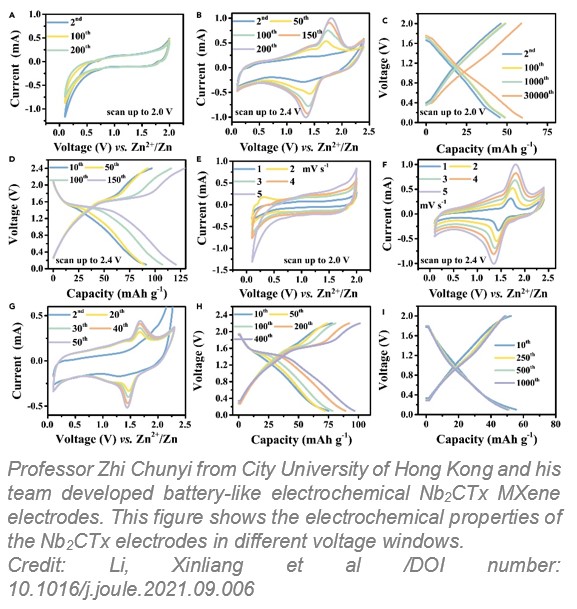
To overcome the problem of unstable energy output, the research team led by CityU successfully developed battery-type Nb2CTx MXene electrodes. The team revealed the completely different electrochemical properties of the Nb2CTx MXene electrode by regulating the voltage windows from 2.0V to 2.4V. Under a high-voltage scanning up to 2.4V, the Nb2CTx MXene electrode showed typical battery-type features, different from the one under low voltage and other previously reported MXene systems.
Superior properties shown when using high-voltage scanning strategy
They discovered that the Nb2CTx/Zn battery could exhibit superior rate capability, durable cyclic performance, and high energy density under high-voltage scanning. More importantly, they succeeded in equipping MXene with a flat and stable discharge plateau of 1.55V to boost their energy densities. A record-level energy density among all aqueous Mxene electrodes of 146.7 Wh kg-1 with 63% contribution from the plateau region was also obtained. It broke the performance bottleneck of MXene devices.

“The absence of distinct voltage plateaus deteriorates MXene electrodes’ capacities and energy densities which limit their potential as high-performance batteries. Our work successfully outlines an efficient route toward achieving high-energy-density MXene electrodes with distinct discharge voltage plateau through a high-voltage-scanning approach, which dramatically improves the electrochemical performance of MXene electrodes,” said Professor Zhi.
Professor Zhi believes that the findings will inspire more researchers to explore the unrevealed electrochemical properties of the MXene family. “Two-dimensional MXene, featured by fast surficial redox and high-rate energy storage, have outstanding energy storage performances. With the stable voltage output and greatly enhanced energy density, MXene-based energy storage devices are one step closer to the goal of practical application,” he said.

The corresponding authors of the paper are Professor Zhi and Dr Fan Jun. The first author is Dr Li Xinliang, a PhD graduate from MSE. Other co-authors include Professor Chen Furong from MSE, and 16 other researchers from 7 universities and research institutes. This research was supported by the National Key R&D Program of China.