
Way Kuo
Distinguished Lecture Series
Distinguished Lecture Series
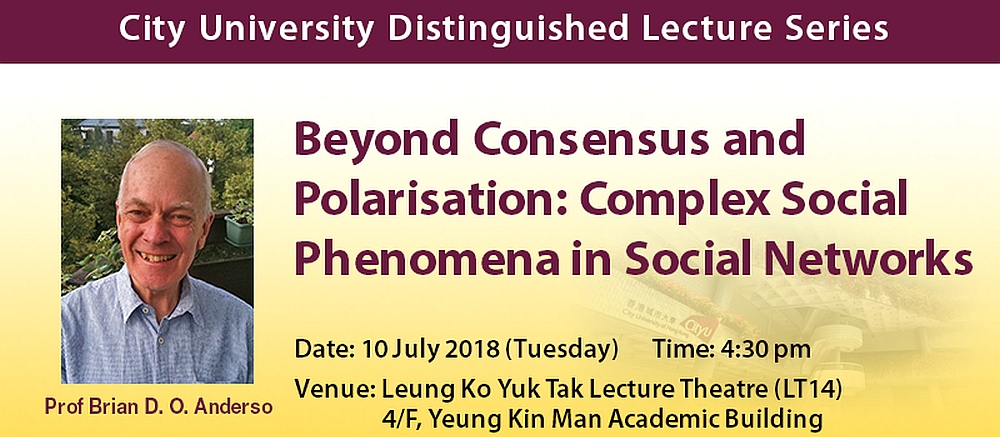
Date: |
10 July 2018 |
|---|---|
| Speaker: | Prof. Brian D. O. Anderson |
Social network analysis is a rich and exciting area of interdisciplinary research that has been tackled by many different scientific communities. Much research draws on ideas of control and systems theory to infer how the opinions of a group of interacting individuals evolve, and to explain the resulting behaviour, often observed in experiments of sociologists, psychologists and the like, in terms of system dynamics concepts.
This lecture will survey several distinct recent developments of this character. We shall present an opinion dynamics model which describes how an individual’s private and expressed opinions (which are not the same in general) evolve under pressure to conform to the majority opinion. In another direction we shall present new results on the recently proposed DeGroot-Friedkin model, which describes how an individual’s self-confidence (termed social power) in his/her own opinion evolves over discussion of a sequence of topics. One key finding is that every individual forgets his/her perceived (i.e. initial) social power exponentially fast, even when the network topology is dynamic. Lastly, we shall describe the opinion dynamics of interacting individuals holding multiple and logically dependent opinions on a number of issues.
Professor Brian D. O. Anderson was born in Sydney, Australia, and educated at Sydney University in mathematics and electrical engineering, with PhD in electrical engineering from Stanford University. Following graduation, he joined the faculty at Stanford University and worked as Vidar Corporation of Mountain View, California. He then returned to Australia to become a department chair in electrical engineering at the University of Newcastle. From there, he moved to the Australian National University (ANU) in 1982, as the first engineering professor at that university. He became an emeritus Professor at ANU in July 2016 and Distinguished Professor at Hangzhou Dianzi University, China, and a Distinguished Researcher in Data61 CSIRO (previously NICTA, National ICT Australia). During his period in academia, he spent significant time working for the Australian Government, with this service including membership of the Prime Minister’s Science Council under the chairmanship of three prime ministers, and he was the inaugural President of NICTA. He also served on advisory boards or boards of various companies, including the board of the world’s major supplier of cochlear implants, Cochlear Corporation, where he was a director for ten years. He has won many awards and medals, and is a Fellow of the Australian Academy of Science, Australian Academy of Technological Sciences and Engineering, Royal Society (London), and a foreign member of the US National Academy of Engineering. He holds honorary doctorates from a number of universities, including Université Catholique de Louvain, Belgium, and ETH, Zürich. He served as IFAC President from 1990 to 1993, and was also President of the Australian Academy of Science from 1998 to 2002. His current research interests are in distributed and networked control and econometric modelling.

presented by
Office of the Vice-President (Research)