
Way Kuo
Distinguished Lecture Series
Distinguished Lecture Series
Date: |
13 November 2017 |
|---|---|
| Speaker: | Prof. Harvey F. Lodish |
Many acute and chronic anemias are not treatable with erythropoietin (Epo) because the terminal erythroid progenitors (colony-forming units erythroid; CFU-Es) that respond to Epo are too few in number to maintain sufficient red blood cell production. Treatment of these anemias requires a drug that acts at an earlier stage of red cell formation and enhances the formation of the Epo-sensitive CFU-E progenitors.
Self-renewal divisions are a fundamental property of stem cells and many types of progenitor cells, but the underlying molecular mechanisms regulating this type of cell division are not known. Several years ago we showed that glucocorticoids specifically stimulate self-renewal of the earlier erythroid progenitor, the burst-forming unit erythroid (BFU-E), and over time increase the production of CFU-Es and subsequently terminally differentiated red cells. Glucocorticoids have been used to treat Epo-resistant anemia but severe side effects limit their use.
Recently we demonstrated that activation of the peroxisome proliferator-activated receptor alpha (PPARα) by clinically tested PPARα agonists, used for dyslipidemia, synergizes with the glucocorticoid receptor to promote BFU-E self-renewal. Over time these agonists synergize to greatly increase production of both human and mouse red blood cells. In BFU-E progenitors PPARα co-occupies many chromatin sites with the glucocorticoid receptor and stimulates transcription of an overlapping set of genes, including at least one RNA-binding protein, that are essential for self-renewal divisions. Our discovery of the role of PPARα agonists in stimulating self-renewal of early erythroid progenitor cells suggests that the clinically tested PPARα agonists we used may improve the efficacy of corticosteroids in treating Epo resistant anemias.
“Early” BFU-E cells forming large BFU-E colonies presumably have higher capacities for self-renewal than do those forming small BFU-E colonies. In order to understand the mechanism underlying this heterogeneity, we conducted single cell transcriptome analysis on BFU-E cells purified from mouse embryos and cultured in vitro. Our analyses showed that there are two principal subgroups of mouse BFU-E cells and that expression of the Type III TGFβ receptor (TGFβ RIII) is markedly elevated in “late” relative to “early” BFU-Es. Expression of TGFβ RIII is correlated with that of GATA1, a gene encoding an erythroid transcription factor induced during the BFU-E to CFU-E transition. Both mouse and human BFU-E sub populations (TGFBR310%lo) expressing the 10% lowest amount of surface TGFβ RIII are indeed enriched for early BFU-Es, and are significantly more responsive to glucocorticoid stimulation, which promotes BFU-E self-renewal, as compared to the total BFU-E population. The TGFBR310%lo BFU-E subpopulation presumably represents earlier BFU-Es with maximal capacity for self-renewal. Consistent with this notion, signaling by the TGFβ receptor kinases RI and RII increases during the transition from early (TGFBR310%low) to late (TGFBR310%hi) BFU-Es and then decreases in CFU-E cells. Blocking TGFβ signaling by receptor kinase inhibitors currently in the clinic increases TGFBR310%lo BFU-E cell self-renewal and increases total erythroblast production, suggesting the use of this type of drug as well in treating EPO unresponsive anemias.
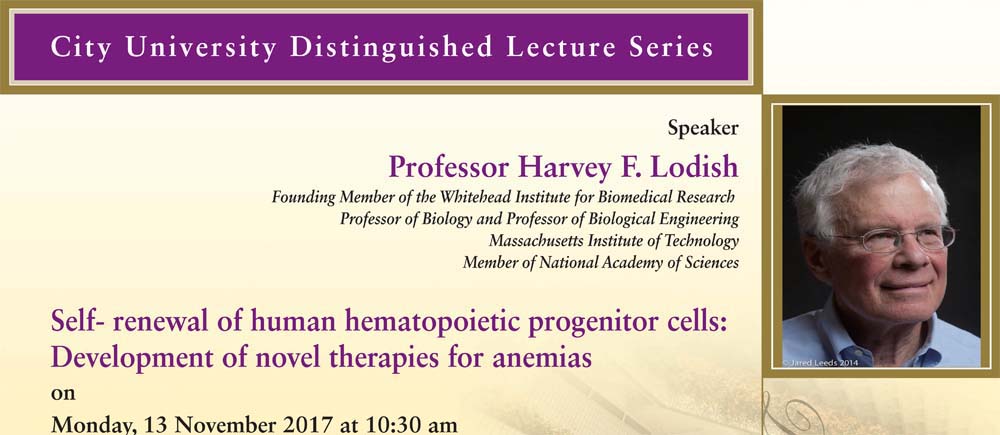
Professor Harvey F. Lodish is a Founding Member of the Whitehead Institute for Biomedical Research and Professor of Biology and Professor of Biological Engineering at the Massachusetts Institute of Technology.
He is a Member of the National Academy of Sciences and a Fellow of the American Academy of Arts and Sciences. Professor Lodish is a member of the Board of Trustees of Boston Children’s Hospital, where he is Chair of the Board of Trustees Research Committee. From 2008 to 2016 he was the Founding Chair of the Scientific Advisory Board of the Massachusetts Life Sciences Center, the group charged with oversight of the state’s 10- year $1 billion investment in the life sciences. He was a founder and scientific advisory board member of several companies including Genzyme, Inc., and Millennium Pharmaceuticals, Inc., and has served on the scientific advisory boards of numerous biopharmaceutical companies.
Professor Lodish is the lead author of the textbook Molecular Cell Biology. The eighth edition was published in April 2016; the book has been translated into 12 languages. During 2004 he served as President of the American Society for Cell Biology.

presented by
Office of the Vice-President (Research)