
Way Kuo
Distinguished Lecture Series
Distinguished Lecture Series
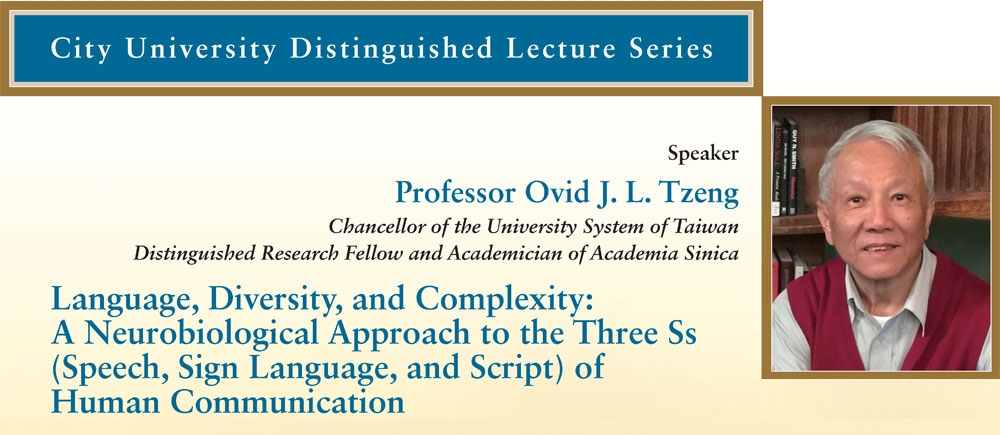
| Date: | 5 May 2016 |
|---|---|
| Speaker: | Prof. Ovid J. L. Tzeng |
Language is an immensely complex system which is at the foundation of human behavior, both individually, and collectively—as members of societies. Over the long course over which language has evolved, we now have a much richer knowledge of history & prehistory, structure & typology, vertical & horizontal transmission, etc. As we probe deeply into the ancestry of people, the situation becomes ever more complex. New fossils are discovered at far- away places, as new and powerful methods become available for inferring the past from an ever enlarging data-base. Advances in epigenetics and in analyzing ancient DNA promise to yield much new knowledge on the ancestry of peoples, including their cognitive capacities and social behaviors. Such knowledge is essential for understanding how and when language emerged
A neurobiological account of human complexity is to understand how these skills lit together to interact with culture and literacy and create human diversity. Language is a mosaic constructed based upon many cognitive, memorial, and sensorimotor skills. All these skills are supported by the human brain, the most complex organ in the known universe. Of particular significance are the recent explorations into the brain using brain imaging technology, to investigate human cognition toward understanding how the brain enables all the intricacies of language (speech and sign languages) and other cognitive behaviors, such as reading, which involves successful mapping between visual forms and speech sounds of the language that they represent. Our research team and other associated researchers across different countries examine whether reading/speech convergence in skilled adult readers depends on the properties of the writing system. Corresponding fMRI experiments were carried out in native speakers of Spanish, English, Hebrew, and Mandarin Chinese, which vary in orthographic depth: the ambiguity of the mapping from spelling to phonology. This mapping is largely unambiguous in Spanish and highly ambiguous in Chinese, with English and Hebrew falling in between. I will discuss the cross-language neuro-imaging results and give a theoretical account for how reading-speech convergence in certain regions of interest (e.g., LH superior temporal gyrus) is modulated by orthographic depth.
In conclusion, we will present a multi-method/multi-variable approach to investigate language evolution and its impact on the developments of human mind at different levels of complexity with respect to the conceptual bases of the so-called five Os: info, cogno, techno, bio, and geno. We believe that a neuro-biological view of language processing is to understand how all the knowledge gained from different research disciplines fit together to form one coherent account of the life and growth of the most precious possession of our species – our language, on which our civilization evolved and is evolving.

presented by
Office of the Vice-President (Research)