
Way Kuo
Distinguished Lecture Series
Distinguished Lecture Series
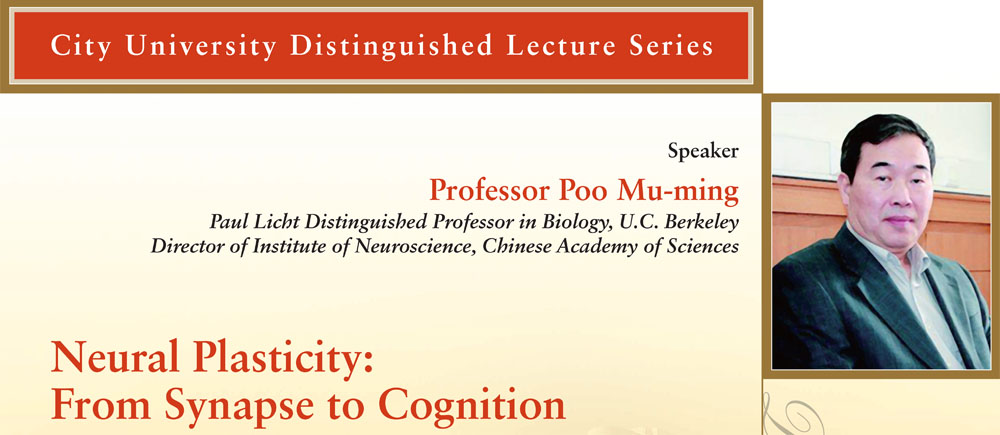
| Date: | 13 April 2015 |
|---|---|
| Speaker: | Prof. Poo Mu-ming |
The cognitive functions of the brain, such as learning and memory, depend on the ability of neural circuits to change their properties of signal processing in response to prior use. Many of these use-dependent changes (“plasticity”) occur at synapses where signals are transmitted between neurons. Depending on the pattern of neuronal activities, repetitive synaptic transmission could cause long-term potentiation (LTP) or long-term depression (LTD) of the synapse in its efficacy for future transmission. I will summarize our studies on how the timing of neuronal activities (spikes) in the pre- and post-synaptic neurons determines whether a synapse undergoes LTP or LTD, a phenomenon known as “Spike Timing-Dependent Plasticity” (STDP), and how STDP may provide the mechanism for coding and storing the information on the temporal sequence and interval of sensory signals, two key elements of episodic memories. I will also discuss in general the idea that neural plasticity is the main factor that shapes the development of neural circuits, and that neural plasticity offers the potential for functional recovery from injuries and diseases of the adult brain. Finally, to argue that higher cognitive functions in humans such self-awareness may originate from experience-dependent neural plasticity, I will present our recent finding showing that mirror self-recognition, a cognitive function known to be limited only to humans and great apes, could be acquired by rhesus monkeys following training of visual-somatosensory association.
Professor Poo Mu-ming received B.S. in physics in 1970 from the Tsinghua University (Taiwan) and his Ph.D in biophysics from Johns Hopkins University in 1974. After postdoctoral research at Purdue University, he had served on the faculty of University of California at Irvine, Yale University, Columbia University, and University of California at San Diego, before joining University of California, Berkeley in 2000, where he has served as the Head of Division of Neurobiology in the Department of Molecular and Cell Biology. He is currently Paul Licht Distinguished Professor in Biology at U.C. Berkeley. Since 1999, he also served as the Director of Institute of Neuroscience, Chinese Academy of Sciences in Shanghai. Professor Poo had received Ameritec Prize (2001), Docteur Honoris Causa from Ecole Normale Supérieure, Paris (2003) and Hong Kong University of Science and Technology (2014), China International Science & Technology Cooperation Award (2005), and Qiushi Distinguished Scientist Award (2011). He is a member of Academia Sinica (Taiwan) and National Academy of Sciences (USA), and a foreign member of Chinese Academy of Sciences. His research interests include nerve growth, synapse development and plasticity, and activity-induced neural circuit modification.

presented by
Office of the Vice-President (Research)