Reviewed by Lexie CornerJul 23 2024
Researchers from the City University of Hong Kong created a novel living passivator that can significantly increase the stability and efficiency of perovskite solar cells, marking a significant advancement in solar energy technology. The research was published in the journal Nature.
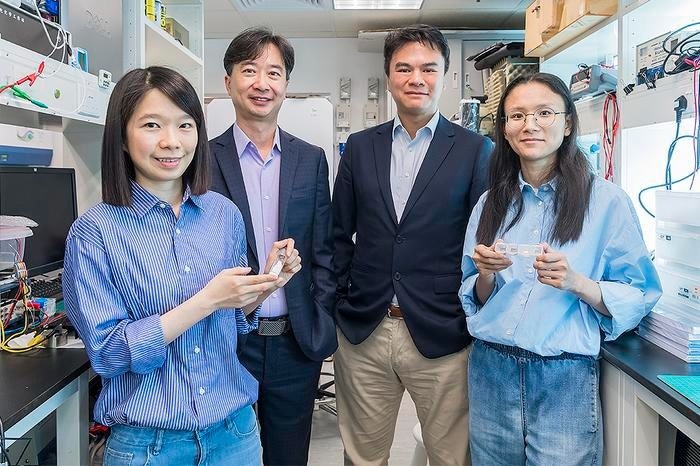 The groundbreaking living passivator developed by Dr. Wang (from left), Professor Feng, Professor Yip, and Dr. Zhou, another first author of the paper, significantly improves the performance and durability of perovskite solar cells. Image Credit: City University of Hong Kong
This recently created passivator is a kind of corrosion inhibitor that noticeably modifies a metal's potential. By utilizing dynamic covalent bonds that become active when exposed to heat and moisture, the CityUHK technology can adapt to changing environmental conditions and create new passivation.
This creative method allows perovskite solar cells to be maintained and repaired in real time. The coating is a viable solution for next-generation perovskite photovoltaics because it resembles sustained-release capsules in medications that continuously release ingredients to cure flaws produced by external stressors like water and heat.
Professor Feng Shien-ping, Professor in the Department of Systems Engineering and Associate Dean of the College of Engineering at CityUHK, led the project in collaboration with Professor Henry J. Snaith at the University of Oxford and Professor Angus Yip Hin-lap, Associate Director of the Hong Kong Institute for Clean Energy at CityUHK.
Perovskite solar cells are a serious contender for the next generation of solar panels because of their remarkable capacity to convert sunlight into power. However, concerns regarding their operating stability and long-term storage remain.
Several passivation techniques have been developed to increase their performance and reliability; however, because they are set in place after manufacture, it is difficult to resolve new flaws that arise over time during operation due to exposure to heat and water.
In response, a team led by CityUHK has discovered via intensive experimentation that the passivator greatly enhances the longevity and performance of perovskite solar cells. It has proven possible to record photovoltaic conversion efficiency of more than 25% and retain operational stability under humid and high-temperature circumstances for over 1,000 hours.
Applying a living passivator on the perovskite surfaces enhances their resistance to environmental factors like moisture and heat. This improves the stability of perovskite solar cells in hot and humid conditions, introducing a dynamic, responsive approach to environmental stressors.
Dr. Wang Weiting, Study First Author, Department of Systems Engineering, City University of Hong Kong
Weiting is also a research associate on Professor Feng's team.
Professor Feng noted that while plants and other living beings can withstand varying weather conditions, perovskite solar cells can deteriorate within months.
The key difference lies in the ability of living organisms to regenerate and heal evolving defects. By incorporating a passivation mechanism that dynamically heals during operation, we can potentially unlock this regenerative concept for perovskite or other electronic devices.
Dr. Shien-Ping Feng, Professor, Department of Systems Engineering, City University of Hong Kong
The team led by CityUHK is working with industry partners to apply this technique to ionic migration and instability in perovskite solar cells during the production and operating stages.
The team also notes that this approach may find utility in other applications, such as anti-oxidation and interfacial contact engineering in microelectronic devices, and believes that improving the stability and dependability of these solar cells could help them become more commercially feasible.
Co-authors include Professor Feng and Professor Henry J. Snaith.
Journal Reference:
Wang, W.-T., et al. (2024) Water- and heat-activated dynamic passivation for perovskite photovoltaics. Nature. doi.org/10.1038/s41586-024-07705-5.