波音游戏源码-波音博彩公司评级_百家乐园天将_新全讯网3344111.c(中国)·官方网站

Materials

Ultra-white ceramic cools buildings with record-high 99.6% reflectivity

Ultra-white ceramic cools buildings with record-high 99.6% reflectivity
A prototype of the new cooling ceramic material on a rooftop
View 2 Images
A prototype of the new cooling ceramic material on a rooftop
1/2
A prototype of the new cooling ceramic material on a rooftop
Samples of the cooling ceramic material, which reflect a record high of 99.6% of sunlight that hits them, cooling interiors of buildings
2/2
Samples of the cooling ceramic material, which reflect a record high of 99.6% of sunlight that hits them, cooling interiors of buildings

Scientists in Hong Kong have demonstrated a new ultra-white ceramic material that can drastically cool buildings by reflecting sunlight and heat at record highs. The beetle-inspired material gets its ability from its nanostructure, stays tough to the elements and should be relatively easy to scale up for production.

When our homes get too hot, the first solution for many people is to crank the air conditioning. It may be effective, but it’s not very energy efficient, as heating and cooling buildings accounts for a huge percentage of energy costs. So, scientists are investigating ways to passively manage interior temperatures, and one of the simplest is to just paint buildings and rooftops white.

Basic physics dictates that lighter colors absorb less light than darker ones, and therefore remain cooler. In recent years new ultra-white paints have been developed that reflect over 95% of the sunlight that hits them, doing a decent job of cooling buildings. But these coatings have their issues, including durability.

For the new study, scientists at City University of Hong Kong (CityU) developed a new cooling ceramic material that performs better than others. Rather than just being a very white paint, the material gets its high reflectivity from its nanostructure, which efficiently scatters almost the entire spectrum of sunlight – just like the Cyphochilus beetle which inspired it. This results in a solar reflectivity of 99.6%, which is a record high, along with an infrared thermal emission of 96.5%.
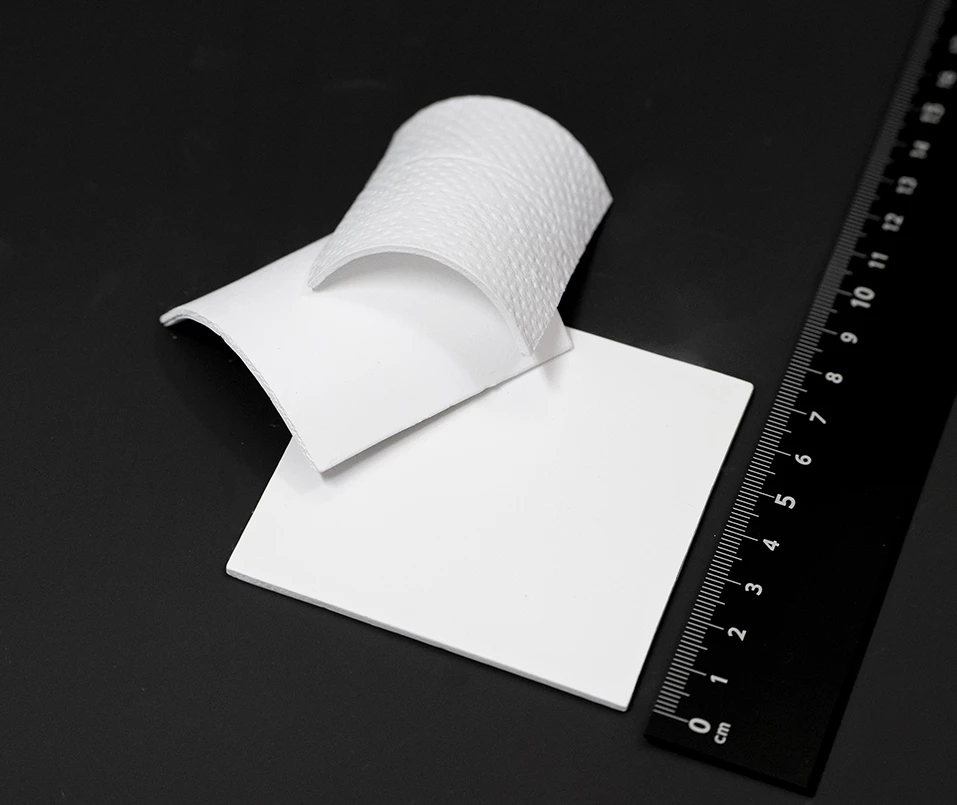
Samples of the cooling ceramic material, which reflect a record high of 99.6% of sunlight that hits them, cooling interiors of buildings

The material is made of alumina, which not only reduces solar absorption, but the team says it makes the cooling ceramic more durable in the face of weather. It resists degradation from UV light exposure, which is a weakness of other passive cooling materials and coatings, and boosts the rate of water evaporation from the surface, which adds the bonus effect of evaporative cooling. It even boasts fire resistance by withstanding temperatures of over 1,000 °C (1,832 °F).

““The beauty of the cooling ceramic is that it fulfills the requirements for both high-performance PRC and applications in real-life settings,” said Professor Edwin Tso Chi-yan, co-corresponding author of the study. “Our experiment found that applying the cooling ceramic on a house roof can achieve more than 20% electricity [reduction] for space cooling, which confirms the great potential of cooling ceramic in reducing people’s reliance on traditional active cooling strategies and provides a sustainable solution for avoiding electricity grid overload, greenhouse gas emissions and urban heat islands.”

Finally, the researchers also say that the material can be easily mass produced, using common materials like alumina and a two-step process of phase inversion and sintering. And if white is too boring for some houses, the material can apparently be produced in other colors and patterns by adding extra layers.

The research was published in the journal Science.

Source: City University of Hong Kong

8 comments
8 comments
TechGazer
White being "too boring" is just a cultural artifact. You need to have some influencer make white roofs popular, and dark roofs something to be ashamed of.
I don't understand how the material can be produced in other colours and maintain its high efficiency. Colours other than white means that the material is absorbing the other wavelengths, unless it's somehow reflecting it in a direction away from the viewer.
DaveWesely
You are correct, TechGazer. The color white is a reflection of the entire color spectrum. The pure color red, for example, is the reflection of the red portion and the absorption of the green and blue wavelengths. By absorbing just a little bit of blue, the color reflected would look a little yellow (the opposite of blue). It's really a matter of color density. The lighter the color, the more light is reflected.
Don Soards
The reflected heat would be an energy benefit during the summer, but wouldn't the reflected heat be an energy liability during the winter?
Trylon
Wasting perfectly good energy. I'd rather have a system that splits the solar spectrum, directing useful frequencies toward solar cells and less useful ones toward blackened absorption pipes to heat water. Why give up perfectly good heat when we need hot water in buildings anyway?
windykites
You could have white roller blinds on the roof. I agree with Trylon. Pipe the hot water into an insulated tank in the house for later use.
TechGazer
To Don Soards: roofs generally have good insulation below them, so a black roof in winter isn't going to warm the building interior much. Really good ventilation would reduce heat gain in summer, but most houses don't have good enough ventilation. Maybe if roofs had another layer, providing a (large) ventilation channel between the roof and the insulation, roof colour wouldn't be much of a issue. I have an arch-frame cabin with only 4" of insulation between the roof and the inner wall, and no ventilation space, so switching from brown asphalt shingles to white metal made a huge difference in indoor temperature in summer.
Niclas
Very interesting in hot and sunny areas, though:
- Does it need frequent cleaning to remain efficient? Though I suppose also solar panels ned some cleaning.
- Whats the cost and durability compared to solar panels + AC per cooling effect? Considering electricity is for free on sunny days when it’s needed.
- Would it also increase isolation inside in houses, heat storage, … or is it not efficient on relatively low temp IR?
ReservoirPup
You would have to pay for this, while PV would pay for itself or even earn $$$
姚记百家乐的玩法技巧和规则 | 澳门网上赌场| 全讯网334466| 百家乐官网翻天qvod粤语| 百家乐2棋牌作弊软件| 网上百家乐官网如何作假| 蓝盾百家乐庄家利润分| 百家乐官网金海岸软件| 老虎机规律| 百家乐官网有试玩的吗| 德州扑克单机| 带有百家乐的棋牌游戏有哪些| 威尼斯人娱乐城送38| 单耳房做生意的风水| 大发888金皇冠娱乐城| 百家乐官网规律打| 万山特区| 申请百家乐会员送彩金| 博天堂百家乐官网官网| 网上真钱赌博| 百家乐群详解包杀| 百家乐评级导航| 百家乐官网游戏真钱游戏| 德州扑克中文版| 网络百家乐真人游戏| A8百家乐官网娱乐网| 太阳城棋牌| 百家乐博弈之赢者理论| 百家乐扑克玩法| 百家乐官网关键词| 明升投注网 | 大发888充钱| 网络百家乐的信誉| 百家乐官网蔬菜配送公司| 百家乐官网怎么样玩| 六合彩生肖| 爱赢百家乐的玩法技巧和规则 | 百家乐官网怎么玩能赢钱| 六合彩开奖| 大发888官方 hdlsj| 大发888娱乐城 建账号|