Cheap and efficient catalyst could boost renewable energy storage
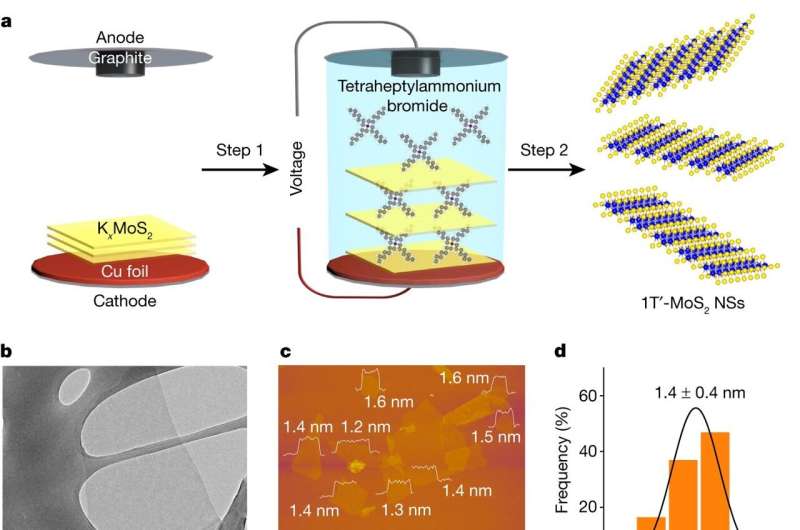
Storing renewable energy as hydrogen could soon become much easier thanks to a new catalyst based on single atoms of platinum. The new catalyst, designed by researchers at City University Hong Kong (CityU) and tested by colleagues at Imperial College London, could be cheaply scaled up for mass use.
Co-author Professor Anthony Kucernak, from the Department of Chemistry at Imperial, said, "The UK Hydrogen Strategy sets out an ambition to reach 10GW of low-carbon hydrogen production capacity by 2030. To facilitate that goal, we need to ramp up the production of cheap, easy-to-produce and efficient hydrogen storage. The new electrocatalyst could be a major contributor to this, ultimately helping the U.K. meet its net-zero goals by 2050."
Renewable energy generation, from sources like wind and solar, is rapidly growing. However, some of the energy generated needs to be stored for when weather conditions are unfavorable for wind and sun. One promising way to do this is to save the energy in the form of hydrogen, which can be stored and transported for later use.
To do this, the renewable energy is used to split water molecules into hydrogen and oxygen, with the energy stored in the hydrogen atoms. This uses platinum catalysts to spur a reaction that splits the water molecule, which is called electrolysis. However, although platinum is an excellent catalyst for this reaction, it is expensive and rare, so minimizing its use is important to reduce system cost and limit platinum extraction.
Now, in a study published Sept. 13 in Nature, the team have designed and tested a catalyst that uses as little platinum as possible to produce an efficient but cost-effective platform for water splitting.
Lead researcher Professor Zhang Hua, from CityU, said, "Hydrogen generated by electrocatalytic water splitting is regarded as one of the most promising clean energies for replacing fossil fuels in the near future, reducing environmental pollution and the greenhouse effect."
Testing tools
The team's innovation involves dispersing single atoms of platinum in a sheet of molybdenum sulfide (MoS2). This uses much less platinum than existing catalysts and even boosts the performance, as the platinum interacts with the molybdenum to improve the efficiency of the reaction.
Growing the thin catalysts on nanosheet supports allowed the CityU team to create high-purity materials. These were then characterized in Professor Kucernak's lab at Imperial, which has developed methods and models for determining how the catalyst operates.
The Imperial team has the tools for stringent testing because they have developed several technologies that are designed to make use of such catalysts. Professor Kucernak and colleagues have set up several companies based on these technologies, including RFC Power that specializes in hydrogen flow batteries, which could be improved by using the new single-atom platinum catalysts.
Using hydrogen
Once renewable energy is stored as hydrogen, to use it as electricity again it needs to be converted using fuel cells, which produce water vapor as a by-product of an oxygen-splitting reaction. Recently, Professor Kucernak and colleagues revealed a single-atom catalyst for this reaction that is based on iron, instead of platinum, which will also reduce the cost of this technology.
Bramble Energy, another spinout led by Professor Kucernak, will test this technology in their fuel cells. Both single-atoms catalysts—one helping turn renewable energy into hydrogen storage, and the other helping that energy be released as electricity later—therefore have the power to bring a hydrogen economy closer to reality.
More information: Zhenyu Shi et al, Phase-dependent growth of Pt on MoS2 for highly efficient H2 evolution, Nature (2023). DOI: 10.1038/s41586-023-06339-3


 百家乐游戏卡通|
兄弟百家乐的玩法技巧和规则|
盛大百家乐官网的玩法技巧和规则|
马德里百家乐的玩法技巧和规则|
太阳城百家乐官网看牌|
中华百家乐的玩法技巧和规则|
百家乐官网真人百家乐官网皇冠开户|
百家乐官网赢钱|
赌博百家乐的乐趣|
bet365体育在线投注|
墨尔本百家乐官网的玩法技巧和规则|
大发888网址是多少|
澳门百家乐官网职业|
湄潭太阳城房价|
吕百家乐官网赢钱律|
卡迪拉娱乐城开户|
百家乐赌场大赢家|
百家乐官网单机游戏下|
大发888游戏下载中心|
有24天星名的罗盘|
网上百家乐官网博彩正网|
大发888娱乐城送白菜|
澳门百家乐公司|
百家乐官网赌博公司|
百家乐官网增值公式|
顶级赌场网址|
百家乐网上投注作弊|
荔波县|
权威百家乐信誉网站|
澳门百家乐官网是怎样赌|
博彩通排名|
太阳城线上娱乐城|
太阳城百家乐手机投注|
首席百家乐官网的玩法技巧和规则
|
现场百家乐官网玩法|
天猫国际娱乐城|
大发888扑克下载|
百家乐tt娱乐网|
百家乐最好的平台是哪个|
罗盘24山图是什么|
百家乐官网庄家怎样赚钱|
百家乐游戏卡通|
兄弟百家乐的玩法技巧和规则|
盛大百家乐官网的玩法技巧和规则|
马德里百家乐的玩法技巧和规则|
太阳城百家乐官网看牌|
中华百家乐的玩法技巧和规则|
百家乐官网真人百家乐官网皇冠开户|
百家乐官网赢钱|
赌博百家乐的乐趣|
bet365体育在线投注|
墨尔本百家乐官网的玩法技巧和规则|
大发888网址是多少|
澳门百家乐官网职业|
湄潭太阳城房价|
吕百家乐官网赢钱律|
卡迪拉娱乐城开户|
百家乐赌场大赢家|
百家乐官网单机游戏下|
大发888游戏下载中心|
有24天星名的罗盘|
网上百家乐官网博彩正网|
大发888娱乐城送白菜|
澳门百家乐公司|
百家乐官网赌博公司|
百家乐官网增值公式|
顶级赌场网址|
百家乐网上投注作弊|
荔波县|
权威百家乐信誉网站|
澳门百家乐官网是怎样赌|
博彩通排名|
太阳城线上娱乐城|
太阳城百家乐手机投注|
首席百家乐官网的玩法技巧和规则
|
现场百家乐官网玩法|
天猫国际娱乐城|
大发888扑克下载|
百家乐tt娱乐网|
百家乐最好的平台是哪个|
罗盘24山图是什么|
百家乐官网庄家怎样赚钱|