A research team led by the City University of Hong Kong (CityU) has made a big breakthrough in nanomaterials research by successfully constructing a highly efficient electrocatalyst that can significantly boost hydrogen production through electrochemical water splitting.
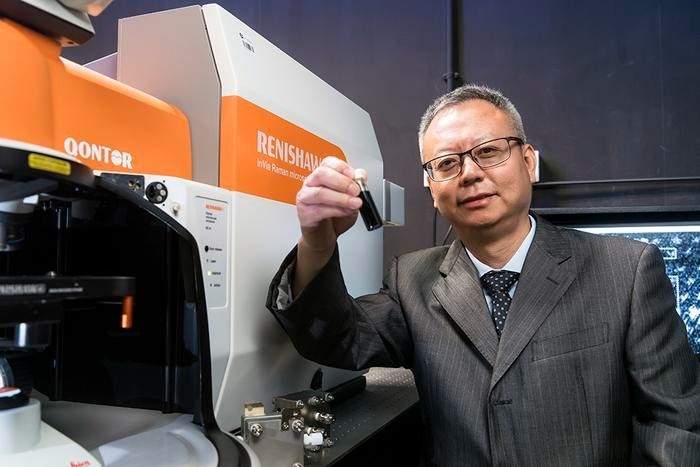 Professor Zhang Hua, Herman Hu Chair Professor of Nanomaterials at CityU, and his team recently developed a highly efficient electrocatalyst which can enhance the generation of hydrogen significantly through electrochemical water splitting. Image Credit: City University of Hong Kong
This significant invention has enormous application possibilities in the renewable energy industry.
Professor Zhang Hua, the Herman Hu Chair Professor of Nanomaterials at CityU, and his colleagues created an electrocatalyst employing transition-metal dichalcogenide (TMD) nanosheets with unusual crystal phases as supports. In the electrocatalytic hydrogen evolution process in acidic conditions, the electrocatalyst showed high activity and good stability.
Our research finding is significant in the sense that the hydrogen generated by electrochemical water splitting is regarded as one of the most promising clean energies to replace fossil fuels in the near future, reducing environmental pollution and the greenhouse effect.
Zhang Hua, Herman Hu Chair Professor, Nanomaterials, City University of Hong Kong
The study entitled “Phase-dependent growth of Pt on MoS2 for highly efficient H2 evolution” was published in the journal Nature.
Professor Zhang believes developing extremely effective and stable catalysts is the key to electrocatalytic water-splitting research. It is critical to select appropriate support to optimize the activity and stability of catalysts during the process.
TMD nanosheets have piqued the curiosity of researchers as an emerging two-dimensional (2D) material due to their unusual physical and chemical features. It has been discovered that phase is a crucial component in determining the characteristics and functionalities of TMD nanosheets.
Molybdenum disulfide (MoS2) with the standard 2H phase, for example, has a semiconductor property, but MoS2 with the atypical 1T or 1T’ phase has a metallic or semi-metallic property, and so has strong conductivity.
However, producing unconventional-phase TMD nanosheets with high phase purity and quality remains difficult, and research into the influence of the TMD crystal phase on the development of other materials is still in its early stages.
Professor Zhang’s research group has successfully generated a variety of high-phase-purity and high-quality TMD crystal materials with unconventional 1T′ phase using novel techniques such as solid-gas reactions and salt-assisted synthesis. These nanomaterials have a high potential for use in optoelectronic devices, catalysis, energy storage, and superconductivity due to their unique semi-metallic characteristics.
The researchers successfully created a new method for manufacturing TMD nanosheets with unusual phases in this study. They also looked at the crystal phase dependence of noble metal development on 1T′-TMD and 2H-TMD nanosheets.
They discovered that employing the traditional 2H-TMD template allows for the epitaxial development of platinum (Pt) nanoparticles, whereas the unorthodox 1T′-TMD template allows for creating single-atomically scattered Pt atoms (s-Pt). Based on these results, the researchers created a catalyst with single-atomically scattered Pt atoms/1T′ phase molybdenum disulfide (s-Pt/1T′-MoS2).
The researchers used an improved floating electrode technique for testing to get beyond the mass transport constraint of Pt-based catalysts in electrocatalytic hydrogen evolution processes in acid media.
The s-Pt/1T′-MoS2 catalyst was discovered to have a high mass activity of 85±23 A mgPt–1 at an overpotential of –50 mV and a mass-normalized exchange current density of (127 A mgPt–1) by means of their experimental findings. Additionally, the catalyst has great application potential by operating steadily for 500 hours in a proton exchange membrane water electrolyzer.
The researchers showed that 1T′-TMD nanosheets can be effective supports for catalysts by methodically examining the phase-dependent development of noble metals on 1T′-TMD and 2H-TMD nanosheets.
The synthesized new electrocatalyst exhibits superior activity and excellent stability in electrocatalytic hydrogen evolution reaction in acidic media, and it will play an extremely important role in the development of clean energy in the future.
Dr. Shi Zhenyu, Study First Author and Postdoctoral Researcher, Department of Chemistry, City University of Hong Kong
The study has broadened the definition of “Phase Engineering of Nanomaterials” (PEN), opening up fresh possibilities for the creation and synthesis of extremely effective catalysts. According to Professor Zhang, the group will carry out more research on the 1T′-TMD-based catalyst and its potential for commercial use in the future to support sustainable development and clean energy.
Professor Zhang and Professor Anthony R. J. Kucernak from the Department of Chemistry at Imperial College London are the corresponding authors. This study initiative demonstrated the value of international cooperation in creating scientific discoveries by bringing together collaborators from universities and research centers in Hong Kong, mainland China, Singapore, and the UK.
Journal Reference:
Shi, Z., et al. (2023) Phase-dependent growth of Pt on MoS2 for highly efficient H2 evolution. Nature. doi:10.1038/s41586-023-06339-3