
Image: ? digieye/Stock.adobe.com
Researchers have found a way to create electricity using as little as a droplet of water, paving the way for rainwater generators.
A new device, developed by a team led by scientists from the City University of Hong Kong, could provide another renewable energy source for countries that experience regular rain.
In a paper published to Nature, the team revealed a water droplet-based electricity generator (DEG) built with a structure similar to a field-effect transistor (FET). This allows for high energy conversion and instantaneous power density thousands of times greater than other devices.
The research estimates that a drop of 100 microlitres released from a height of 15cm can generate more than 100V. This single drop would be enough to power 100 lightbulbs.
The instantaneous power density from a drop is not the result of additional energy, but simply the kinetic energy of the moving water. Also, both rainwater and seawater can be used to generate electricity in this way.
“The kinetic energy entailed in falling water is due to gravity and can be regarded as free and renewable,” said Wang Zuankai, who led the research.
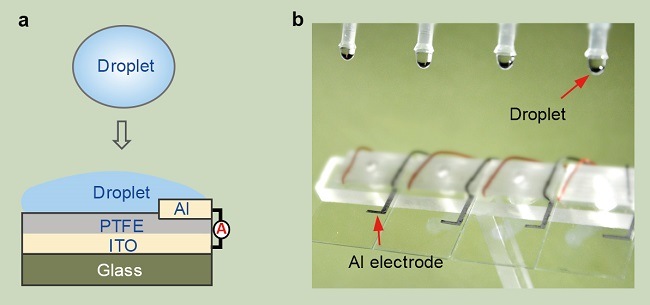
From left: The schematic diagram of the droplet-based electricity generator (DEG). The right frame is four parallel DEG devices fabricated on a glass substrate. Image: City University of Hong Kong/Nature
Raindrops instead of oil and nuclear energy
In the area of hydropower, previous work in low-frequency kinetic energy – such as in rain, waves and tides – has resulted in a fairly inefficient source of renewable electricity.
The team said that two crucial factors allowed this breakthrough. The first was when continuous droplets fall on polytetrafluoroethylene (PTFE) – an electromagnetic material with a quasi-permanent electric charge. Over time, it will accumulate and gradually reach charge saturation. This new discovery helped overcome the bottleneck of low charge density encountered in previous devices.
The second factor is that the device consists of an aluminium electrode and an indium tin oxide (ITO) electrode with a film of PTFE deposited on it. When a droplet falls and spreads over its surface, it naturally bridges the aluminium electrode and the PTFE/ITO surface, creating a closed-loop electric circuit.
“Generating power from raindrops instead of oil and nuclear energy can facilitate the sustainable development of the world,” Wang said.
In the long run, he added, the design could be applied and installed on different surfaces where water comes in contact with a solid. This could range from the hull surface of ferries or coastlines, to the surface of umbrellas and even inside water bottles.