In Search of a MOOC Platform
?
Massive Open Online Course, MOOC in short, has brought about a revolutionary change to how education can be delivered to learners worldwide. By definition, MOOC is a course with purposes to serve a massive number of distant learners simultaneously via online platforms. It brings a host of opportunities, as well as challenges, to any ambitious universities. It is the best of times for a university to stretch across continents to reach learners from different ethnicities to build its prestige and spread its influence; and for the same reason has made MOOC development highly challenging in terms of instructional designs and assessment methods. As a leading institution for research and professional education in Asia, City University of Hong Kong (CityU) has started its MOOC journey by launching its debut MOOC in September 2016.
With September 2015 having been set as the tentative launch day of CityU’s first MOOC offering, the journey to search for the platform began in September 2014. There was a wide array of MOOC platform solutions demonstrating different visions and pedagogy in education and teaching with diverse business models. To cherry-pick the most suitable platform which fits well with CityU’s strategic plan, we took a meticulous examination on features and learning experience of various MOOC platform solutions by (1) collecting information on the web, (2) asking for advice from peer universities, and (3) attending MOOCs offered on several platforms. At the same time, we reached out to the platform providers to enquire on their operation modes and CityU’s obligation as a partner.
Contacting the two largest MOOCs providers in the world, Coursera (www.courera.org) and edX (www.edx.org), was a sensible first step for CityU to venture into the MOOC business. Interestingly, many share the same experience of not being able to get feedback from Coursera. Our attempt verified this understanding when no one from Coursera replied our enquiry. Besides Stanford University and Princeton University, the Hong Kong University of Science and Technology and the Chinese University of Hong Kong are also Coursera partners. Our counterparts at those two local universities confirmed their memberships were established by invitation from Coursera.
edX presented a clean and modern user interface when “Making Sense of News” offered by the University of Hong Kong was enrolled. Innovative tools such as “word cloud” were impressive and the peer assessed written assignment was highly effective in terms of attaining learning outcomes. With the Massachusetts Institute of Technology and Harvard University being the creators, edX attracted many world-class universities to become partners in a short period of time. However, edX had switched to a membership fee model and the high start-up cost made further negotiation infeasible.
To secure a delivery solution, we turned to a platform well known to the CityU community – Instructure Canvas. Instructure offers two MOOC delivery solutions: Canvas Network (www.canvas.net) and Canvas Catalog (www.canvaslms.com/higher-education/catalog) to accommodate different approaches in offering MOOCs. Canvas Network works similar to edX and Coursera where a common platform allows all partner institutions to deliver their courses to registered learners. In contrast, Canvas Catalog is a private instance of Canvas Network with the inclusion of payment gateway, available for rent to MOOC offering institutions who demand complete autonomy. Both solutions share the same interface with CityU Canvas so our MOOC educators can adopt either in no time. Considering the limited exposure of Canvas Network at the time, CityU settled with Canvas Catalog as a backup plan if a better solution could not be implemented before the launch.
With help from our connection in IT services at the Hong Kong University of Science and Technology, CityU finally established a communication channel with Coursera in June 2015. Completing “Learning How to Learn: Powerful mental tools to help you master tough subjects”, one of the most attended MOOCs offered by the University of California, San Diego, helped to expedite our comprehension of the features. Although Coursera was an attractive solution with no cost to join, we were told that the board of directors from Coursera decided not to accept new partners eventually. At the same time, the launch of CityU MOOC had been postponed to January 2016 due to delay in course content development.
The negotiation with Coursera helped us recognize the difficulty to attract learners on a platform with no existing learners. This decisive insight also ended our investigation on the adoption of Open edX (open.edx.org), the open-source version of edX, which serves Stanford Online Lagunita (lagunita.stanford.edu) and many others favouring a standalone platform for their MOOCs.
Invitation from FutureLearn (www.futurelearn.com) was realized as a highly beneficial proposition when it had housed over two million learners in the summer of 2015. Taking “The Science of Nuclear Energy” developed by the Open University in the United Kingdom (www.open.ac.uk) revealed learning outcomes could still be achieved with limited features and functions within the MOOC platform. The course introduced Carbon Footprint’s carbon calculator (www.carbonfootprint.com/calculator.aspx), an external resource, to alert learners how their annual activities could be adjusted to reduce carbon dioxide emission to fight against global warming. Eventually, CityU confirmed its partnership with FutureLearn in November 2015 because of its comprehensive support and its pledge to bring CityU’s MOOCs worldwide. While the settlement of the desired platform helps solve parts of the puzzle in launching MOOCs, close collaboration with FutureLearn to fine-tune the assessment tools and multi-language support are on the agenda so as to offer the best user experience to educators and learners.
Looking back to this brief history of MOOC at CityU, we treasure the establishment of partnership between CityU and FutureLearn where over five million learners have registered to this third largest MOOC provider in the world by November 2016. FutureLearn also holds the world record of the largest learner population, over 430,000 students, in a single MOOC run of an IELTS preparation course developed by the British Council. Many new MOOC developing institutions are queuing up to partner with FutureLearn even a cost is required since the second half of 2016.
For the time being, CityU’s first MOOC, “Foundation of Innovation and Entrepreneurship in China” (go.cityu.hk/innova1) developed by Dr. Hongyi Sun, has been successfully completed in October 2016 (rerun available in January 2017) with learners from 144 countries and regions.
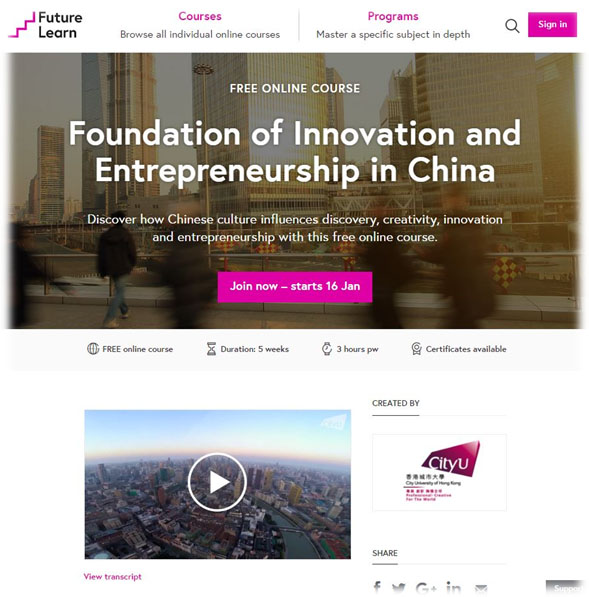
Upcoming courses, “Discovering Socially Engaged Art in Contemporary China” by Dr. Bo Zheng and “Virtual Hong Kong: New World, Old Traditions” by Prof. Horace Ip, have been scheduled to launch in February and March 2017 respectively. Let us go on the journey of MOOCs and explore the full potential of future education together.