Network Management System: What's It All About?
During the recent CTNET upgrade, the CityU's campus network had expanded in terms of capacity and supported features so as to provide a smooth platform for deploying advanced network applications and services. After the upgrade exercise, the CTNET now composes more than 200 networking devices, including switches, routers and network appliances. A single Network Management System (NMS) is therefore required to monitor the complex and expanding network. The NMS should meet the following requirements:
-
Provide an unified and central environment for managing the campus network
-
Ensure scalability of the management platform to cope with network growth
-
Carry out data consolidation and analysis function to highlight critical events
-
Maximize network uptime by effectively tracking problems to the source
-
Provide Network Capacity planning function
-
Access Real time network statistics and provide event notification
Functional Components of NMS
NMS is a suite of integration management software that allows network administrators to manage the network devices from a single interface. The NMS is composed of three main functional components:
- Vital Net
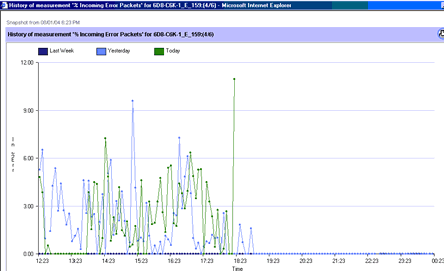
It provides automatic collection and aggregation of network-wide performance data. It also allows
on-demand access to overall network performance information to help network administrator to identify critical areas before problems arise.
In addition, the NMS provides trend analysis of network traffic, device performance statistics for network managers to prepare for network capacity planning.
-
Vital Apps
It delivers monitoring and diagnostic capabilities to help network administrators to obtain application performance statistics from network applications and services such as e-mail, Web, DNS, etc.
All data are collected throughout the day and are stored in a central database. Consolidated and analyzed application performance information is presented through summary reports and graphics.

-
Vital Event
It delivers real-time, visual monitoring, measuring and analysis of network performance using operations thresholds.
This helps network mangers to pinpoint problems as they occur and pre-empt others. After automatic consolidation, all high-risk events are shown before those low priority events which allow network administrators to focus on the most critical areas.

Architecture of NMS
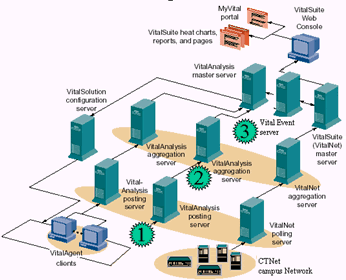
The NMS is based on layered architecture. The processing of the network and application performance data are broken down into three phases:
-
Raw Data Polling and Collection
-
Aggregation and Consolidation of collected data
-
Processing and Presentation of consolidated network and application information
The advantage of this layered approach is that NMS can be more manageable and scaleable to cope with network growth.
By adding more servers to each layer, the processing power of each layer can be expanded.
Application Performance Monitoring
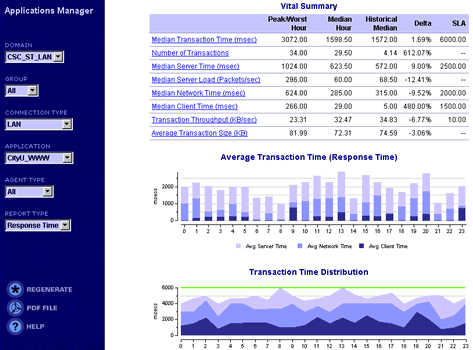
Nowadays, mission critical applications are more dependent on the quality of network environment, it is important to monitor not only the availability of the network but also the health, performance of network devices as well as response time of the applications servers. The NMS can meet these requirements by collecting and processing application performance information - especially from user perspectives.
With the installation of small agent software into client workstations, the application response time, network delay and throughput of most IP based application/services can be measured and recorded.
With prolonged use of the application with monitoring, the trend of the application response time, network delay, server loading and throughput can be easily obtained, thus provides network management and server administrators with valuable information in traffic base lining, troubleshooting and capacity planning.
Conclusion
As can be seen, the deployment of NMS does help network administrators not only to monitor the day-to-day network status but also provide real-time alarm, capacity planning and detailed reporting function. In addition, with the application monitoring function, the NMS provides a clear view of how a network application behaves along the network access path; from clients, networks to application servers. Combining the network and application monitoring capabilities, we now have a total network management solution for our campus network.